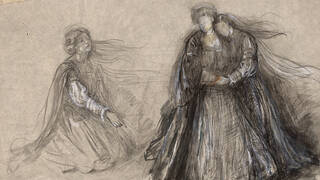
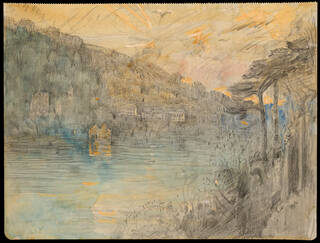
Headlam’s style is characterised by layers of chalk, watercolour and gouache, creating images infused with a sense of romanticism. She was particularly inspired by artists like J. M. W. Turner (1775 – 1851) and Samuel Palmer (1805 – 81). Her landscapes often capture the translucent light of the gloaming: she liked to work at sunset and sunrise to capture their unique atmospheric effects. An illustrator of fairy tales, a quality of enchantment seeps into Headlam’s works, whether imaginative or observed.
Early days
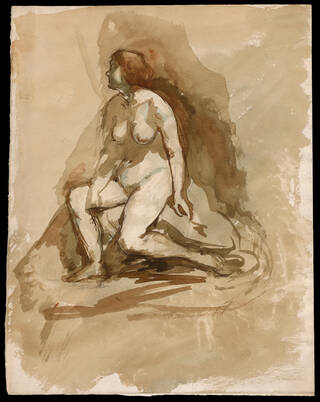
Born Mary Corbett in Norfolk in 1873, Headlam’s artistic interests were encouraged by her father Admiral John Corbett (1822 – 93), who was himself an accomplished watercolourist. She attended the Slade School of Fine Art in London from 1892 to 1896, which was unique in Britain at the time for allowing women to draw from the partially nude male model. Students were encouraged to study and make copies after the Old Masters and devote an hour a day to one of the national art collections. Many talented students enrolled at the Slade in the 1890s, including Augustus John (1878 – 1961), Gwen John (1876 – 1939) and Edna Waugh, later Clarke Hall (1879 – 1979). During her time there, Headlam met the Scottish artist Ethel Walker (1861 – 1951). A watercolour by Walker was found among Headlam’s own works during the cataloguing process.
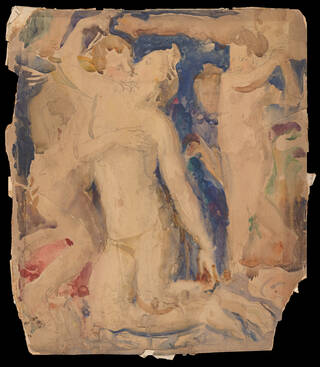
A copy of Bronzino’s allegorical painting of Venus and Cupid, now in the National Gallery, the work is a material testimony to their friendship as well as the impact of the Slade’s educational methods.
Headlam’s main media was drawing, watercolour, and printmaking. Although considered by some in the art world of the time as less prestigious than oil painting, this focus enabled Headlam to develop her practice through a volume of small-scale works on paper that possess a striking intimacy and a unique artistic vision.
Fairy tales and illustration
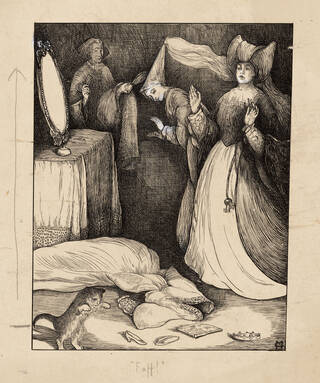
While still a student, Headlam met Nellie Syrett (1874 – 1970), one of four sisters who were artists, illustrators, designers, writers, and contributors to the famous Yellow Book journal. Headlam and the Syrett sisters were among the middle-class young women who in the late 19th century claimed their independence and sought greater economic, professional and cultural opportunities beyond societal expectations of domesticity and marriage, a phenomenon framed as the ‘New Woman’. Headlam’s first professional commissions were illustrations for romantic literature and fairy tales, whose flexible narrative formulas could be used to explore women’s agency. A proof state of her illustration for Fuff by Christina Dening, featured in the annual The Dream Garden (1905) edited by Netta Syrett (1865 – 1943), depicts the moment a defiant princess turns herself into a cat to avoid her wedding day.
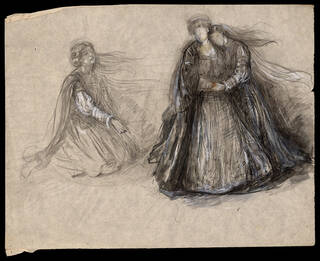
Headlam also made illustrations for the Eventyr of Hans Christian Andersen (1805 – 75). These fairy tales gained widespread popularity in Britain after they began to be translated into English from the 1840s. Studies and compositions for Andersen’s stories make up a considerable body of the drawings and prints by Headlam in the V&A collection. Although she created illustrations for some of Andersen’s most famous narratives, such as Thumbelina (1835) and The Little Mermaid (1837), Headlam also made works responding to some of his less well-known tales like The Old House (1848) and The Wind Tells of Walderman Daa and His Daughters (1859). Often they are related to gardens, flowers, or the natural world, which might reflect a personal enthusiasm shared with her husband Horace Headlam, who she married in 1906. Although these illustrations were not published in an illustrated edition, some of them were exhibited at the New English Art Club.
Women in interiors
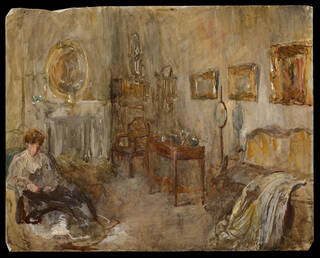
A number of Headlam’s works in the collection depict women in interiors, often performing tasks of sewing or mending. In one watercolour, Headlam positions a seated woman close to the edge of her page, embedded in the heavily furnished room with its glistening mirror, picture frames, and tea service. The integration of her sitter with such a setting is reminiscent of the paintings of Édouard Vuillard (1848 – 1940).
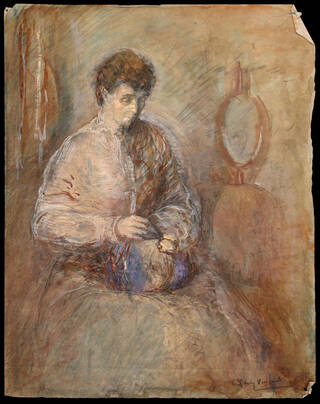
In a portrait inscribed with the name ‘Daisy Vincent’, the slightly eroded features of the woman’s face and the dense working of chalk, watercolour and gouache convey the sitter’s concentration, looking down at the bundle of material she holds in her lap.
Landscapes
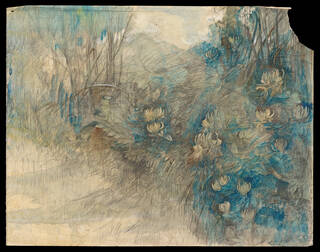
The intimacy and introspection of Headlam’s depictions of women in interiors can also be seen in her landscape drawings and watercolours. Words inscribed by the artist on ‘Earthly Paradise’ in one of her sketchbooks evoke their romantic mood: ‘The drawing is in clean bright colours like the colour of sunrise, the river trembles with light, the ground is thick with many coloured flowers.’
Headlam often visited places associated with the picturesque in Britain, such as Tintern Abbey and the fells of the Lake District in Cumbria and travelled across Europe to Italy and Switzerland. Headlam visited Jamaica in late 1936, where she made landscapes of the coastline of the popular tourist destination Montego Bay and studies of fruit sellers and fruit carriers loading the trading boats at Port Antonio. Two sketchbooks from this journey trace Headlam’s progress in a steamer across the Caribbean Sea, containing sketches of her fellow passengers and glimpses of the mountain ranges of South America.
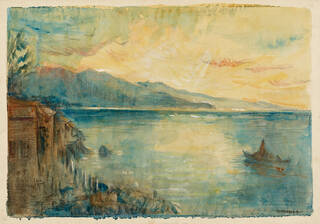
Another notable location for Headlam’s poetic landscapes was Kingswear in Devon, where Headlam lived from about 1941 to 1954. In a series of works made along the River Dart, Headlam applied shimmering blue washes of watercolour to her drawings of its densely wooded banks and castle ruins.
Printmaking
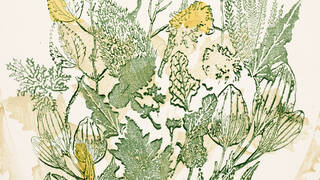
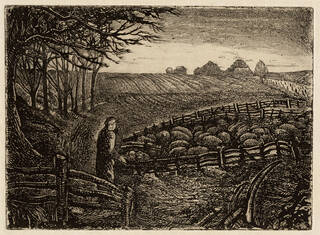
Headlam began printmaking in earnest in the 1920s, enrolling in a class taught by Graham Sutherland (1903 – 80) at the Chelsea Art School. She was influenced by the seminal exhibition Drawings, Etchings & Woodcuts by Samuel Palmer and other Disciples of William Blake at the V&A in 1926, which cemented the reappraisal of Palmer’s reputation and made his visionary Shoreham watercolours accessible to a wider audience for the first time. Etchings by Headlam of fruit-laden trees and a shepherd beside a flock of sheep shows the influence of Palmer’s pastoralism.
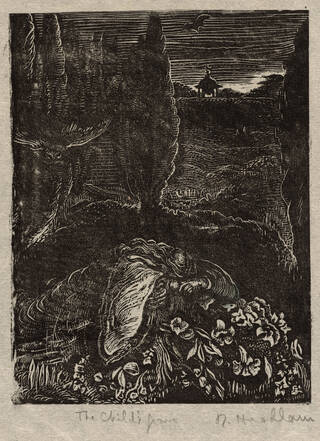
Headlam also returned to her illustrations of Hans Christian Andersen, reworking many of her compositions into wood-engravings in the 1930s. Multiple proof states touched with chalk or gouache reveal her process and decision-making for their design, working out the details of trees and flower or the spread of light on the horizon. Headlam’s friend Gwen Raverat (1885 – 1957), a leading figure of the wood engraving revival, illustrated Four Tales from Hans Andersen (1935) for the Cambridge University Press. The book was published in the same period when Headlam was working on her Andersen wood-engravings, and it is possible that Raverat assisted Headlam with developing her technique. The death of Headlam’s husband in 1936 halted her plans to finally publish these illustrations, but the V&A collection reveals her ambitions and sensitive engagement with her medium.
Headlam has been largely unknown until the recent exhibition at Abbott and Holder gallery in London in 2024. The entry of her works on paper into the V&A contributes to the growing interest in women artists of her generation and their creative networks. This material demonstrates the artist’s sustained experimentation across drawing, illustration and printmaking, and their strong interrelationship, as well as the stories and imagery she returned to repeatedly. At the V&A Headlam’s work can be placed in dialogue with women who worked at the forefront of illustration and wood engraving, as well as the art of Samuel Palmer and the modern artists who responded to his romantic affinities.