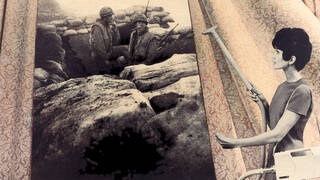
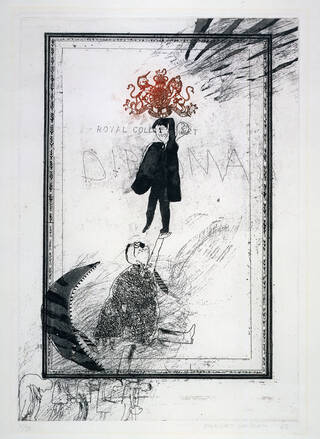
The V&A began collecting his work the year after he graduated from the Royal College of Art (RCA), London in 1962. The print The Diploma (1962) lampoons the senior staff of the school and his fellow downtrodden students, displaying his fearlessness and famous sense of humour in the face of threats to fail him for not participating in all modules of his degree course. His final year work ultimately won him a gold medal for painting, and he burst hungrily into an art scene in the throes of seismic stylistic shifts as weighty Abstract Expressionism gave way to the levity of Pop Art and the simplicity of Minimalism. Hockney marched to the beat of his own drum, steering clear of any firm attachment to specific art movements or schools.
"The teaching of drawing is the teaching of looking. A lot of people don't look very hard."
Hockney gifted some early drawings to the museum, such as Man Peeping (1963), which centres the simple act of looking. Hockney demonstrated an early interest in exploring male voyeurism, which would develop significantly as his star began to rise. His unabashed embrace of homoerotica and gay life during a time when it was still illegal for men in the UK is another central reason why Hockney became so beloved as a pioneering force for positive change, breaking down barriers of prejudice around sexuality and class.
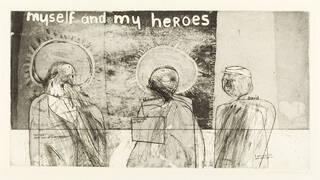
Hockney was inspired in this respect by the American poet Walt Whitman (1819 – 1892), who is featured in his etching Myself and My Heroes (1961), produced while still at the RCA. Hockney had already reused the title of an 1891 Whitman poem (We Two Boys Together Clinging) for one of his seminal early paintings of 1961 while still at art school. Hockney places himself in a sort of holy trinity beside Walt and anti-colonialist pacificist leader Mahatma Gandhi (1869 – 1948), who he keenly engraves was a venerable 'vegetarian as well'. Hockney draws himself in a pale flat cap as he was frequently photographed wearing throughout his lifetime, while his two laudable heroes are deified with halos.
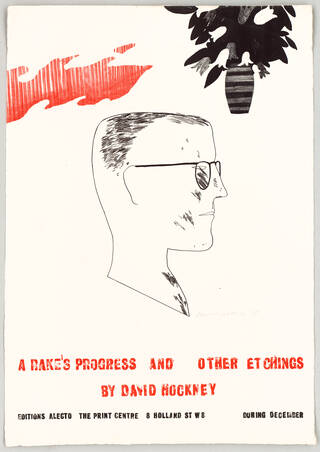
Still before graduation, in 1961, he embarked upon an ambitious and celebrated suite of 16 etchings and aquatints titled The Rake’s Progress. Explaining in the preface to the portfolio, he began "after a visit to the United States. My intention was to make eight plates, keeping the original titles but moving the setting to New York. The Royal College...were anxious to extend the series...accordingly I set out to make twenty-four plates, but later reduced the total to sixteen". Inspired by William Hogarth’s 1735 series of engravings documenting the decline of young Tom Rakewell, heir to a fortune amassed through colonial exploits in India, Hogarth’s ‘rake’ ends up destitute and syphilitic in the notorious asylum Bedlam in London, on the brink of an early death. Hockney’s interpretation of this tale formed the basis of one of his first solo exhibitions organised with Editions Alecto and held at The Print Centre, London in December 1963.
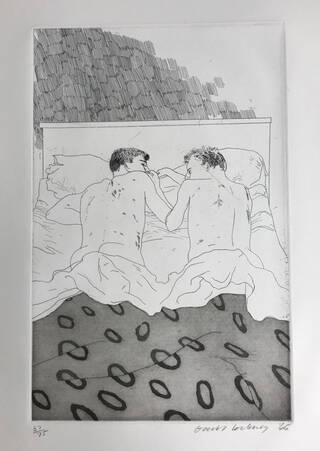
With a lifelong love of travel, in 1966 Hockney went to Beirut, Lebanon, for inspiration for a suite of etchings to accompany 14 poems by the Egyptian-born Greek poet Constantine P. Cavafy (or Konstantinos Petrou Kavafis, 1863 – 1933), whose work explored same-sex love and desire. Hockney revealed on the BBC Radio 4 programme, A History of the World in 100 Objects that he had stolen a Cavafy volume from his local library:
"I’d found Cavafy in the Bradford Library (in 1960). But you had to ask for it..because they didn’t want too many people reading these poems... And actually, I never took it back – I kept it. …You couldn’t buy this book in England at the time. And of course, the poems were wonderful."
Ultimately, his prints ended up being largely set in his Notting Hill flat in London, using friends as models. Their simplicity of line coupled with the intimacy and tenderness of the men depicted became a beacon of gay pride when they were published in 1967 – the year which also saw the partial decriminalisation of homosexuality in England and Wales.
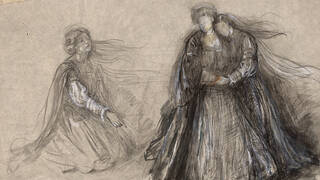
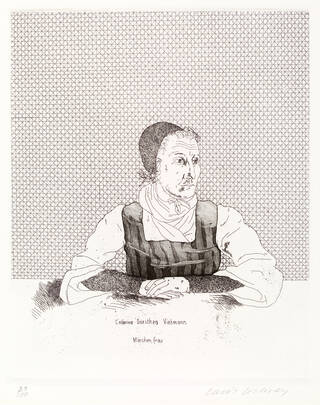
Another significant suite of his etchings and aquatints in the V&A collection illustrates fairytales by the Brothers Grimm. Published by the Petersburg Press in 1970, the plate Catherina Dorothea Viehmann (1969) serves as the frontispiece and honours the woman who supplied many of the stories for the two writers as they travelled throughout Germany in the early 19th century documenting ancient folk tales and legends. Catherina was the daughter of a pub landlord and she passed on the stories she had collected over the years in the tavern to be treasured by future generations.
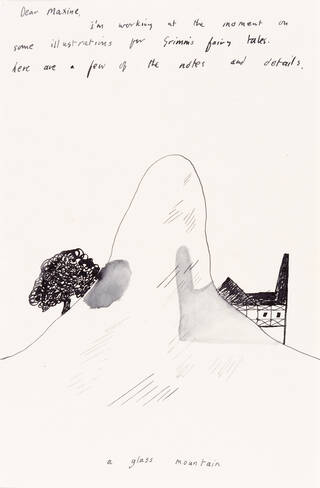
Hockney went to the Rhineland in Germany before starting the series of 39 prints, sketching and photographing castles between Mainz and Cologne. In 1972, he kindly gifted 14 of these working drawings annotated with notes to the V&A. Old Rindrank (1969) illustrates a foreboding folk tale (like many of the era) of a princess who falls into a glass mountain and is captured by an elderly cave-dwelling man, forcing her into servitude. In 1973, Hockney made a further generous gift of all the steel plates used to print the series, with cancellation holes bored through the centre. These cancellation plates are routinely made in different styles to ensure no unauthorised impressions can be printed from them later.
Hockney was well-established in Los Angeles by this point and entering the peak of his love affair with Southern California. He was living with his boyfriend Peter Schlesinger (born 1948), who was the model for several of the famous pool paintings, including Peter Getting Out of Nick's Pool (1966). Schlesinger also appears in a group of 42 photographs taken by Hockney which formed a V&A touring show in 1971 highlighting the artist’s work with a camera. Shortly after, Jack Hazan made the semi-fictionalised documentary A Bigger Splash about Hockney and Schlesinger’s break-up.
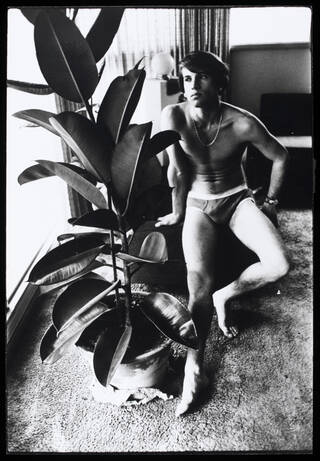
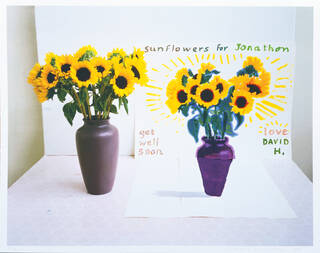
Famously often disparaging about photography as a fine art in itself, Hockney was nonetheless open about how it formed a key part of his practice as a painter. The original label text for the 1971 show noted that the artist 'keeps the ever-expanding row of photograph albums up to date, writing in careful notes of times and places. When a photograph is used as the basis for a painting, it is usually attached to the canvas or pinned on the easel, so as to be constantly before the artist’s eye as he works.'
Incorporating new technology as it emerged and embracing many facets of digital art making, the last work the V&A collected in his lifetime was the book A History of Pictures: From the Cave to the Computer Screen (2016) in collaboration with Martin Gayford. In the foreword Hockney explains: "The history of pictures begins in the caves and ends, at the moment, with the computer screen. Who knows where it will go next?"
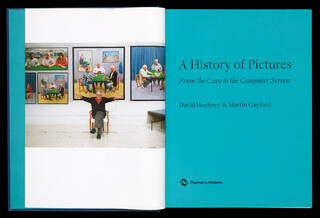
Hockney undoubtedly shaped the history of pictures. Unafraid to experiment, he injected the art world with queer joy and breathed new life into portraiture, still-life, landscape and illustration. His immense body of work and unceasing wonder in the world around him will surely go on to inspire generations of artists and audiences to come.