Fuchsia Hart, Sarikhani Curator for the Iranian Collection at the V&A, spoke with Amak about the project's origins in 19th-century Iranian photography, her connection to the princess, and the experience of editing work from the deeply personal perspective of exile.
Fuchsia Hart: The V&A already holds 19th-century photography from Iran, so your work speaks beautifully to our existing collections. Zanjir has a particular relationship with this period, and with Naser al-Din Shah, the ruler of Iran who was really one of the country's first photographers – and, as you've pointed out, one of its first family photographers. Can you tell us about your relationship with his photography and with 19th-century Iranian photography more broadly?
Amak Mahmoodian: It's wonderful to have this conversation with you, Fuchsia, about imaging an imagined conversation! Zanjir means "chain" in Persian, and the project is a way of bridging the past and present through a circular narrative – embedded in the sequencing of the photographs and, of course, in the book itself.
To explain the project, it might be helpful to start with how the past came to meet the present. I studied photography at the Art University of Tehran, and one of my tutors, Bahman Jalali, was researching Qajar-era photographs and making collages with them. While I was working on my final BA project, he introduced me to the Golestan Palace. We would sometimes visit his studio in Tehran, where he showed us books we couldn't access at university. When I mentioned my interest in family photographs – rooted in my relationship with my own family and the way I came to know absent relatives through portraits during the years of revolution and war – he suggested I visit the museum's archives of 19th-century family photographs.
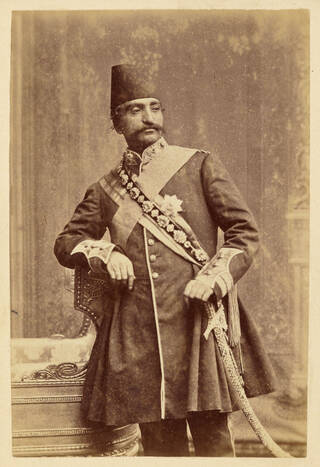
Golestan Palace is in the heart of Tehran, a breathtaking place with its mirror hall and diamond gallery. But for me, the connection was different: I knew this museum had once been the home of the Qajars, and that it was where photography first arrived in Iran. Naser al-Din Shah received the first camera as a gift from the Queen of England. Before that, he had tried painting but wasn't particularly skilled, so photography became an extraordinary medium for him – he could capture and create images quickly. He built his first darkroom in 1868 and became very active as a photographer.
As a king, unfortunately, he wasn't successful – that's the history of Iran. But I still believe, after nearly eight years of research, that he was a remarkable artist and a remarkable supporter of artists. He photographed many subjects – documentary work from Tabriz, Tehran, various cities he travelled to – and among his subjects was his family, the women living in the harem at what is now Golestan Palace.
What was fascinating to me was his approach as a family photographer. Because of religious and cultural circumstances, no foreigner could enter the harem, so he was the only photographer documenting his family in such varietym– essentially, he became the first family photographer of Iran.
I went to the Palace in 2002. They gave me access to eight original albums with velvet covers and the king's handwriting. He had a remarkable process: he always wrote captions beneath the photographs – who the people were, the location, the occasion. This became the first stage of my research. After a few weeks, the museum offered me a position identifying the names of the women in 48 family albums. In return, I could copy 14 photographs for my research. That was a dream come true.
FH: Can you tell us more about Taj al-Saltaneh and the relationship you developed with her through her diaries?
AM: Taj al-Saltaneh lived 136 years before me. When I read her diaries, I realised we didn't know much about her, yet she was one of the king's daughters, his favourite by many accounts. She was extraordinary; an activist, a feminist, a poet, and a painter. She spoke and wrote in five languages: French, English, Arabic, Persian, and Turkish.
What struck me was the connection between her handwriting and the photographs. It was both visible and invisible, seen and unseen. I was looking at material completely connected to a visual language, and at diaries with no images at all, yet I could visualise her words. You know how when you read fiction, you can see the room, feel the temperature, picture the characters? That's how I felt reading her diaries. Perhaps because it was one woman reading another woman's words across 136 years.
There were many differences between her era and mine, but also profound similarities: a shared sense of agency, of fighting for your rights, which was present in all her writing. She was the first person to remove her scarf in court. She was a princess, but when I read her diaries, she didn't feel like one. She was like a knight in armour, fighting for her rights. When her husband was unfaithful, she went to court, fought for a divorce, won, and raised her four children alone.
If she had lived in my era, she would have been one of us – a fighter, breaking through religion, tradition, and culture. That's why I became so interested in her writing. From 2004 to 2009, before leaving Iran, I took the photographs that would eventually become part of the work you now hold.
FH: It would be wonderful to hear more about the trajectory of the project. I know you began by taking individual photographs, but the work transformed, eventually becoming the book. I understand this was shaped significantly by your experience of leaving Iran and living in exile.
AM: The shape of the project was formed firstly by the experience of living in Iran, and then by editing and making the book in 2019, almost twelve years after the project began. The sequencing came through the lens of experiencing exile, distance, and hope – the hope of returning.
When I started, the project was called Niqab, meaning "mask." It was about us, the people of Iran – our religion, traditions, identity, our men and women. It was also about others and their perceptions of us. I was travelling between Iran and the UK, working on proposals for my PhD, and through conversations in Western contexts, I could see the difference between the reality at home and the constructed reality in the media.
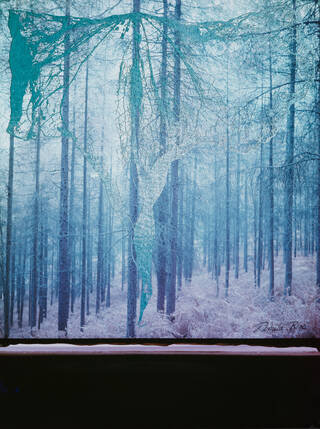
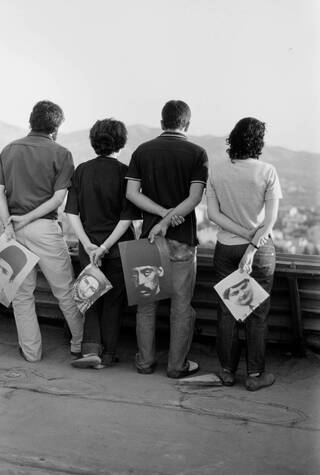
So Niqab became a project about them, about those constructed images. That's why I concealed the faces of contemporary people behind the masks of the past. I conceal in hope of revealing. Through the project, I invite audiences to think about what lies behind these masks – the reality of these people, their challenges and strengths, their identity and culture, the battles they have fought for decades against dictatorship.
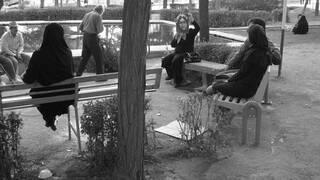
I photographed people I knew – neighbours, family – because it was a challenging project. Between 2002 and 2004, as a photographer, I needed permission to photograph in public places. When I wanted to take the masks, made from historical Qajar images, into public spaces, I was denied permission. So I said I wanted to photograph the parks of Iran because I was concerned about deforestation and construction. They gave me permission. That's how the parks became my canvas. If anyone asked what I was photographing, I would say, "The park", without explaining the real concept.
The project finished for me around 2008. It became a proposal for my PhD and a simple project on my website. And then I came to the UK, and I started working on Zanjir in 2019.
FH: You've spoken about conversation being at the heart of Zanjir – the meaning of the word as "chain," the linking of past and present. Can you tell us about the conversation that changed how you present these images?
AM: In 2019, three years after publishing my first book, Shenasnameh, which the museum also holds, the publisher contacted me. He had seen the project on my website and wanted to make a second book. I thought naively that it would be straightforward – Niqab had been ready for eight years. But when I sat in this room, my studio, and went through the negatives to scan them, it was incredibly difficult.
I was looking at these people after ten years of exile and separation. I knew the faces, but in some photographs, I couldn't remember them anymore. I couldn't remember voices, smells, even the structure of houses. The places had become unfamiliar, yet I carried them with me. I believe our home travels within us – that's one of the lines of poetry I use in Zanjir. Another is: "I live in the past." That was exactly what I was feeling.
One of the most important moments was finding a photograph of my parents performing for me behind the mask, alongside an outtake showing them without it. I thought: my present – those days – is now my past. My father passed away. I didn't see him. I haven't seen my mother for ten years. I was experiencing the same history, the same distance.
I went back to the publisher and said I needed more time, at least six months. There were gaps in the sequencing I couldn't resolve. Then I remembered Taj al-Saltaneh's writings. Her diaries helped me connect to my past, because they are mostly about her family, her memory, her homeland. Her diary became a map for the project, a path. This imagined conversation between us became a way of structuring, editing, and sequencing my photographs in response to her words.
In a way, she saved me. I would edit my photos in response to her writing. There were moments when I could visualise her diaries but couldn't find a visual response in my photographs. That's when I thought: in the history of photography, we talk about writing with light. What if I write with words when I cannot see those photographs?
I tried to take photographs in Bristol, but I couldn't see those moments externally. So I began to write poetry in response to her poetry, and to write the photographs I had in my head but couldn't find outside. They were internal photographs rather than something I could document. That's how the project changed its title to Zanjir (chain), connecting past and present, speaking about identity, memory, land, and distance.
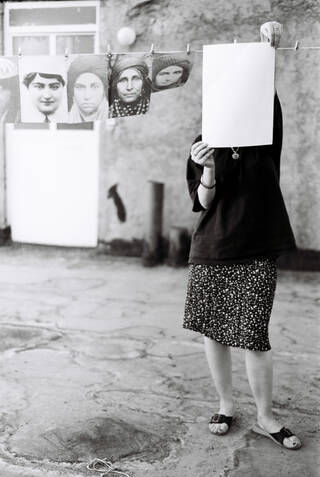
FH: The project reached its final form in 2019, which is now itself a moment in the past. How do you view the work now? And given the current situation in Iran, what can looking back across many moments in the past tell us about today?
AM: It informs us about today and the future. It tells us there is a way to move forward by looking into the past.
I never call myself an activist or a feminist, but this project is a feminist body of work. One of the things I'm most grateful for is introducing Taj al-Saltaneh to the contemporary era. When we talk about 19th-century activists, we name many women from around the world, but Taj was rarely mentioned. People didn't know her. That created a sorrow in my heart. She was so different from other princesses, always with her armour on. One of the promises I made to myself, and to her in our imagined conversation, was that this project would be about her rather than me. I needed to make sure her voice was clear.
It worked. After the project was published, I did an interview with Tate Modern, and most of the conversation was about Taj, not about me, not even about Zanjir. They hadn't known about her. That was something: looking at the past and seeding it into the present.
The fight we're witnessing has been happening for centuries, and in my country for decades – the last four decades have been brutal against women. But it hasn't stopped them. The battle has become more obvious, stronger, more strategic. It became a movement, especially after Mahsa Jina Amini's death in 2022.
Through my imagery, I try to convey this silent protest, which is often the loudest. These quiet moments of dialogue bring attention to the battles and resilience of my people. Even now, photographers like Tahmineh Monzavi and Parastou Ahmadieh are punished – 74 lashes – because of singing. It hasn't stopped them, and it won't. They will do it again.
For me, it's about how to go beyond their experiences and feelings, beyond what the media or social media wants to show, and towards something unseen. That is what I am interested in. I believe in the power of these unseen feelings, these imagined dialogues.
FH: There's something beautiful in the masking of the figures. Your work started as something intensely personal, and it has remained so, particularly through the process of editing. But it has also become something that speaks to a collective narrative, a wider experience of women and families in Iran today.
AM: Absolutely. My projects are always deeply personal, but they are also always connected to wider social meanings and concerns. It was a personal narrative between me and Taj al-Saltaneh. And then it became a collective narrative – the experience of thousands, millions of people I hope to reach.
I hope to invite the audience, the viewer, to create their own real conversation in response to this imagined one. How many conversations can you create? How many dialogues? That, I hope, is the impact of this project.
Poem by Amak Mahmoodian
Today
I think about things
that I forgot to remember
I remind myself
to remember
If I am afraid of the life
I have created in photographs
It is because of my dreams
I dream
I remember
With no family but memory
With no land but traces
My land travels within me
I live in the past
I have created a life
A life of memories.