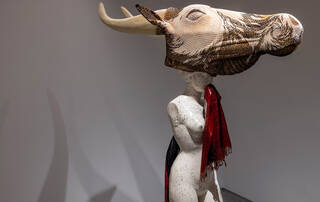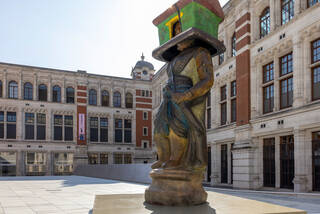
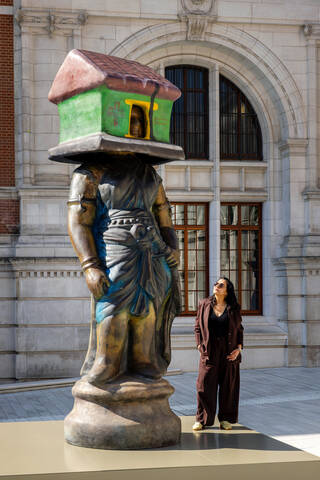
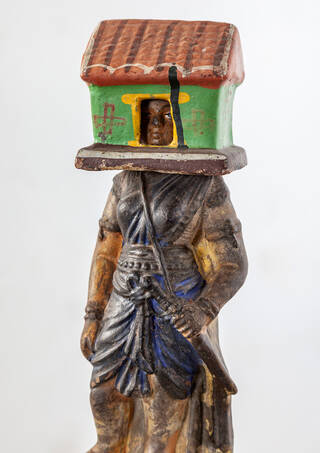
Originating as a small clay maquette, Gaia is part of a series of works by Bharti Kher called Intermediaries, in which she reassembles pre-existing small sculptures into new configurations. Collected by the artist over many years, these small, often handmade and easily accessible sculptures are called ‘Golu’ figurines and are displayed during festivals in homes across South India. When transported to Kher’s studio, the fragile figurines often arrived damaged, inspiring her to piece the fragments back together in what became a process of repair and an opportunity to create new meanings.
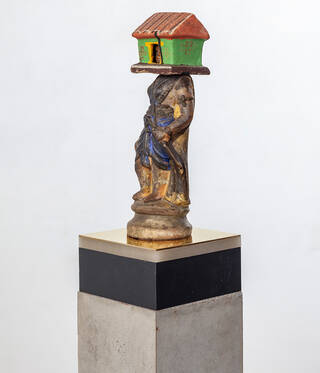
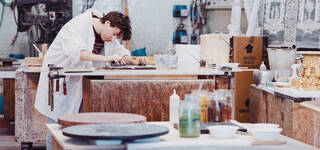
To transform the original maquette into a four-metre-tall bronze sculpture, the artist worked closely with the Morris Singer Foundry in Hampshire, UK, recognised as the oldest fine art foundry in the world. Gaia was made using a process called sand casting, in which molten bronze is poured into a mould of compacted sand. When the bronze has cooled, the sand can be chipped away to reveal the cast. Due to the scale of this work, Gaia had to be cast in many smaller, separate sections which could then be soldered together to make the whole piece. Enlarged and cast in bronze, the original maquette is transformed into a monumental guardian. Named Gaia after the ancient mother-earth goddess, the sculpture comes to symbolise protection, questioning what home can mean, how we protect it and how it protects us.
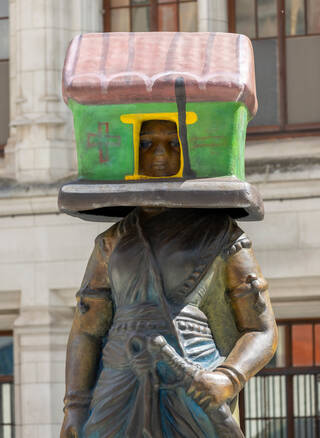
Although taking on grand new proportions in a material able to stand the test of time, Kher’s sculpture has been carefully treated to recreate the surface texture and colour of the original clay figurine. To achieve this, a process called patination was used. This involves applying a variety of chemicals to the surface of the bronze, which, when combined with heat, produce reactions that can create different colours: Gaia exemplifies the great variety of colours and tones that can be achieved though patination. Through the careful application of this technique, a feeling of the original material is maintained, while also becoming something completely new. Kher prompts us to consider the transience of material, culture and context, raising questions about the meaning of cultural identity and homeland in an increasingly interconnected world.
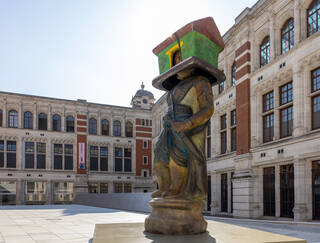
In its temporary home in the Exhibition Road Courtyard, Gaia creates a colourful contrast to its white-tiled surroundings, while echoes of the sculpture’s simplified architectural forms can be seen in the surrounding 19th- and 21st-century architecture. At the V&A, the work raises questions relevant to the museum’s own collections: Kher’s process of repair and transformation explores how material carries meaning, as well as how far objects can be removed from, or remain connected to, their cultural heritage.