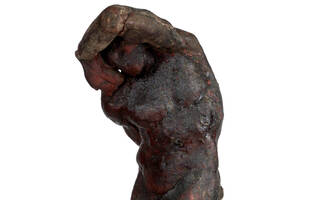
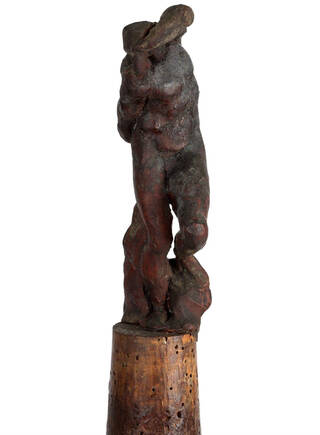
Michelangelo Buonarroti (1475 – 1564) worked on this monumental project for 40 years, and when the tomb was eventually completed in 1545, more than three decades after the pope's death, it was smaller and less complex than originally planned. This model relates to an intermediate phase of Michelangelo's designs. He began carving four over-life-size marble Prisoners for the tomb, including one based on this model (now in the Gallerie dell’Accademia, Florence), but they were not part of the final reduced design and remained unfinished in the artist's studio at his death.
According to the 16th-century artist and biographer Giorgio Vasari, Michelangelo used wax models like this to help him visualise his excavation of a figure from a block of marble. He would submerge his model in water and gradually raise it to reveal more of the form above the surface to guide him as the carving of the marble progressed.
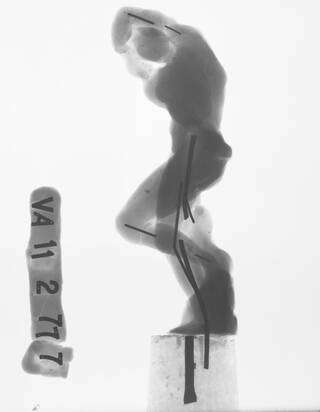
Michelangelo modelled the figure in red wax over an armature (framework) that is attached to the cork base. The wax overlaps the base along the edge, so there is good reason to think the base is original.
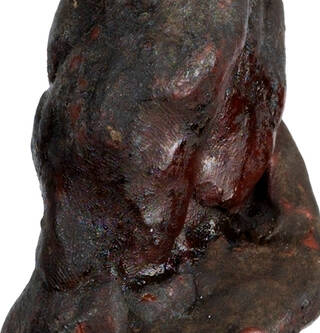
The surface of the wax contains many partial fingerprints, though until we conduct comparative research we can't be sure how many of these belong to Michelangelo himself, and how many record the touch of other individuals who handled or restored the object at some point in its 500-year life. In 1924, for instance, we know that the sculpture suffered serious damage when a distracted visitor walked backwards into its case, breaking it, and sending the sculpture crashing to the ground.
Museum records from the time indicate that the wax pieces that broke off were carefully collected and the sculpture was repaired within a matter of weeks. A few old photographs in our archives document the state of the sculpture before it was repaired.
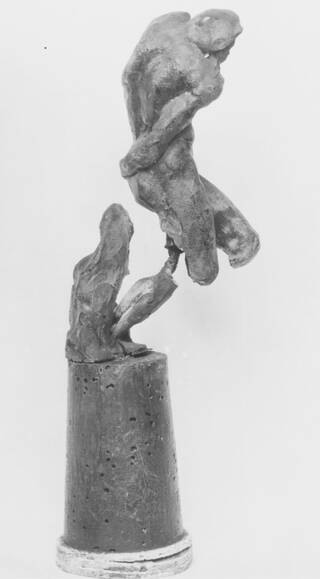
While our modern-day cases are much heavier and more stable than those the museum used a century ago, our Michelangelo is still vulnerable to other types of damage. Because the Medieval and Renaissance galleries at the V&A South Kensington are not climate controlled, this object and many of the other wax treasures in our collection must be removed from display in the summer months and often well into the autumn, as they are at risk of melting. They can't return to their cases until ambient temperatures remain stable below 26 degrees. This means that visitors are unable to experience one of the highlights of our collection for at least four months of each year – and often longer.

In December 2023, the V&A's Photography team created a 3D digital model of the Michelangelo sculpture. The object spent a full day in our Photography Department, where Kira Zumkley and Ed Lyon took over 500 extremely high-resolution photographs using a turntable and polarised ring flashlight. Polarisation avoided issues caused by glossy areas on the sculpture, and the use of a ring flashlight minimised unwanted shadows. Our photographers kept a close watch on the temperature in the studio. Due to the delicate nature of the object, it was decided that the underside of the base would not be imaged.
This 3D digital model now means that anyone, anywhere, and at any time of year can closely examine this sculpture. Nothing, of course, can ever replace encountering a work of art in person, sharing in its environment, and immediately grasping its scale, colour, and texture. But the fragility of our Michelangelo wax means there are limitations to how closely we can, in fact, examine it: we handle it only when absolutely necessary and only by its base. The 3D digital model, however, makes it possible to turn it around – virtually – in our hands, so we can look closely at every fingerprint and inside every crack and crevice.
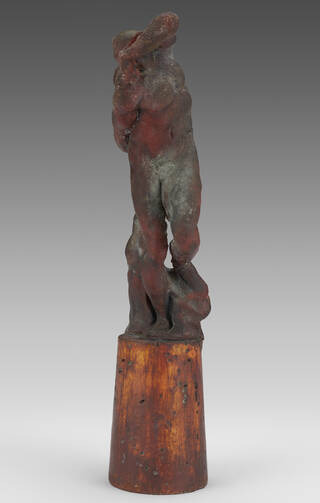
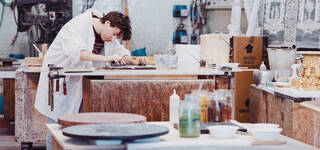
Our digital model has already led to some exciting outputs in the physical world: In 2024, we commissioned Factum Arte Foundation to create a high-fidelity 3D facsimile that we can display for visitors over the summer in the absence of the original.
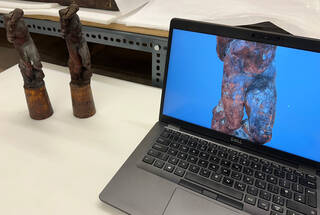
While the replica is remarkably accurate, it is a work of art in its own right, not simply a substitute. Made through a blend of digital technologies and traditional craftsmanship, it joins the V&A’s collections of other historic reproductive techniques, including plaster casts and electrotypes.
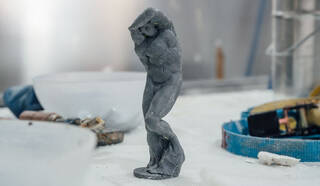
In the cooler months, when the Michelangelo original returns to our galleries, we are using the new facsimile for research and handling sessions.
Discover more of our Sculpture collection.
Explore our Renaissance collection.