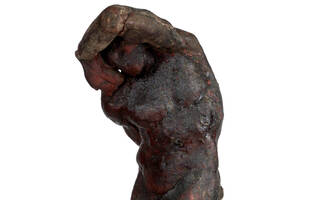

Antonio Canova’s Theseus and the Minotaur, completed in 1782, depicts the hero Theseus in calm, noble, neo-classical style, triumphant over the Minotaur. Half man and half beast, the Minotaur is one of many hybrid creatures described in the classical epic poem, Ovid’s Metamorphoses, which served as inspiration for Canova and countless other European artists. The destructions, transformations and rebirths of Metamorphoses evoke a world in flux: a reminder that everything may change.
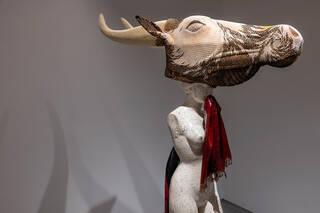
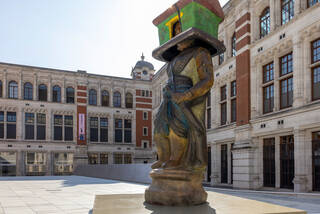
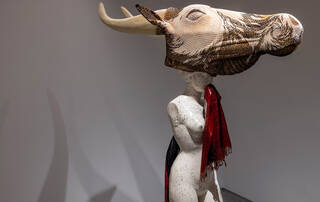
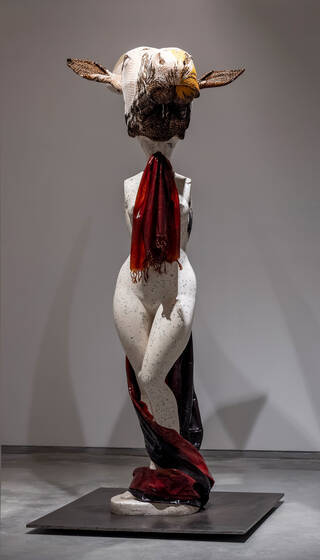
Displayed only a short distance from Canova’s Minotaur in Room 22 of the V&A’s sculpture galleries, Bharti Kher’s Animus Mundi takes the form of another hybrid creature. Unlike the Minotaur, Kher’s hybrid is not defeated, but stands tall over the gallery. Depicting a goddess-like figure crowned with an ox-head, Kher has merged human and animal forms to represent the interconnectedness of all things: manmade and natural, physical and spiritual. Kher’s armless figure recalls ancient classical statuary, but has been swathed in a resin-soaked, blood-red sari, and intricately adorned with bindis – materials chosen for their personal and cultural resonance, and connections to spirituality.
Continuing a sculptural tradition, Kher has often taken inspiration from Ovid’s Metamorphoses. Transformation, hybridity and change are central themes throughout her work. However, Kher reminds us that these concepts are not limited to Western art and culture, commenting that “the idea of hybridity, the idea of something turning from one thing into the other, is not unique”. From the part-animal gods of Hindu mythology to Buddhist concepts of reincarnation, Kher’s influences span cultures and traditions, showing that Western sculpture is only one part of a much broader story.
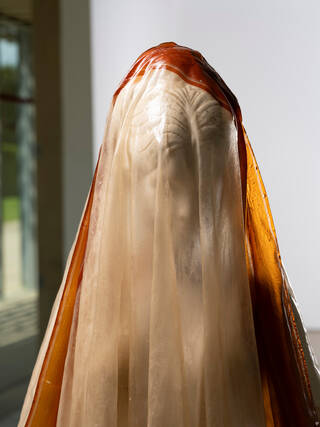
Alongside the mythological themes of European sculpture, Kher’s practice also references classical techniques, such as the rendering of delicate drapery in marble by sculptors like Canova. It was Kher’s fascination with this effect that motivated her experimentation with coating textiles in resin, replicating classical-style drapery by physically setting the cascading movement of fabric in place and time.
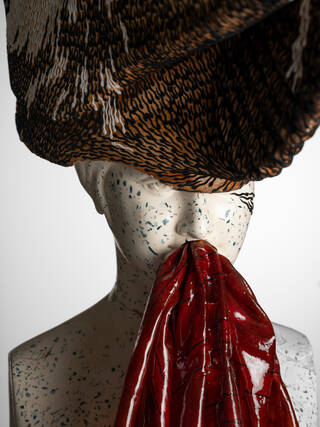
This technique is central to another work in Kher’s display, Ghost. Here, a resin-dipped sari obscures the figure beneath, becoming a semi-translucent veil. At first glance, the figure resembles a classically posed statue, but on closer inspection reveals a 1950s shop mannequin. For Kher, the mannequin suggests both the presence and absence of a body, becoming a carrier of the viewer’s projections. It also has a personal relevance for Kher, prompting nostalgia for the mannequins in the shop window of her mother’s sari shop in Streatham, London during the 1970s. Kher uses the sari – a marker of identity, labour, and shared experience – to connect personal memory with broader cultural histories of South Asian women.
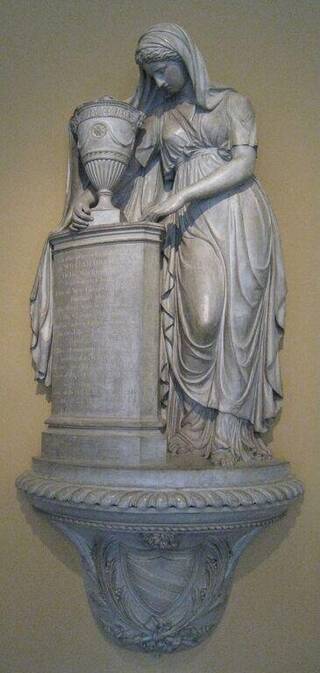
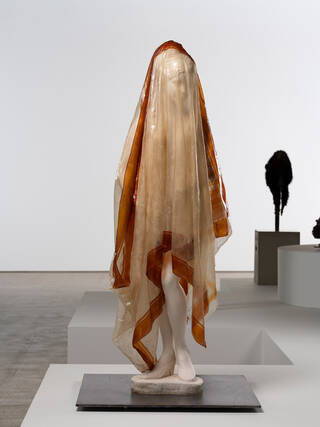
At the V&A, Kher’s Ghost acquires new layers of meaning. Surrounded by the funerary monuments of Room 24, Ghost evokes something concealed, missing or hidden.
“Museums are sites of memory and they’re not neutral spaces. They talk about aesthetic, they talk about history, they talk about politics, but there’s also this underlying ghostly presence.”
Ghost speaks to the invisible histories in museums that are inseparable from Europe’s colonial past – stories that have been overlooked or left untold. Kher uses the forms and themes of classical sculpture to question established narratives of art and representation, pushing against them to make space for a global framework of references and her own South Asian heritage.
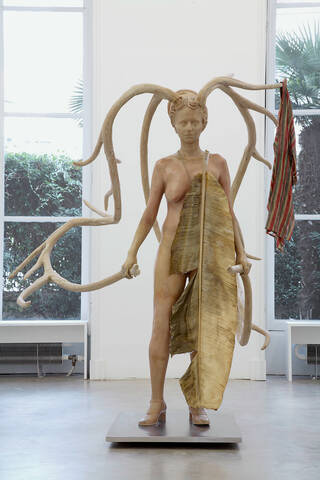
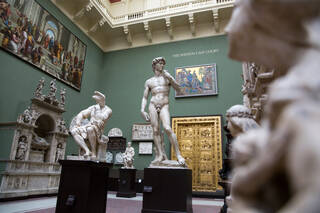
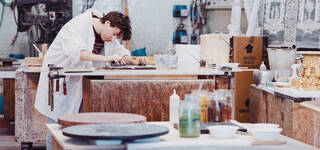
When discussing her personal relationship with the V&A, Kher cites the Cast Courts as having the greatest impact on her practice, since her early visits as an art student: “when I first went there, I found this sort of magical process”. Casting has been a central part of Kher’s material practice for the majority of her career; sometimes in plaster, but also in more contemporary materials such as resin and papier-mâché. Displayed just metres away from the Cast Courts, Kher’s Warrior with Cloak and Shield explores the evolution of the casting tradition in contemporary practice.
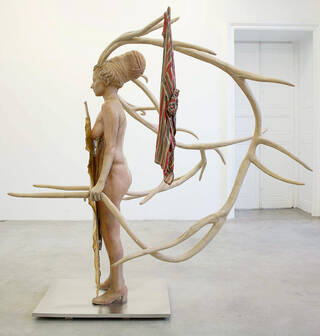
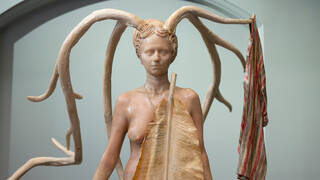
Originating as a life cast made directly from the body of the artist’s friend, Kher’s Warrior is reconfigured into an otherworldly hybrid. Merging human and mythical elements, the figure becomes a warrior with a powerful presence, and yet possesses a deliberate sense of improbability, even awkwardness – her impractical antlers have caught on a shirt, and her large shield is simply a fragile banana leaf. Kher sees the process of casting as a way to capture essence, memory, and experience, allowing her sculptures to inhabit a fantastical realm of myth and metamorphosis but remain clearly anchored in the real world. In Warrior, Kher has captured a human vulnerability through this real, non-idealised body in sensible underwear and low-heeled shoes. Simultaneously magnificent and mundane, Kher’s sculpture takes up a space of possibility and contradiction, reflecting the shifting and fluid nature of femininity.
At the V&A, Warrior with Cloak and Shield looks out into a gallery filled with the smooth, perfect bodies of idealised sculptural forms. In this way, Kher’s works introduce a different kind of presence into these spaces. While evoking the classical and mythological origins of many European sculptures, her works firmly reinstate an embodied experience of womanhood. From life casts to mannequins, humans to animals, and myths to lived realities, Kher’s intervention employs hybrid forms and culturally resonant materials to invite visitors to see both contemporary sculpture and the museum’s collections in new ways.