
Most were used to hold snuff (powdered tobacco), although some held small sweets or bonbons, hence their name bonbonnière. They were presented as gifts to friends and lovers, and by monarchs to ambassadors and courtiers. The boxes also led to the ‘language of the snuffbox’, a phenomenon at European courts where specific gestures involving a box had hidden meanings – a secret code between individuals.
Arthur and Rosalinde Gilbert delighted in the dazzling details of these boxes which combine gold with porcelain, hardstones, enamel or mother-of-pearl. Their materials were worked with incredible skills, often now forgotten, on an astonishingly small scale. As collectors, the Gilberts enjoyed handling their boxes close-up and finding out about their previous owners. Their collection of over 200 boxes is one of the most extensive ever formed.

Their uniqueness is indebted to their owners’ desire to express not only their status in society but also their personal beliefs and tastes. All boxes in the Gilbert Collection were meant to be viewed from all sides, as their decoration continues on the base and interior.
'Toys' for tobacco
The 18th century was the highpoint of courtly elegance – before the French Revolution brought about its decline. Paris was the epicentre of the production of refined, precious trinkets then known in England as ‘toys’. Numerous specialised workshops partnered with so-called 'marchand-merciers' – luxury retailers who used their extensive and global networks to supply the most stunning masterpieces to their discerning clientele.
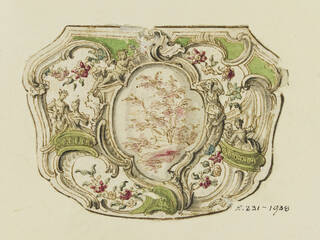
The designs for gold boxes in Paris came from some of the most creative and innovative minds of the period, including Juste-Aurèle Meissonier and Jean Mondon. The rest of Europe by and large emulated Parisian style.
In France boxes for snuff became known as 'tabatières', a word derived from the French for tobacco (tabac). Tobacco had first come to Europe from the Americas in the late 16th century. Settlements such as New Amsterdam (today New York) were important ports for ships taking tobacco across the Atlantic. Originally praised for its medicinal properties, tobacco soon became a recreational drug, and smoking a widespread pastime. Among the beliefs about tobacco noted by doctors and encyclopaedists, was that it helped to preserve sight and smell if used in moderation, especially when mixed with "fragrant oils and flowers or their essences". Not everyone agreed. King James I of England, who wrote a pamphlet entitled A Counterblaste to Tobacco in 1604, and King Louis XIV of France, both thought tobacco noxious.
Boxes specifically for tobacco came into fashion during the 1650s as snuff-taking became popular at the expense of pipe-smoking. These boxes were pocket-sized and had a tight-fitting lid to prevent the snuff from drying out. This, in turn, encouraged the development of pockets in skirts and coats in order to hold these boxes. Because snuff-takers often sneezed, handkerchiefs also became crucial accessories. By the 1700s, the snuffbox was fully developed as a highly functional fashion accessory.
Precious souvenirs
The fascination with snuff boxes first arose at court where snuff helped courtiers through long days in cold palaces. Soon, the act of handling the box and offering snuff evolved into a secret code which, though never written down comprehensively, had a particular name: the ‘language of the tabatière’. This ‘language’ must have had many dialects and variations. Karl Alexander von Lothringen recorded in his diary that taking snuff, and then pretending to flick traces of it from his coat or fur tippet, was his way of asking his beloved whether she would attend a ball.

Though possibly less elaborate, the use of a snuffbox as a means of wordless communication is apparent in the painting Two ladies and an officer seated at tea, English school, about 1715, which has been interpreted as an accepted marriage proposal: after all she is dipping her hand in his box...
In a society where marriage was often a matter of politics, not love, gold boxes became a way of lending intimacy to decisions made principally with dynastic considerations in mind. The Gilbert Collection includes an early and beautiful reminder of this. Made about 1714, as a wedding gift to Elisabetta Farnese (1692 – 1766), the box shows symbols of love with entwined initials on the outside, while the inside of the lid is fitted with an intricate miniature depicting her husband Philip V, King of Spain.

Courts were also the environment where another function for precious snuffboxes emerged – as a token of appreciation and payment in kind. This new type of diplomatic gift stemmed from so-called 'boîtes à portrait', portrait boxes set with diamonds – a gift of honour introduced by Louis XIV of France in the 17th century. From the 1720s, French snuffboxes became adorned with those portraits and offered a wider variety of materials and decorations, which could be tailored to suit the recipients’ status.

Historically, in England and Ireland, city authorities traditionally presented a freedom box to citizens in recognition of their services. The tradition originated from the medieval practice of granting individuals freedom from serfdom (farmers who were bound to the land owned by a landlord).

Fast moving fashions
The 1715 Frauenzimmer-Lexicon (‘Woman’s Lexicon’) lists the most common materials for snuffboxes as "silver, ivory, steel, horn or exotic wood". Gold was mainly used to mount or embellish boxes until 1721 when Paris authorities allowed goldsmiths to create snuffboxes entirely of gold. From then on, goldsmiths took their creations to new height of luxury, inventing countless shapes and designs. The constant demand for novelty encourage goldsmiths to embellish gold boxes with sparking gems, and colourful enamels, sometimes imitating stones and other materials.
In 1759, Pierre Philippe Choffard designed an oval snuffbox that was made by the workshop of Jean Ducrollay near Pont Neuf a year later. It is included in an album of designs compiled over three generations at his workshop and is now part of the V&A’s collection.

This is the earliest dated box in the new neoclassical design, defined by comparatively austere, clear forms inspired by antiquity and architectural ornament. The difference is all the more pronounced when compared with other pieces marked the same year: swirly rococo forms dominate a box set with playful enamel plaques after François Boucher made by Ducrollay’s competitor Jean Frémin.

Parisian goldsmiths also developed cagework mounts, which were skeleton gold structure onto which workshops could easily fit an array of decorative panels made of a wide variety of mediums such as miniature scenes painted on vellum by the renowned van Blarenberghe family.
Pan-European networks
It could take up to 14 people to produce one single box. While many goldsmiths can be identified from their marks, the names we know today thanks to inscriptions and signatures on boxes, (or to inventories and other sources), are very few in comparison to the overall numbers of other specialists who have been involved in making gold boxes.
Those objects are testament to the creative energy and the buzzing atmosphere of the craftsmen’s quarters in Europe’s largest cities – Paris and London, but also Hanau, Berlin, Dresden. The latter two cities particularly stood out for their incredible talent in carving their local wealth: hardstones such as jaspers, agates, chalcedonies etc.
Pan-European networks existed alongside local hubs, and journeymen travelled to learn new skills and perfect their art. Emigration for religious or economic reasons also helped to spread the latest innovations in design and technology across the continent and to London. This explains why some of the eminent makers and artists associated with certain centres of production were not actually born in their adopted home town: such as George Michael Moser in London, Daniel Chodowiecki and Daniel Baudesson in Berlin, or Pierre Ador in St Petersburg.
Collectors
Design and material value made gold boxes not only fashionable but also collectable, a trend already apparent in the 18th century. Heinrich Graf von Brühl was prime minister to Augustus the Strong, Elector of Saxony and King of Poland, and one of the most powerful and influential people of his time. He was also a voracious collector of boxes, with more than 800 listed in the inventory compiled after his death. He owned an album, now lost, in which his outfits, including accessories such as boxes, hats and dress swords were recorded.
Frederick II, The Great, of Prussia
Some surviving gold boxes, including many in the Gilbert Collection, are known to have been owned by historically important 18th-century figures, none more so than the group of table snuffboxes associated with King Frederick II, the Great, of Prussia.
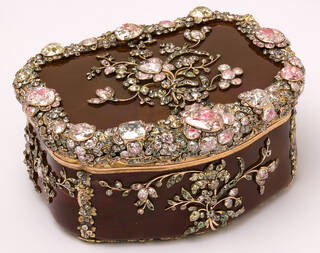
The boxes designed for him, some of them even in part by him, hold a special place among 18th-century gold boxes: they are as recognisable as the Fabergé eggs produced in Russia about 150 years later. Playful and precious in equal measure they are set with a multitude of diamonds which sparkle in various colours, thanks to coloured metal foils set underneath. The king commissioned them in part to support and develop local craftsmanship. He proudly showed the boxes on bespoke tables, almost as if they were part of the interiors of his palaces. Camels, with their careful even walk, were allegedly employed to move these fragile marvels from the king’s residence in Berlin to his palaces in Potsdam.
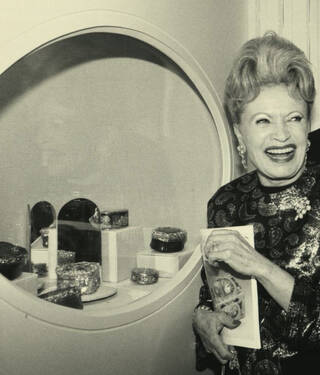
The fascination with these small-scale masterpieces continued, even after the habit of snuff-taking went out of fashion by the mid 19th and 20th centuries. Snuffboxes became and remain highly collectable works of art.

