On gently removing each print from its protective sleeve, I am quietly struck by the fragility and softness of these objects in my hands. The air fills with the delicate scent of these 100-year-old prints – a reminder of the way photographs change over time, and a sensory evocation of the age of the photographic medium itself. As I handle Seymour’s prints, my mind drifts to the careful touch that would have held and positioned each stem or leaf within the photographs, whilst the scent of lilies, chrysanthemums and orchids filled his studio. There is a lightness and gentleness to photographing these objects, whether in Seymour’s handling of a poppy, or in my encounter with his prints, now vulnerable with age. I began thinking about what it means to encounter and photograph a fragile and changing object at one point in its lifecycle, and where the two practices of botanical photography and museum photography might meet.
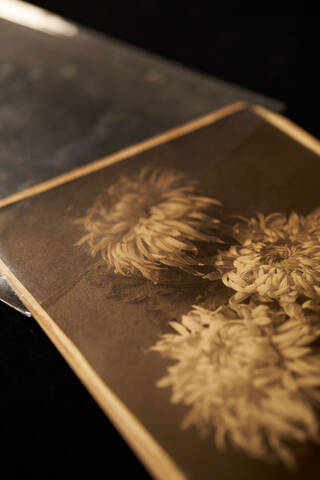
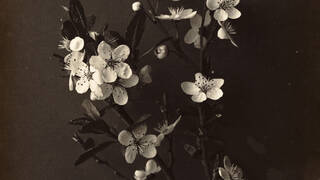
Seymour’s flower photographs, shot between 1904 and 1915, occupy a fascinating and important space in botanical photography, embodying both the aesthetic beauty of a pictorialist floral still life, and a scientific, botanical study. An article in Photography and Focus magazine (1908) noted how he created his life-sized floral compositions using short exposures directly onto orthochromatic plates (coated with an emulsion sensitive to only blue and green light), which he then quickly developed, stopping the process as soon as he was satisfied with the density of the highlights. Using this process, Seymour created meticulously crafted yet dreamlike images and is thought to have established something of a new school of flower photography – The Photographic News for Amateur Photographers (1908), describing his images as “gems of pictorial quality and masterpieces of technique, each of which appears as a careless study, yet perfect in composition and tone”.
In 1905, he was elected as a member of the Royal Photographic Society (RPS), presenting work at its exhibitions in 1904, 1906 and 1910. Seymour then retired from exhibiting and lecturing shortly after in 1915, showing only one photograph at the 1927 RPS exhibition before his death in 1942 at the age of 85. Despite a relatively short career, Seymour made a significant contribution to botanical photography, creating imagery that is timeless in its beauty and simultaneously grounded within a transitional moment in early 20th century photography.
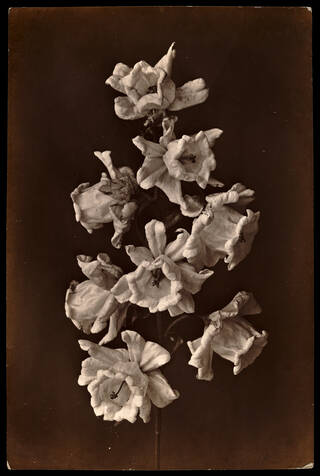
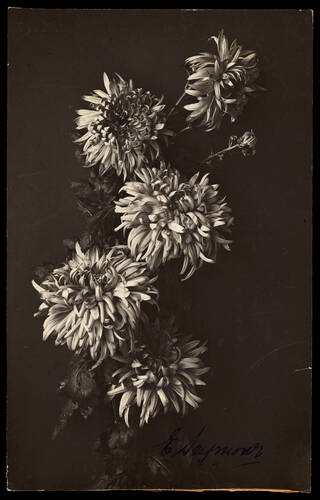
Seymour’s flowers, whilst romantic and ethereal, like much Victorian and Edwardian photography (see for example Julia Margaret Cameron), seem to signal to something that feels also modernist in tone. Despite their careful arrangement within the frame, the flowers are in a process of decay, caught at a moment between life and death that recalls the way plants and flowers often appear in modernist literature and art: as symbols of, or pathways to, the subconscious. My experience of looking through Seymour’s flower photographs was like wandering through an endless garden of fictionalised and symbolic plants – through D.H. Lawrence’s chrysanthemums, T.S. Eliots’s lilacs, Virgina Woolf’s red-hot pokers, Georgia O’Keeffe’s red cannas and finally into the heart of Frida Kahlo’s magnolias.
Seymour captured his plants on the cusp of transformation – a moment so fleeting yet held and preserved within the image so that it appears to echo through time, the flowers almost shimmering in their instability. Similarly, handling and examining these original prints also brings to mind the paradoxical process of preserving and documenting fragile museum objects, which inevitably shift and change over time.
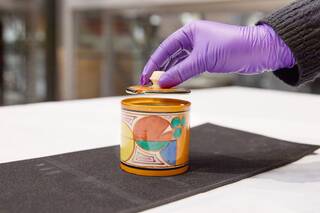
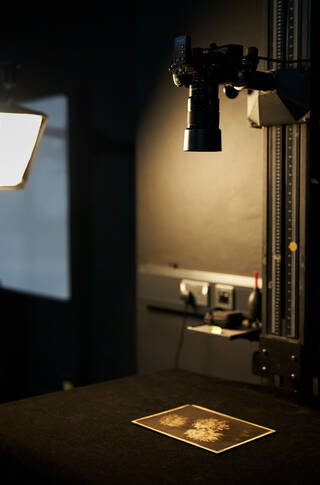
Photographing photographs is a strange and fascinating practice, a set of technical decisions that aim to accurately capture the qualities and conditions of an object: how it might feel in your hand or appear to your eyes, whilst also communicating something of the affect of the photograph – that intangible magic orchestrated by a photographer that captivates us and continues to reverberate across time.
Once I have a photograph in my hands and begin to understand some of its qualities, (how it interacts with light, how sensitive or fragile it is), I can make decisions and adjustments to my photographic setup to best represent it in its current state. Yet, I have often found, once the shot is calibrated and the object is lit, my encounter with the photographic object is transformed at the moment the shutter clicks, and I witness a form of doubling, echoing and reverberation. Digitising photographs and attempting to communicate their affective qualities can feel similar to the process of recollection, of memories swimming in the subconscious over time and shifting slightly each time they are called to the surface. The blink of the shutter tries to catch the echo from the original photographer, allowing the beauty and ephemerality of the original objects to trace through to the digitised image.
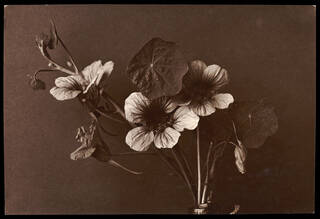
This echo-trace was markedly powerful when digitising Seymour’s flower studies. The flowers wilting, their petals curling and darkening, feel both earthly and liminal, occupying a transitional state between here and not here. Despite what I imagine was a process of meticulous arrangement, the plants have an unruly quality about them – sometimes pushing at the edges of the image, alluding to something that is perhaps ungraspable, or not easily wrangled into the stillness of a photograph.
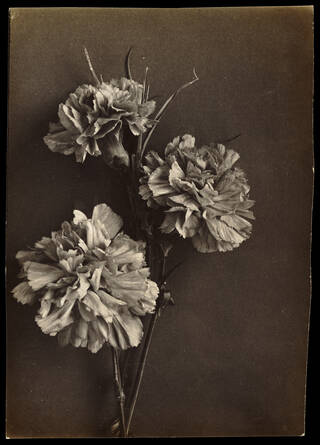
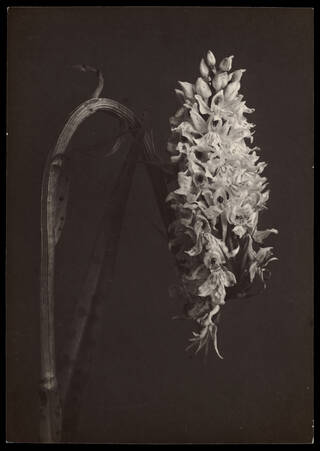
Seymour chose to photograph these flowers just as they were beginning to fade, and this transition is echoed by the digitisation process: photographing these prints is a way of capturing an object that over time may change materially or chemically, and to hold onto some of its present magic. The plants in Seymour’s photographs went on to decay, just as many museum objects have slowly transformed over long stretches of time. Yet, by capturing them at specific moments we create a document of this transience. This is where I witness the doubling – two different forms of changing matter (plant and print), flickering across histories, in symbiotic dialogue with one another.
Whilst digitisation work is an entirely different practice from the photographic artistry of the objects we document, the process of digitising Edward Seymour’s work crystalised for me the paradox of the ephemerality and fixedness of photography. Photographers capture something at a point in time, fixing it there, whilst fundamentally creating another object – a print, transparency, or digital image – that will shape-shift through time. In the case of copy photography, when we are successful and we see the echo of an original photograph’s beauty translated through the digital image, we experience a sort of stretching of time. It is for this reason that I find something endlessly fascinating about the moment the shutter clicks and a photograph of a photograph is created – a representation of a representation, an image of an image of a flower, its petals softly falling into the surrounding darkness.
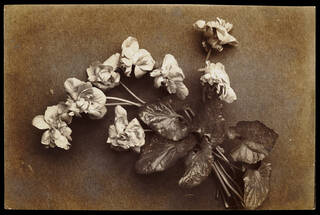
With thanks to Sarah Beattie for her biographical research.
The cataloguing and digitisation of Edward Seymour’s images, and other horticultural photograph in the RPS collection, is supported by the Finnis Scott Foundation.