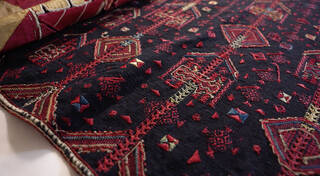
Created between 1706 and 1716, the designs are Europe's earliest surviving dated patterns for woven silk, produced by Huguenot master weaver and designer James Leman (1688 – 1745), a prominent member of the Spitalfields silk industry in London's East End.
James Leman was born in Stewart Street, Spitalfields in London in 1688. His family were weavers of Huguenot descent having fled from Tourcoing in France to escape religious persecution in the late 16th century. In 1702, at the age of 14, James was apprenticed to his father, Peter, and trained as both a pattern designer and a master weaver, which was unusual at that time. In 1711, he was admitted as Foreign Master to the Weavers' Company – the oldest trade-based guild in the City of London – and on his father's death in 1712 he took over the family business.
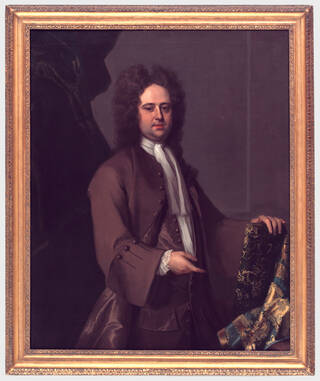
As well as producing his own designs for silks, Leman hired other designers, notably Christopher Baudouin (1662 – 1724) and Joseph Dandridge (1665 – 1747), who were both well known in their day.
Leman rose to high office in the Weavers' Company, becoming a Liveryman and member of the Court of Assistants. In 1731, he was elected Renter Bailiff, second-in-command in the Company. He was active on a number of committees supporting the interests of the Weavers' Company until his death in 1745, when he was helping to organise a campaign against the sellers and wearers of printed calico.
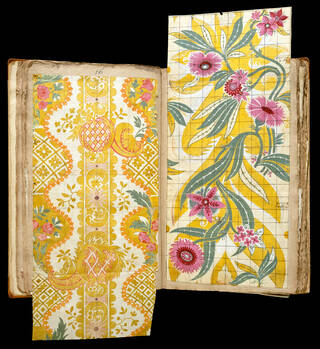
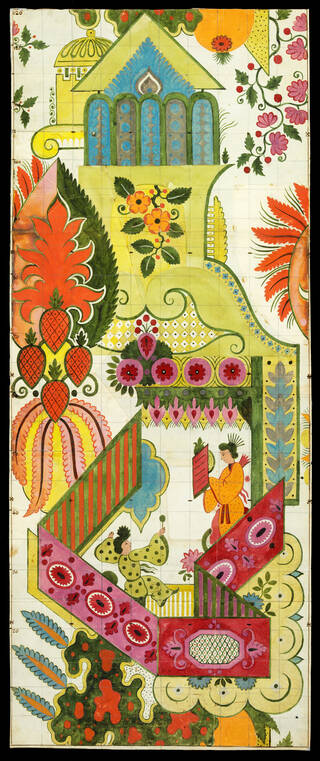
Leman's designs are an astonishing accomplishment, especially considering how young he was at the time. They are both visually bold – mixing floral and architectural forms inspired by the latest textile designs from France, Italy and Asia – and technically complex, showing a clear understanding of how to exploit the intricate mechanisms of the drawloom on which the silk would be weaved. This rare combination of being both a skilled designer and manufacturer of complex silks of the highest quality earned him the title of ‘the ingenious Mr Leman’.
Leman’s will records that he had a collection of ‘prints and picture books’ that he also used for inspiration. One of them may have been A Treatise of Japaning and Varnishing: Being a complete Discovery of those Arts (1688) by George Parker and John Stalker, which features a range of chinoiserie patterns that correspond to motifs that appear in many of Leman’s designs.

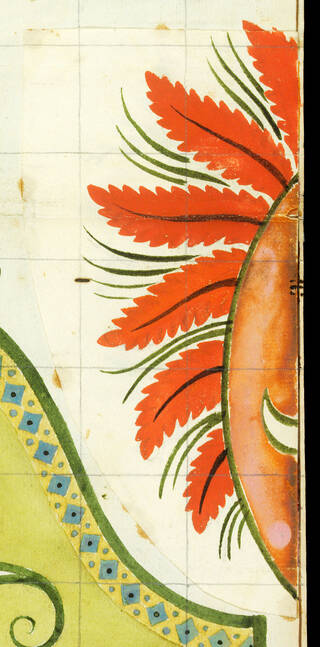
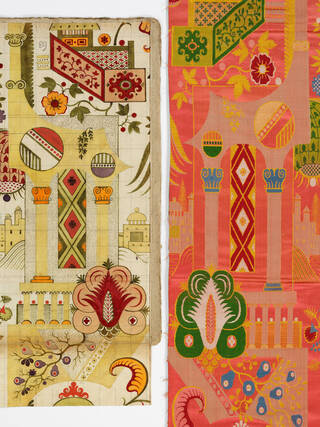
Leman sometimes altered his designs by pasting new sections over the existing pattern, either to satisfy himself, the dealer in silk, or the customer. Like many of his designs, it is ‘squared up’ – overlaid with a grid – to indicate the arrangement of the warp and weft threads that were to be used in the weaving process. The pattern would then be transferred onto grid paper, known as 'point paper', which the weaver would use to set up the loom and execute the design. This design was made for Mr Carr, one of the most important silk dealers of his day, who supplied goods to the royal court on a large scale, and bought several of Leman’s designs.
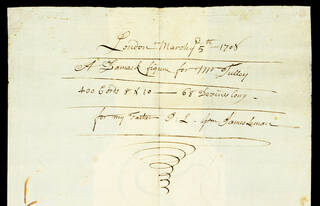
Leman often annotated the reverse of his designs – some were inscribed 'For my father, Peter Leman, by me, James Leman', while others included manufacturing instructions and the name of the customer who had commissioned it. This gives us a unique source of information about the technical production of woven silks in early 18th century England.
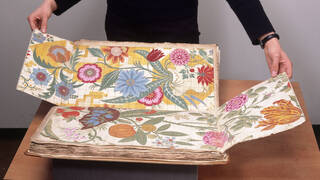
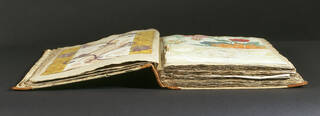
The binding of the album dates from the early to mid-20th century and is not original to the 18th century designs. A decision was made by conservators at the V&A to remove the designs from the binding as it did not open comfortably and many of the designs were being damaged from the way they had been folded to fit inside it.
Structural harm to some of the papers had also been caused by the properties of copper pigments, which over time cause paper to split and crumble. The removal of the designs from their support pages has aided scientific analysis and conservation repairs. Leaving the designs unbound is now the best way to ensure their long-term stability.
The V&A also has in its collection one of only two known silks in existence, designed and manufactured by James Leman. The length of woven silk fabric is dated 1709 and corresponds to its original design drawing in the collection. A major difference between the design and the finished silk is the background colour, suggesting that customers, having approved their desired pattern, could also pick a colour scheme. The design’s inscription tells us it was commissioned by a Mr Issac Tullie, a leading dealer in silk in Covent Garden, London, and drawn by Leman on 15 July 1709, when he would have been about 21. The silk is in an unparalleled state of preservation, with exceptionally vibrant colours, having never been fashioned into clothing and kept away from light for the past 300 years.
You can request to view the Leman Album in our Prints and Drawings Study Room at V&A South Kensington.