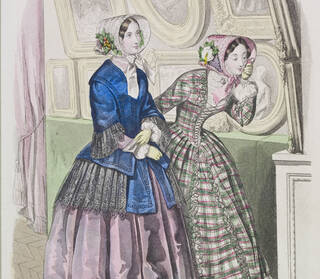
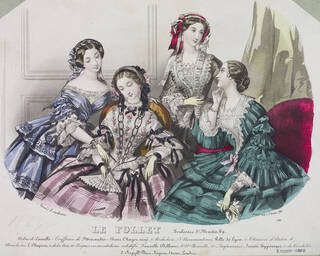
Héloïse Leloir (1819 – 73), Anaïs Toudouze (1822 – 99), and Laure Noël (1827 – 78) produced over 140 different fashion plates now identified in the V&A collections. Most were acquired as part of large acquisitions of groups of works and were assumed to be unsigned, however, more careful recent examination by V&A Project Documentation Officer Steph Haire has revealed the names and hidden histories of these three women.
Fashion plates: depiction and dissemination
Male designers such as Charles Frederick Worth, dubbed the ‘Father of Haute Couture’, are often credited with the genius at the centre of 19th-century fashion innovation. However, the fashion industry relied on a whole host of creative individuals to power its engines, including seamstresses, milliners, haberdashers, and advertisers. The latter were instrumental in publicising new styles imagined by Worth and his contemporaries through the publication of fashion periodicals (the predecessors of 20th-century fashion magazines like Vogue) filled with fashion plates.
Named for the copper engravers’ plates from which they were printed, fashion plates were a precursor to the fashion photography we are familiar with today.
Illustrated by an artist, the drawings were then meticulously engraved onto the metal surface using a sharpened tool known as a burin. Many fashion plates also feature etched lines achieved by the printmaker adding an acid that cuts into the metal.
Printed in large batches by commercial printers, and often individually coloured by hand before being published, these illustrations were the tools that fashionable women used to determine their wardrobes for the coming season. Often overlooked, however, are the artists who created these plates and the roles they played within the fashion system.
The Colin sisters
Working professionally under their married names, it is not immediately apparent that the artists Héloïse Leloir, Anaïs Toudouze, and Laure Noël were sisters.
Born into an artistic family, whose line of ancestors includes the painter Jean-Baptiste Greuze (1725 – 1805), the sisters were exposed to arts and culture from an early age.
Their father, Alexandre-Marie Colin (1798 – 1873), was a painter and lithographer who had a studio in Paris and associated with some of the foremost artistic names of the time. He instructed his five children in artistic techniques himself, rather than sending them to study at an art school.
The Colin siblings – Héloïse, Adele-Anaïs, Laure, Isabelle, and Paul – would all go on to become artists. All four sisters contributed illustrations to magazines from their adolescence and won medals for their work. Héloïse, Adele-Anaïs, and Laure worked as professional fashion plate illustrators, drawing inspiration from the family's reference collection of historical garments to inform and inspire their works. Their illustrations can be found in collections across the globe.
Anaïs Toudouze
The most prolific of the sisters, Anaïs Toudouze (born Adele-Anaïs Colin), produced illustrations for over 35 different French and British publications, 93 of which have been identified in the V&A collections.
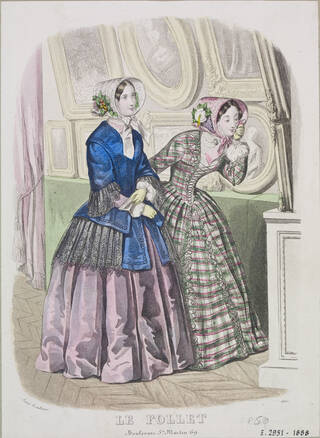
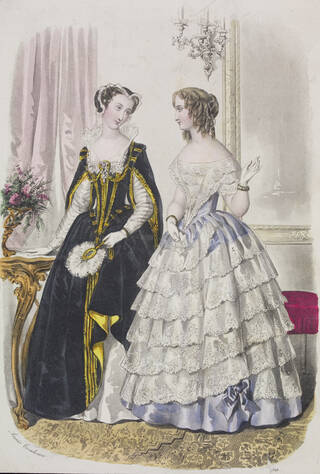
She spent four years travelling in Sicily, Egypt, and Turkey as a young woman to further her artistic skills, and married architect and engraver Gabriel Toudouze in 1845. He was eleven years her senior, and after he died in 1854, Anaïs used her work as a fashion plate illustrator to provide for her three children.
Her eldest son, Gustave (1847 – 1904), became a novelist whose son Georges-Gustave (1877 – 1972) wrote a book about French fashion history entitled Le Costume Français. Her second son, Edouard (1848 – 1907), became a painter, and her daughter, Isabelle Desgrange (1850 – 1907), became a fashion plate illustrator like her mother and aunts before her.
Anaïs continued to work as a painter and illustrator until late in her life, and some of her family portraits survive in European collections.
Héloïse Leloir
Héloïse Leloir (born Héloïse Suzanne Colin) was the eldest of the Colin sisters. She married the religious painter Auguste Leloir and had two sons, the painter Alexandre-Louis Leloir (1843 – 84) and the illustrator, collector and historian Maurice Leloir (1853 – 1940), who published a dictionary of fashion history, and whose daughter Suzanne Leloir also became a painter. The Leloir family donated a collection of artworks to the Museum of Art and Archaeology of Guéret.
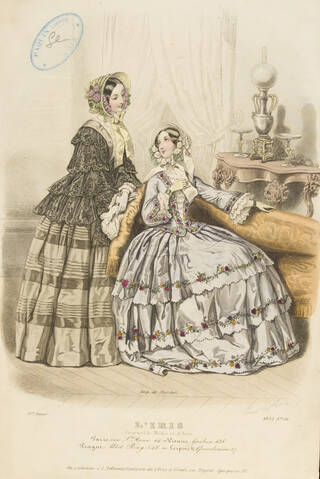
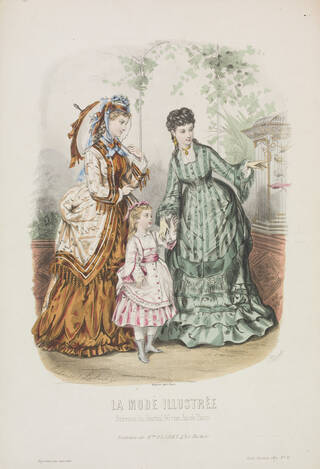
There are 74 Héloïse Leloir fashion plates in the V&A collections.
Laure Noël
There is less known about Laure Noël (born Laure Colin) than her sisters. She also married and had children, but seems to have been less prolific than her two older sisters.
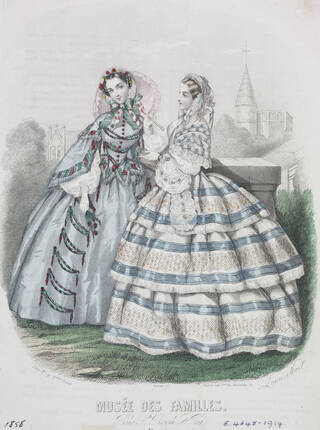
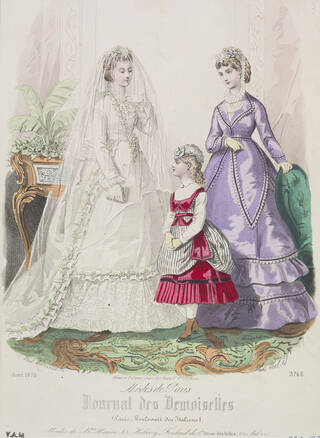
There are 16 of her fashion plates currently identified in the V&A collections.
The sisters' legacy
The work produced by these three sisters contradicts the absence of women from the narratives of art history that emerged in the 20th century. While the sisters' major competitors were indeed men – most notably the artist Jules David – the volume of their work, and the fact that they worked with the same printers and publications as David, indicates that they were valued and esteemed by their contemporaries.
They also passed their love of fashion and the arts down to their descendants, inspiring them to publish their own artistic and written works. Anaïs Toudouze’s grandson Georges-Gustave Toudouze wrote the following about his family in the foreword to his cousin Maurice Leloir’s Dictionnaire du costume et de ses accessoires, des armes et des étoffes, des origines à nos jours:
In the universal history of the Arts… we note the existence of artists, who, not only in the direct line from father to son, but also at all degrees of collateral kinship, even distant, constitute true dynasties whose members have all devoted themselves, the women with as much ardour as the men, to the defence and illustration of artistic expression in its most varied forms… and they all had this common family trait: the unique, absolute, and dominating love of pure and selfless Art.
This impassioned epitaph clearly shows that the Colin sisters were regarded within their family as serious artists to be respected as significantly as their male relatives.
Furthermore, the styles that they chose to illustrate would undoubtedly have shaped the evolution of global fashion.
Published in French periodicals such as La Mode Illustrée, Le Follet, and the Petit Courrier des Dames, and distributed to Britain, the US, the rest of Europe and beyond, the fashion plates drawn by Héloïse, Anaïs, and Laure would no doubt have served as sartorial inspiration for thousands of women.
Reminiscent of Meryl Streep’s now iconic ‘cerulean blue’ monologue in The Devil Wears Prada – in which she explains how even the most seemingly insignificant pieces of clothing are influenced by the choices made by the editors of fashion publications – the decisions made by the Colin sisters would have influenced the progress of 19th-century style.
Their contributions would have supported an industry upon which countless people relied for their livelihoods, and which would begin to shape our understanding of how fashion operates today.
With advances in technology, copper plate etchings gave way to the camera. Continue the story with 100 years of fashion photography.