'1984' musical (1973 – 74)
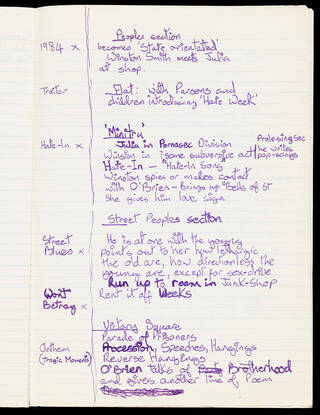
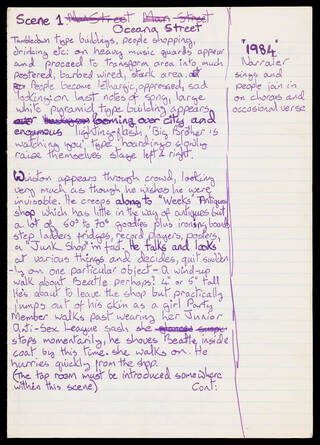
In 1973 – 74, Bowie began devising a musical-comedy adaption of George Orwell’s dystopian novel Nineteen Eighty-Four with director and playwright Tony Ingrassia. Ingrassia had previously directed the stage adaptation of Andy Warhol’s play Pork, which Bowie had seen in London in 1971. Bowie and Ingrassia co-wrote a treatment for 1984 and Bowie wrote multiple songs to feature in it. Although the musical was never fully realised, Bowie continued to explore the project’s themes through the development of the (unrealised) Diamond Dogs film. The songs 1984 and Big Brother were included on the album Diamond Dogs (1974), which Bowie was working on at the same time as the film project.
'Diamond Dogs' film (1973 – 74)
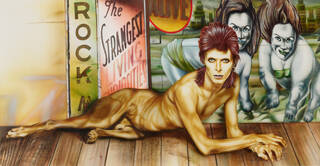
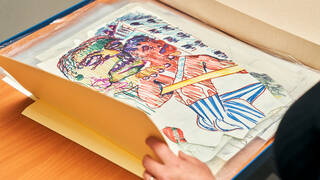
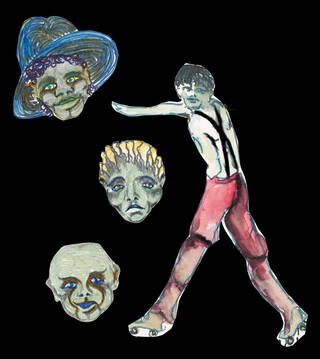
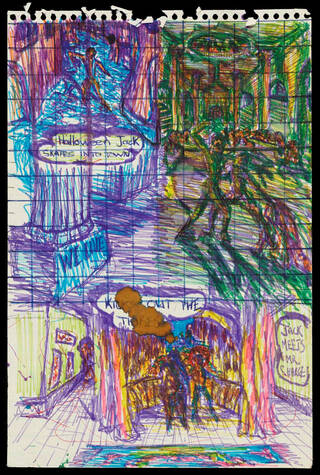
The Diamond Dogs film evolved from the dystopian world of George Orwell’s novel Nineteen Eighty-Four. Bowie created the fictional Hunger City, which he describes as “a highly advanced technocracy in an advanced state of decline”, as the setting for the narrative. Here, residents roller skate through backstreets and are sustained through the drug ‘mealcaine’ – a “hybrid protein stimulant”. The story centres around the characters Halloween Jack, Harpie, Charge, and Mach, who form the rebel DOG group as a resistance to the authoritarian state. In the David Bowie Archive, there is an extensive amount of material, including Bowie’s handwritten plot descriptions and notes, storyboards, and drawings. All these elements had a huge influence on the Diamond Dogs album and tour – from Bowie’s embodiment of the Halloween Jack character to the ambitious, German-expressionist-inspired tour set, designed by Mark Ravitz.
'Young Americans' film (1974 – 75)
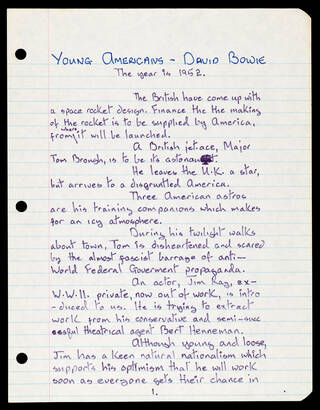
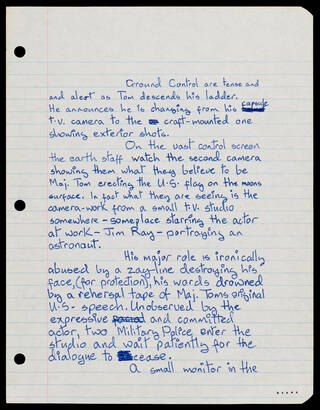
Bowie’s Young Americans film follows British astronaut Major Tom Brough on the first space mission to the moon. It is set in a dystopic, 1950s America during a campaign for a communist World Federation Government. It explores politics, nationalism and celebrity at the birth of television broadcasting – very different themes to Bowie’s 1975 album Young Americans. The archive contains a drawing, Bowie’s handwritten notes and plot summaries, as well as an extensive reading list, demonstrating how involved he was in creating these worlds. Major Tom is a character Bowie explored throughout his career in songs such as Space Oddity (1969) and Ashes to Ashes (1980), and the video for Blackstar (2016).
'The Catastrophy Cabinet' film (1974 – 75)
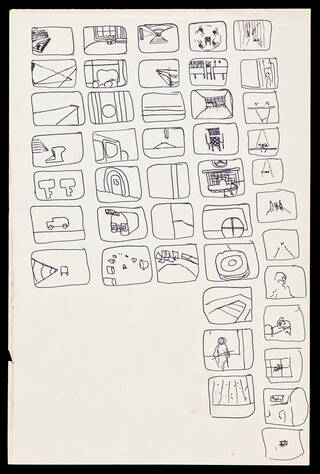
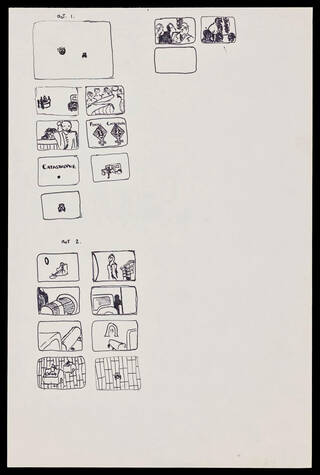
The Catastrophy Cabinet was an hour-long film for television, which Bowie wrote and intended to direct. It is set in a dark, dystopian America and focuses on a young and old man, and their interest in a cabinet of curiosities, or ‘Wunderkammer’. The pair meet after a confusion over two keys, one labelled ‘psychic’ and the other labelled ‘catastrophy’. They form an unlikely bond after they survive a ceiling collapse at a fashion show of “tramps” and “bright young things”. The archive contains Bowie’s original handwritten notes, storyboards, and summaries of each of the seven acts.
'All The Emperor’s Horses' film (1982)
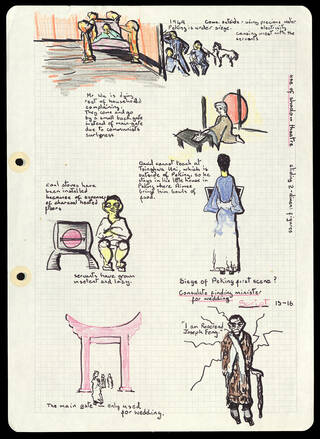
All The Emperor’s Horses was a collaborative film endeavour between Bowie and David Kidd, who had written an autobiography in 1960 detailing his journey to Peking (modern-day Beijing), Hong Kong and Japan during the Chinese Communist Revolution. There were plans to adapt the book into a film, with Bowie acting in the lead role. The archive contains a series of letters between Kidd, Bowie, and his personal assistant Corinne "Coco" Schwab, a copy of the book, and Bowie’s storyboards and notes. Sadly, the collaboration was not realised as Bowie had scheduling conflicts due to filming Merry Christmas Mr. Lawrence at the same time.
'Neutron' film (1980 – 83)
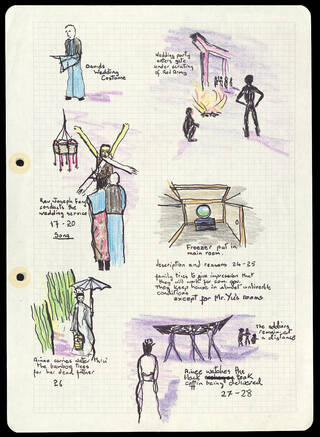
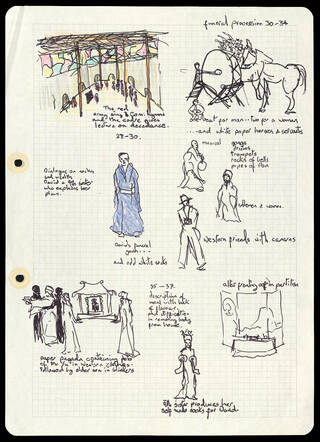
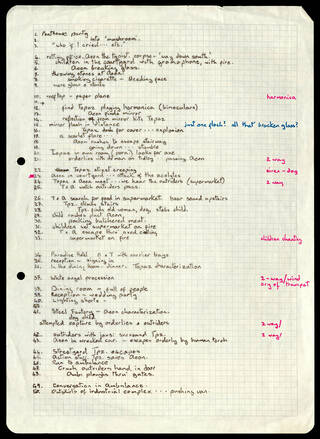
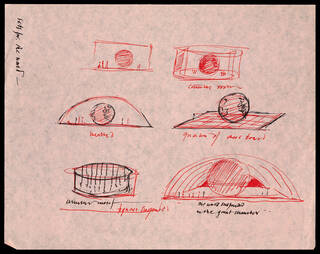
Following the success of his film adaption of The Tempest (1979), Derek Jarman began developing Neutron, an apocalyptic science fiction film, with the writer and actor Lee Drysdale. The pair cast Bowie and Steven Berkoff in the lead roles, set against the backdrop of Battersea Power Station in London and the area around the Berlin Wall in Germany. Created as a response to the 1980s political climate of Thatcherism and threats of nuclear war, Neutron explores an apocalyptic nightmare and broken society.
There are six published manuscripts of Neutron, which zig-zag their anti-heroes Aeon and Topaz across the horizon of a bleak and twilit post-nuclear landscape. ‘Artist’ and ‘activist’ in their respective former lives, they are caught up in the apocalypse, where the PA systems of Oblivion crackle with the revelations of John the Divine. Their duel is fought among the rusting technology and darkened catacombs of the Fallen civilization, until they reach the pink marble bunker of Him. The reel of time is looped – angels descend with flame-throwers and crazed religious sects prowl through the undergrowth. The Book of Revelations is worked as science fiction.
The tag line in the scripts refers to the film as “A Diary of the end of the World”, with later drafts reportedly co-written with the English music journalist, writer and broadcaster Jon Savage. Sadly, the collaboration was not realised and Jarman passed away in 1994. In the David Bowie Archive, there are multiple versions of scripts alongside correspondence, drawings and Bowie’s handwritten notes. Throughout, Bowie is frequently regarded as a collaborator on the project.
'Twilight' album (1981)
The Twilight album was intended to be a compilation album, featuring songs from Bowie’s back catalogue personally chosen by himself. The track list included: Red Sails, All The Madmen, Always Crashing in the Same Car, After All, and It’s No Game on Side One. And Joe the Lion, We are the Dead, Bewlay Brothers, Sons of the Silent Age, and Fantastic Voyage on Side Two. RCA Records created a test pressing of the album in 1981, but it was shelved before its intended release. The archive holds the test pressing, as well as handwritten song lists and a memo from Bewlay Bros Ltd. – Bowie’s office at the time.
'Miracle Jack' film (1974 – 88)
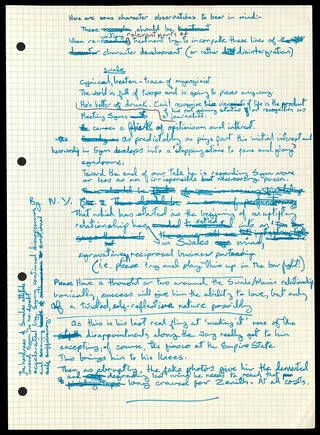
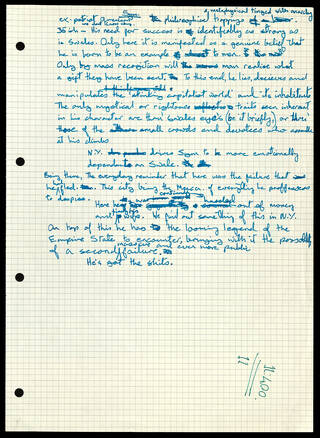
Bowie purchased the rights to Michael Baldwin’s 1967 novel Miracle Jack with the intention of adapting it into a film starring the American musician Iggy Pop. The story follows Francis Sym, a preacher turned steeple-climbing "miracle-jack”, and Bertram Swale, a cynical, drunken journalist. The archive contains a script written by Bramian Ross in March 1974, a film treatment by Corine Schwab in 1988, and Bowie’s handwritten notes about the project and characters. There are multiple photos of Bowie and Iggy Pop interspersed throughout the film treatment taken in 1982 by Tim Geaney in a New York apartment.
'Johnny Wierd' production (1975 – 2000)
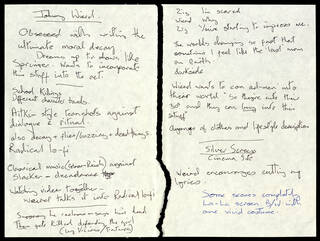
Little is known about the Johnny Wierd project. The archive contains only four pages of Bowie’s handwritten notes relating to a “production called Johnny Wierd”. The notes are undated but contain various plot lines, as well as mentions of characters such as Zig, Wierd, and Gilly, who Bowie fans will recognise from Ziggy Stardust. The notes open with the line, “Obsessed with writing the ultimate moral decay” and also include, “Wierd encourages cutting up lyrics” – a nod to the songwriting method Bowie had begun to adopt in the 1970s.
'The Leon Project' (1994)
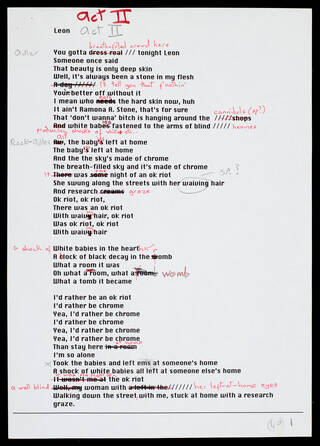
The Leon Project was a collaboration between Bowie, musician and songwriter Brian Eno, artist and author Andre Heller, and Director Rolf M. Engel. This marked the first time Bowie and Eno had worked together on a project since the Berlin Trilogy – the three studio albums Low, "Heroes" (both 1977) and Lodger (1979). Using Eno's Oblique Strategies cards – a card-based method for promoting creativity – the pair explored more experimental types of music creation in a series of recording sessions in Montreux, Switzerland. The project explores a society that has been subject to a series of art crimes, murders and muggings with key characters including Leon Blank, Nathan Adler, Baby Grace, Algeria Touchshriek, and Ramona A. Stone.
The project had a series of outputs. The first was a CD-ROM made up of various scenes, including music, characters and text across three acts. The second component involved an audio-only CD, which was intended to be sold through the American shopping channel QVC as a companion to the CD-ROM. The third was a CD-ROM focussed on the making of the project.
The Leon Project later developed into Leon in India, which involved a live performance in India, featuring local performers, alongside a documentary of the process and a book about the event. In line with Bowie and Eno’s interest in outsider art, an arthouse version of Leon involving patients from the House of Artists at the Maria Gugging Psychiatric Clinic was planned. The final component involved Bowie and Eno promoting the project in a series of lectures and an art installation where material from the CD-ROM was shown as a 3D projection.
The project was never fully realised, but the music components of Acts I – III were bootlegged under the title The Leon Suites in 2003. The themes, characters, and songwriting techniques were developed and inspired Bowie’s album Outside, released in 1995.
'The Spectator' musical (2015)
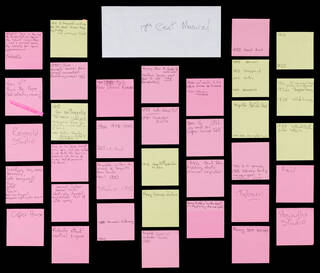
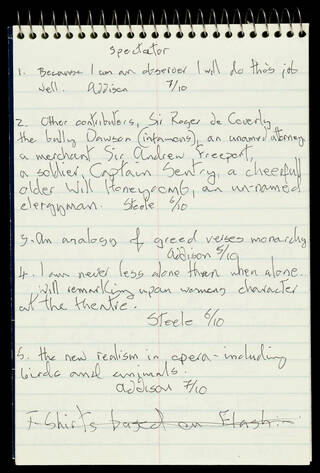
The Spectator was an idea for a musical set in the criminal underworld of 18th-century Covent Garden in London. Bowie developed the concept in 2015, and it features real historical figures from that time, including Jack Sheppard, a prolific thief and prison escapee, and Jonathan Wild, a thief-taker (a private individual hired to capture criminals) who ran a criminal empire. It begins with the hanging of Jack Shepherd at Tyburn (the principal public execution site in London from 1196 until 1783) with mention to wider philosophical ideas that were emerging at the time. The project was seemingly in its early stages of development. The archive contains a range of Post-it notes, a notebook of handwritten research notes, and some notecards.
Other projects
Alongside material around specific projects, the David Bowie Archive also contains a variety of unrealised performance sketches and scripts, including a script for an episode of The Simpsons and for The Princess Bride, for which Bowie turned down the role of Prince Humperdinck.