“I’ve lost audiences many times over the years, and they’ve come back again for one reason or another. I’ve sort of got that mutual agreement with them.”
David Bowie was a fan. He expressed admiration for his 'major hero' Elvis Presley, wrote a song dedicated to Andy Warhol, and Tony Visconti recalled he was so starstruck when first meeting John Lennon that he was unable to speak for two hours. He was moved to tears live on air when surprised with a birthday message from Scott Walker during a 1997 radio interview. An enthusiast of theatre, film, literature, art, music and technology, Bowie understood what it was to be a fan, and had no qualms in drawing heavily on these inspirations for this own work. He once said, "I'm a collector, and I collect personalities and ideas”. Perhaps for these reasons, the David Bowie Archive reveals an artist with an openness to conversing and collaborating with his fans, and a conscious desire to leave a lasting archive that could inspire fans for years to come.
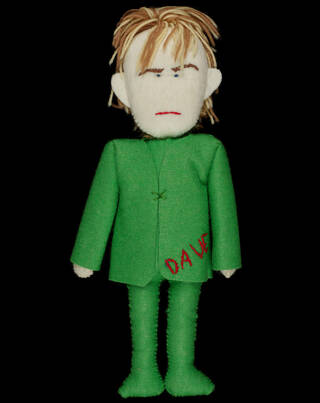
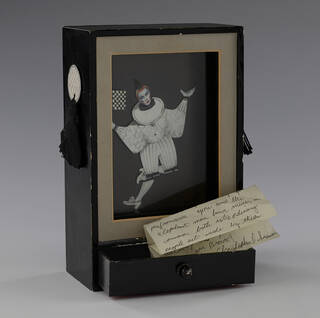
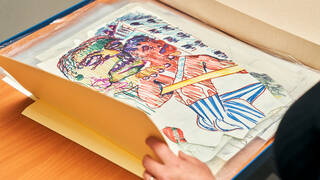
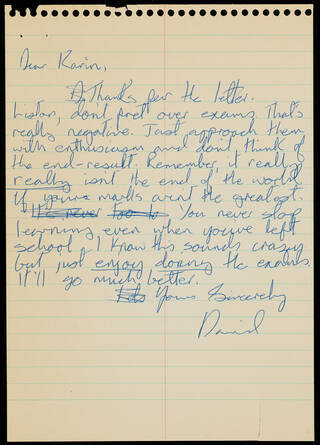
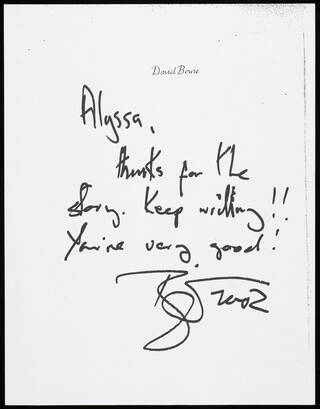
The Archive includes hundreds of drawings, letters, dolls and clothing made by fans and sent to Bowie across his career, such as a hand-sewn cloth doll, embroidered affectionately with the name 'Dave' and a homemade music box with a hand-drawn dancing Bowie as Perriot. There are many touchingly kind moments to be found in Bowie’s handwritten draft responses to his fan letters, such as reassuring a teenage girl about her upcoming exam nerves or complimenting another’s writing.
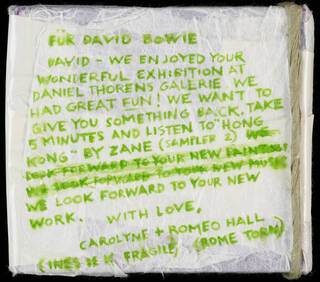
Fans expressed the desire to repay his creativity in some way by sending art of their own, to create a symbiotic relationship of sorts. Two fans from Rome sent along a cassette wrapped with a handwritten note saying, 'We want to give you something back'. Bowie and his archive team kept this material with the same level of care as his costumes and instruments. Bowie’s official social media account posted in 2018 that 'David Bowie collected all of the fan art he was sent over the years and now the Brooklyn Museum has fulfilled his dream that one day they should be exhibited', referencing the special addition of a Fan Art display at the Brooklyn Museum iteration of the V&A's touring exhibition David Bowie Is.
In the 1990s, Bowie said, “I want to see what the new construction is between artist and audience. There is a breakdown". He had previously allowed his fans to see snippets of new material and his working processes in a haphazard manner. The so-called 'Sigma Kids', who camped outside Sigma Sound Studios during the recording of Young Americans, were invited in for an exclusive listen to the freshly recorded album, as documented by photographer Dagmar and included in the Archive.
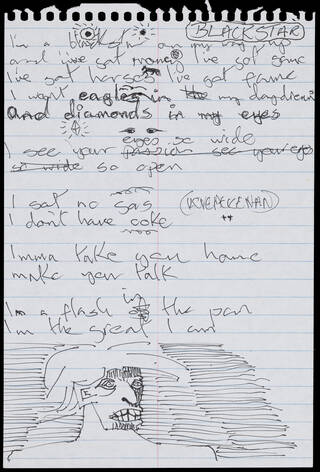
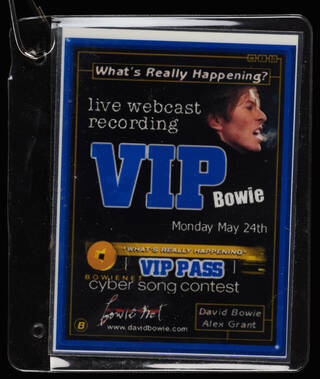
However, with the dawn of the internet, Bowie created one of the first formal fan-forum-cum-social-networks, where performer and fan could meet. Inspired by the possibilities of the internet, and by early 90’s rave culture where “the audience is at least as important as whoever is playing at the rave”, BowieNet was to be “…a single community where vast archives of music and information could be accessed, views stated, and ideas exchanged”. Graphic design for the site, as seen on its merchandise, focused on the visual metaphor of a complex solar system of discourse. Bowie himself regularly posted on the site under the pseudonym ‘Sailor’, becoming well known for his wry comments. He performed exclusive shows for BowieNet members and, in 1999, held a Cyber Song Contest where fans could send in lyrics and compete to co-write the song What is Really Happening. The competition was won by 20-year-old Ohioan, Alex Grant, and the finished song featured on the album Hours.

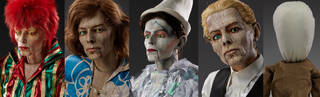
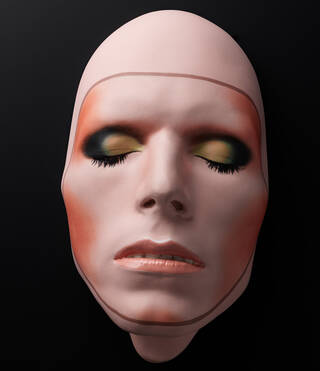
The David Bowie Archive reveals further circular exchanges of creativity between artist and fan. Bowie kept himself informed of artworks made in his image, such as contemporary artist Mark Wardel’s painted plaster masks of Bowie. Wardel said, “I had a message that Bowie’s New York office wanted my contact details. I thought I was about to be told to stop making the masks however, it turned out that Bowie himself wanted to buy two of them for inclusion in his official archive”. These masks are now, indeed, part of the archive, and Wardel’s work has become part of the Bowie canon.
The Archive portrays an artist with a keen sense of legacy, and an almost obsessive completionism. Bowie documentarian Brett Morgan sums it up, “People know he was a collector of personalities, but he was just a collector. He’d saved everything. He was a bit of a hoarder”. While Bowie did keep a huge amount of material, over the decades lots of memorabilia made it into the hands of fans, collectors and auction houses. The archive contains multiple examples of Bowie seeking out and purchasing back memorabilia, such as a hastily notated Christie’s auction catalogue proclaiming 'Got it!' next to a listing for a rare early studio recording of the song Star. Bowie was intentional about building a full, rich archive of material for the next generations of artists, designers, performers, writers, and musicians.
This vast archive is not only a final gift to fans, but a document of an extraordinary relationship between fans and artist. Before a time of Instagram Live, Reddit AMAs and direct messaging, Bowie set the precedent for a synergetic, collaborative atmosphere of fandom. Perhaps one of Bowie’s greatest skills as a performer was to make every fan feel like they were a friend.
The material featured in this article is housed at V&A East Storehouse and can be viewed online or ordered in-person via either Explore the Collections or Search the Archives.
Visitors can explore the collection in person by scheduling advance appointments with the Archives team. Paper-based material is available to view on Thursdays and Fridays only, between 10.00 – 17.00.
Find out more about the David Bowie Centre.