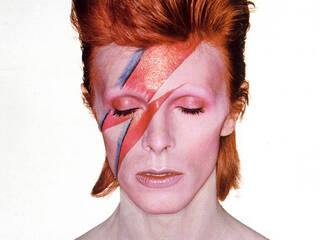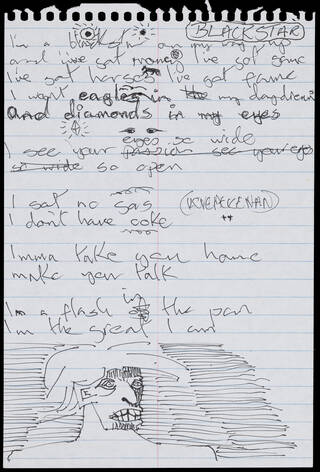
He made Blackstar for us, his parting gift.
David Bowie released his final album Blackstar on 8 January 2016 on his 69th birthday, two days before his death. Many people have been intrigued about the creative process behind Blackstar and what Bowie believed would come after. Was he working on anything else at the same time?
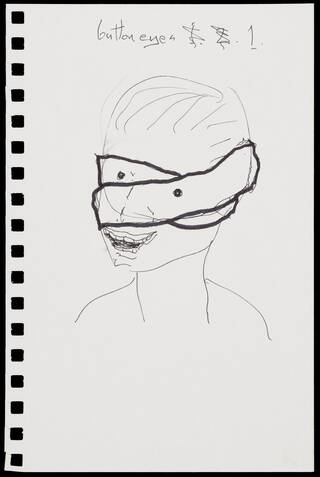
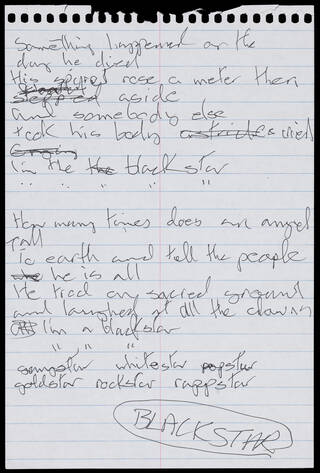
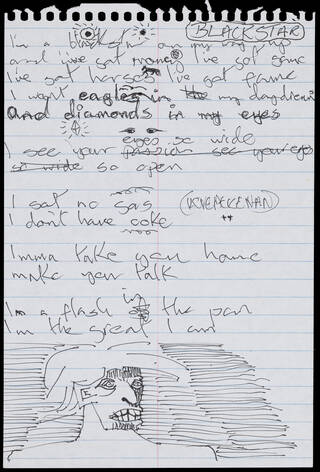
The David Bowie Archive contains hundreds of handwritten notes, lyrics, illustrations, and scripts that were central to Bowie’s musical and theatrical projects. Through these materials, it is possible to see how his creative process adapted over time. What is interesting about Blackstar is Bowie’s return to handwritten lyrics and drafts. In the 1990s, his draft lyrics tended to be typewritten, and he was particularly fond of the Verbasizer sentence generator as a songwriting device – a digital app he co-created with Ty Roberts, Bowie's technical collaborator and former Chief Technical Officer of Universal Music Group. However, the Blackstar project files are full of Bowie’s handwritten lyrics, drawings, and notes – much like the project files of his first releases.
The archive also holds material which was labelled ‘unrealised projects’ while it was still in Bowie’s ownership. This includes well-known projects such as his musical adaptation of Nineteen-Eighty-Four, which evolved into the Diamond Dogs film, both of which contributed to the development of the Diamond Dogs album. There is also material relating to the Young Americans film, written at the same time as the Young Americans album, and to The Leon Project, an ambitious multi-media project, created alongside Brian Eno and Andre Heller, that explored similar themes as those on the album 1. Outside.
Bowie was never settled working on just one project. So, whilst Blackstar was his final masterpiece, there are glimpses of other projects that he was working on during this time. Whilst cataloguing material in 'unrealised performances', an undated set design was discovered...
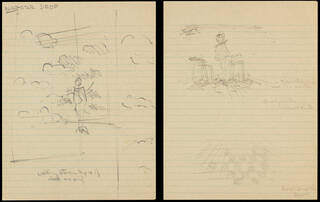
The sketch includes the annotation ‘Blackstar’, and features a figure dressed in the striped costume Bowie wears in the Lazarus video, a direct reference to an iconic 1974 costume comprising blue trousers and a cropped shirt, painted with diagonal white stripes. The annotations suggest the inclusion of a forced perspective floor (an optical illusion that makes an object appear further away, closer, larger or smaller) and a solo figure walking between layers of clouds, perhaps a nod to the themes in the music videos released with Blackstar.
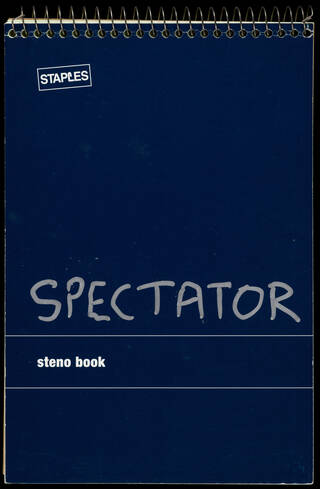
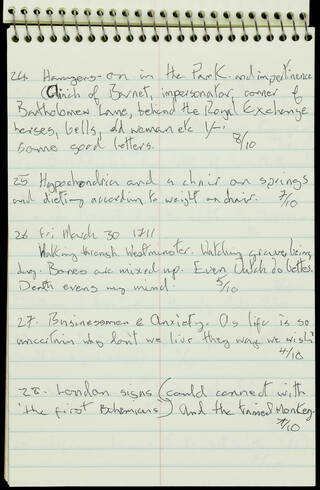
At the same time, Bowie was working on a project called The Spectator. Thanks to information from Bowie’s team, we know that The Spectator was an evolving idea for a musical that he was working on in 2015. The musical is set within the criminal underworld of 18th-century London, and features historical figures such as Jack Sheppard, a prolific thief and prison escapee, and Jonathan Wild, a thief-taker who ran a significant criminal empire. Additional context is drawn from the Age of Enlightenment and developments in science and philosophy, with reference to artists William Hogarth and Sir Joshua Reynolds, and the establishment of Molly Houses at the time, which were meeting places for LGBTQ+ men and gender-nonconforming people. Although never realised, the research and rough outlines of themes and plot structures allows us to explore Bowie’s initial plans for the project and we can clearly pinpoint how he began his creative process.

Similarly, Bowie’s creative process for The Spectator can be seen in the series of hurried notes and post-its, each outlining his intentions for the project. We do not know what order the post-its were organised in, but it is interesting to see the different narrative devices and themes he wanted to portray. We don't know what sparked Bowie’s interest in this historical period, or in the renowned criminal and prison escapee Sheppard, but it is incredible to gain insight into his creative process and inspiration.
Sheppard was a popular character in 18th-century London. He had a strong following and community who helped him escape from prison multiple times, and hundreds paid four shillings each to visit him in his cell. He was so popular that his execution was attended by 200,000 people, and the route to his execution was reportedly lined by women dressed in white who threw flowers and cried, in a similar fashion to the women referenced in the Blackstar lyrics ('On the day of execution, only women kneel and smile'). According to legend, Sheppard had planned one last daring escape, due to take place during his execution, but in an attempt to give him a quicker and less painful death, the watching crowds pulled his legs as he was hanged.
Bowie had a great interest in dystopia and the heroes that arise from the injustice – Major Tom, Halloween Jack, and Ziggy Stardust all exemplify this. It is possible that Sheppard had fascinated Bowie in the same way. Perhaps Blackstar and The Spectator impacted each other – would one exist without the other? Would Bowie’s musings about mortality that feature on Blackstar be any different if he had not encountered the world of Jack Sheppard? Or did these themes draw him to this historic tale? We may never know, but these projects serve as a testament to Bowie’s commitment to creativity and his artistic legacy.
This part of the collection includes sketches, designs, writings, lyrics, press cuttings, books, and photographic prints. The catalogue is structured thematically, and you can find brief descriptions of the content you will find in each file.
Visitors can explore the collection in person by scheduling advance appointments with the Archives team. Paper-based material is available to view on Thursdays and Fridays only, between 10.00 – 17.00.
Find out more about the David Bowie Centre.