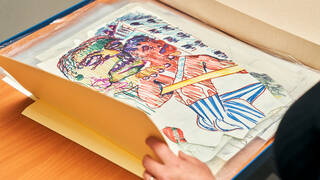
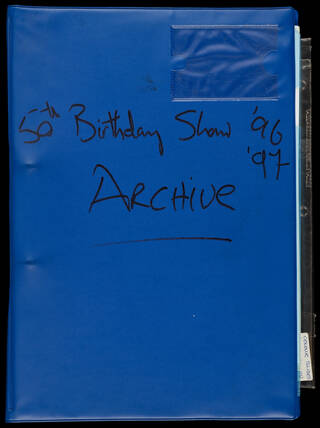
Bowie referred to his collection as the ‘archive’ and we can see it in his own handwriting on items within the archive, including on the cover of a blue folder. The folder contains lyrics and notes for David Bowie and Friends: A Very Special Concert – a gig at Madison Square Garden in New York organised by Bowie to celebrate his 50th birthday. Bowie wrote the gig name and date on the front and presumably added ‘archive’ to indicate where it should be stored.
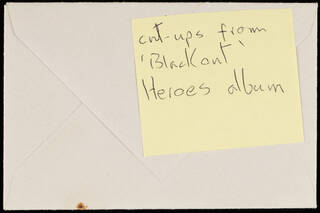
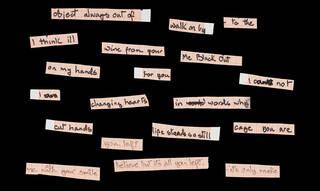
We also see it in a series of hand-written post-it notes in Bowie's handwriting dispersed throughout the archive that explain the significance or provenance of individual items – including a note left on the back of an envelope that identifies the contents as ‘cut-ups from 'Blackout’ Heroes album’.
The David Bowie Archive is a record of Bowie’s professional life. Likely intentionally, it does not contain records about David Jones, the private individual behind Bowie’s public personas. The largest sections of the archive are photographic sessions of Bowie the star – hundreds of boxes of press cuttings spanning his entire career from over 50 countries – and the project files relating to his albums, tours, television appearances, and films.
Despite this, it is tempting to look for the ‘personal’ within the archive – traces of David Bowie / David Jones himself – the person behind the persona.
Bowie’s photographs
There are tantalising glimpses of more personal material within the Bowie archive. For example, there are a small number of photographs taken by Bowie himself, including a file of photographs taken while he and his wife Iman visited South Africa in 1995. Although there for work – Bowie and Iman were photographed by American Vogue in Cape Town, and Bowie reviewed the first South African Biennale in Johannesburg – there are also photographs by Bowie of local landscapes and interesting finds.

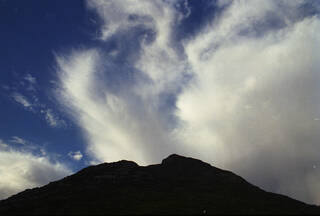
We get a sense of someone having fun, someone enjoying the landscape – but the bulk of these photographs are images of the Johannesburg Biennale, Bowie’s work visit.
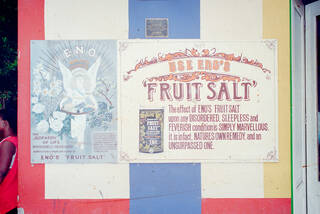
The archive also contains ‘backstage’ photographs taken by Bowie behind the scenes of his public appearances. A series of polaroids annotated in Bowie’s handwriting from his 50th birthday concert include images of his dressing room and band.
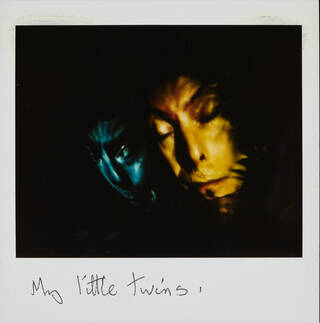
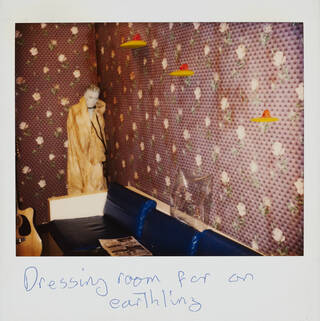
Bowie's annotations offer insights into a man with a sense of humour. For example, the note that says ‘Dressing room for an earthling’, and another which shows a cake alongside the annotation ‘And eat it too!’. In another note, Bowie described Tony Oursler’s puppets somewhat irreverently as ‘my little twins’. However, there is a question as to whether Bowie took the polaroids himself – they are in the archive, but unattributed, stored among photographs by another photographer. Are we seeing the world through Bowie’s eyes – or someone else’s?
Bowie in costume
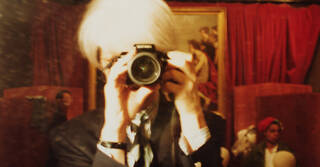
A particularly intriguing pair of photographs in the archive feature Bowie in an apparent mirror-selfie styled as Andy Warhol in Julian Schnabel’s Basquiat (1996).
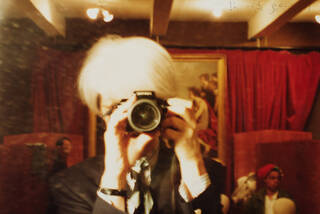
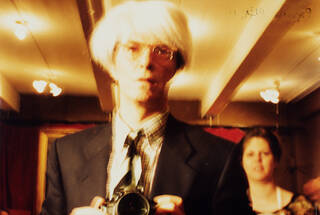
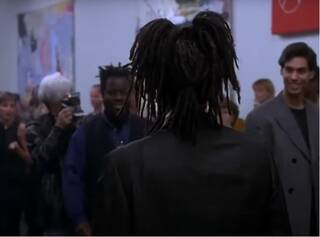
Could it be that these images were Bowie’s personal response to his appearance in costume as Andy Warhol? A man he had met in a reportedly awkward meeting and named a song for (1971’s Andy Warhol, released on the album Hunky Dory). Are they really off-the-cuff mirror selfies of Bowie in costume – or are they a deliberate emulation of the famous photographs of Andy Warhol taking selfies? In a nod to Andy Warhol’s ever-present camera, there is a scene in Schnabel’s Basquiat in which Bowie’s Warhol can be seen in the background taking a polaroid photo, spending the rest of the scene clutching the polaroid while talking to Jeffrey Wright’s Basquiat. Is our photo, perhaps, a practise shot for that scene?
The search for personal material within the David Bowie Archive offers many hints about his own experiences or feelings, but perhaps raises more questions about what the material is really telling us.
Bowie’s level of fame is such that fans feel – and perhaps expect – a level of personal closeness to the man behind the persona. Unprecedented numbers of people visited the V&A’s exhibition, David Bowie Is, in 2013. When Bowie died, there was an unexpectedly wide-reaching outpouring of public grief. And when the David Bowie Centre opened in September 2025, tickets sold out within less than a day. The extensive fan section of the archive – complete with letters, art, and books sent by fans to Bowie over several decades – is testament to this.
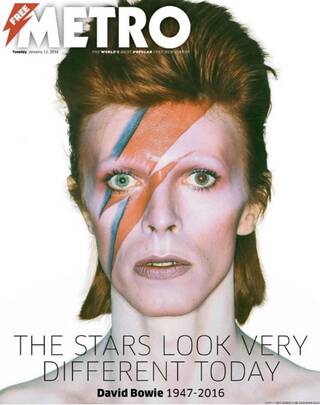
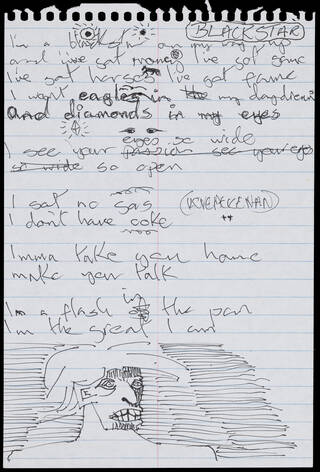
But the truth is that the archive doesn’t reveal much about the man behind David Bowie, Ziggy Stardust, and the Thin White Duke. It reveals so much about Bowie’s creative processes and the work that went into producing his albums, but that’s where it stops. The final song on Bowie’s final album, Blackstar, is titled I Can’t Give Everything Away, and perhaps the lack of personal material in the archive is the final expression of this – while the public now has unprecedented access to records of Bowie’s professional life, some things are too personal to be shared.
Browse the catalogue for paper-based material in the David Bowie Archive, including everything mentioned in this article.
This part of the collection includes sketches, designs, writings, lyrics, press cuttings, books, and photographic prints. The catalogue is structured thematically, and you can find brief descriptions of the content you will find in each file.
Visitors can explore the collection in person by scheduling advance appointments with the Archives team. Paper-based material is available to view on Thursdays and Fridays only, between 10.00 – 17.00.
Find out more about the David Bowie Centre.