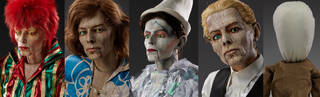
Puppets became a recurring motif in Bowie’s music videos and live performances, with some even being reused for different projects over the years. They often accompanied themes of the passage of time and of the many personas the prolific artist embodied, creating an uncanny crossing of worlds where the many sides of David Bowie could meet.
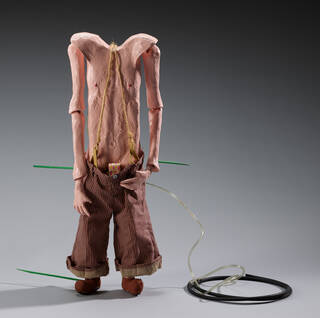
And then again, sometimes they were used for pure spectacle. A puppet in the Archive, a small, headless papier-mâché construction, was used as a costume for Bowie’s notorious 1979 performance on Saturday Night Live. Remarkable for its originality, style and daring, the performance remains one of the best in the television programme’s history – due in no small part to this puppet designed by Bowie and made by his long-time collaborator Mark Ravitz. In cataloguing the puppet, we discovered the air pump mechanism by which a strategically placed party-blower could be inflated, as well as two spare pairs of trousers in different fabrics.

In Bowie’s initial design sketches, we can see his plans to use chroma key technology (also known as green or blue screen) to enable the show’s editors to transform him, for the viewer at home, into a human-headed marionette. He operated the limbs himself whilst performing Boys Keep Swinging, providing a bizarre and rather dextrous performance. Bowie safely predicted to his backing singers Klaus Nomi and Joey Arias before the show, “People are gonna freak out when they see this”.
It was not so long before this performance that Bowie was introduced by John Lennon to The Uncle Floyd Show. The programme was a low-budget television comedy featuring various salvaged and homemade puppets. It found avid fans not just in Bowie and Lennon, but other rockstars like Iggy Pop and The Ramones. Bowie recollected, “I knew so many people of my age who just wouldn’t miss it. We would be on the floor it was so funny. Two of the regulars on the show were Oogie and Bones Boy, ridiculous puppets made out of ping-pong balls or somesuch… I just loved that show”.
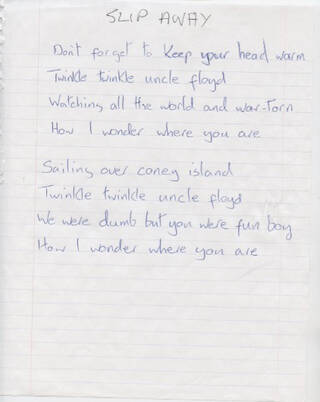
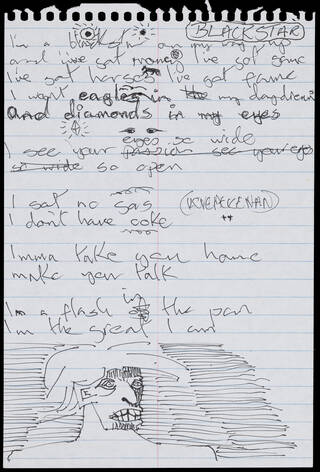
Indeed, he loved it so much that he attended a live performance of The Uncle Floyd Show in New York in 1981, insisting on meeting the host backstage. Many years later, he also wrote a song about Uncle Floyd: Slip Away, from his 2002 album Heathen. The handwritten lyrics for the song in the Archive mention Floyd and his puppets by name, and reminisce on good times past. “For me it was a fun time, the late ’70s, it really was. …. Saying ‘Uncle Floyd where are you now?’ is really like Ray Davies saying ‘Where Have All The Good Times Gone?’ So yes, that’s my yearning song, as far as looking backwards. But most of it is about looking rather anxiously into the future.”
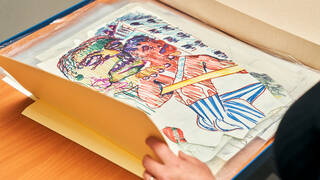
The cast were touched by the tribute, and sent Bowie a letter which included the above sketch. Floyd described Bowie as, “An artist, in the fullest sense of the word. He loved everybody who was off the path”.
Another artist Bowie admired who treads an unconventional path is multimedia installation artist Tony Oursler. In the mid-1990s, the pair developed a friendship after Bowie became fascinated with Oursler’s method of projecting video imagery of human faces onto sculptures and puppet-like forms. Oursler calls these works ‘electronic effigies’, and Bowie would describe them as “really very, very strange. I’m a huge fan of his work”.
Bowie commissioned Oursler to create several of these works as stage props for his 50th birthday concert in 1997, including a small, faceless ragdoll. Simple in construction, the doll was made of cloth stuffed with wadding and styrofoam. However, during the concert its unassuming form was magically transformed as Oursler’s projectors beamed Bowie’s pre-filmed face onto its head.
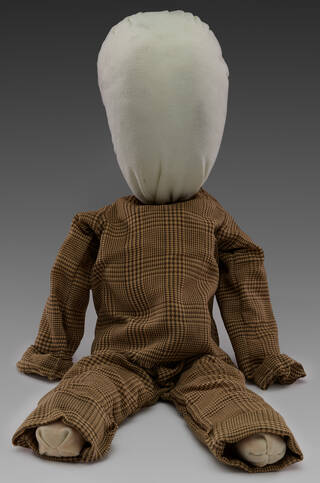
Related material in the Archive – such as Bowie’s concept sketches and a live photograph by Kevin Mazur – give us insights into Bowie’s vision for how the puppet would be incorporated into the show’s choreography, from the design stage through to performance.
Another puppet documented in Bowie’s sketches and created by Tony Oursler for the 50th birthday concert is the 'pair of twins’. Interestingly, it was reused years later in 2013, for the Where Are We Now? music video. More pensive than the puppet’s playful debut at Madison Square Gardens in New York, the video was filmed by Oursler in his home studio. The puppet sat on top of a suitcase and featured the projected faces of a solemn David Bowie and the painter Jacqueline Humphries, Oursler’s wife. It was released on Bowie’s 66th birthday. Speaking of the clip, Oursler said, “It’s themed on his time in Berlin, but there’s a sense of loss, you know the way time just sheers off whole existences and there’s the feeling of the profundity of moving forward over decades, and how certain things are lost and certain things are retained”.
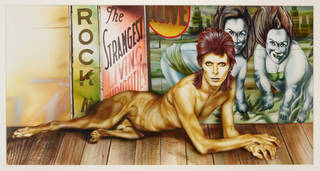
Collaborations between Bowie and Oursler were many. The mind-bending music video for Little Wonder, directed by Floria Sigismondi, contains multiple ‘electronic effigies’ by Oursler. One of these is a sculpture resembling a mummified dog. In the video, footage of Bowie’s face is projected onto the creature – a device similar to that used on the album cover for 1974’s Diamond Dogs. Whether this throwback was intentional or not we do not know.

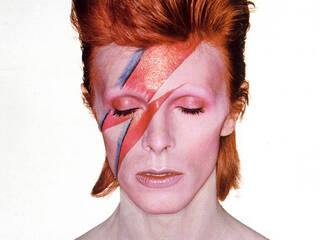
The relationship between Bowie’s use of puppets and the examination of his own passage through time recurred in multiple performances and music videos. Perhaps the most striking examples in the Archive are the four life-sized marionettes. Made by master craftspeople at Jim Henson’s Creature Shop, they resemble David Bowie at various stages of his musical career; each dressed respectively as Ziggy Stardust, the Thin White Duke, The Man Who Sold the World, and the Pierrot clown from the Ashes to Ashes music video. Each puppet is fully functional – complete with controls to rotate their eyes and open their mouths. While predominantly made of fibreglass and foam, their faces and hands retain the wood grain texture of the timber they are carved from, giving them a handmade aesthetic which makes their uncanny resemblance to Bowie all the more eerie.
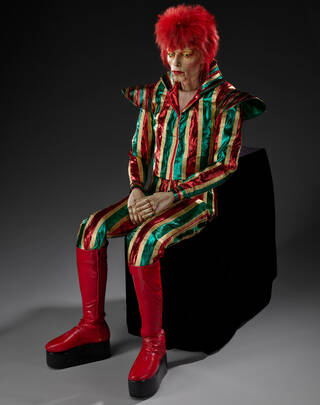

Bowie commissioned them in 1999 for the music video for The Pretty Things Are Going to Hell. However, he didn’t approve the video for release as he considered the result too “funny” and not “dark” enough. On-set photographs in the Archive reveal images of Bowie being followed and attacked by the puppet figures within a theatre. These behind-the-scenes glimpses illustrate biographer Nicholas Pegg’s interpretation that the video would “appear to represent one of Bowie’s most pressing concerns as an artist: the constant struggle to avoid being overwhelmed by his own past”.

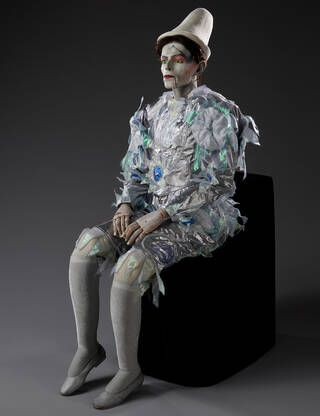
Despite the video being shelved, Bowie stored the marionettes for 14 years before using the Thin White Duke and Pierrot versions in his music video for 2013’s Love is Lost (Hello Steve Reich Mix). Directed by Bowie himself and featuring Tony Oursler-style projections, the video is certainly dark, with its chiaroscuro (dramatic, contrasting) lighting and ominous puppets staring from mysterious doorways. Echoing the themes of future and past, Bowie’s projected face on the Pierrot clown sings:
Your country's new, your friends are new
Your house and even your eyes are new
Your maid is new and your accent, too
But your fear is as old as the world.
However, the sense of “being overwhelmed by his own past”, which is revisited in this video, is accompanied by a gentleness and compassion too: the Thin White Duke can be seen cradling Pierrot in his arms, as if to comfort the clown, or as if in mourning. Bowie himself strikes the same pose in an on-set photograph by Jimmy King.
Bowie alluded to this need for empathy for one’s own past in a 1990 interview when he said, “You have to accommodate your pasts within your persona. You have to understand why you went through them. That’s the major thing. You cannot just ignore them or put them out of your mind or pretend they didn’t happen or just say, ‘Oh I was different then’”.
Learning more about the tireless artist, David Bowie, has been an exercise in learning more about all the David Bowies there were. Not only the many famous and beloved personas, but also the collaborator, the advocate for other artists, the designer, the childlike lover of puppetry, and the human being aware of the passage of time. Beyond the eccentric and surprising visual performances, Bowie’s puppets inadvertently offer a sense of empathy – for others, as well as for our many selves (whether we choose to have bespoke marionettes made to represent them or not!). In a timeline where all the characters we have been could meet face to face, what would they say, and what could they do?
The material featured in this article is housed at V&A East Storehouse and can be viewed online or ordered in-person via either Explore the Collections or Search the Archives.
Visitors can explore the collection in person by scheduling advance appointments with the Archives team. Paper-based material is available to view on Thursdays and Fridays only, between 10:00 – 17:00.
Find out more about the David Bowie Centre.