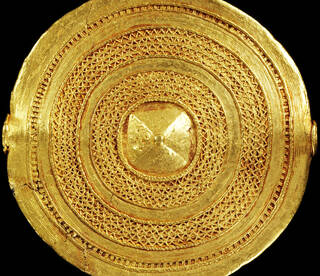
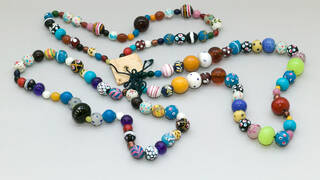
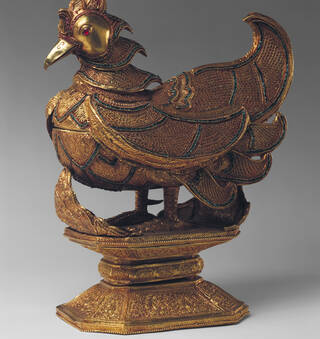
Objects looted at Maqdala, or otherwise collected during the course of the expedition, can today be found in the V&A collection along with photographs, drawings and archival material relating to this period in Ethiopian and British history. The museum also holds a small amount of Ethiopian material unrelated to the events of 1868, including a selection of Ethiopian paintings from the 1940s.
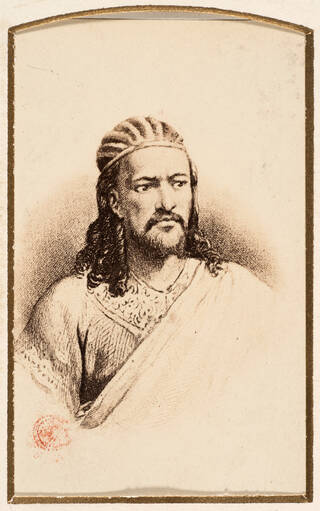
The 1867 – 68 expedition and the looting of Maqdala
Following his coronation as Emperor of Ethiopia in 1855, Tewodros II made attempts to establish an alliance with Britain. He wrote letters to Queen Victoria in 1857 and 1862, requesting British military assistance. In 1863, after these letters had gone unanswered, the Emperor took hostage around 30 European diplomats and missionaries who were stationed in Ethiopia at that time.
After failed diplomatic attempts to secure the release of the hostages, a large-scale British military expedition was launched from Bombay, India, in October 1867. The expedition was led by General Sir Charles Robert Napier, and comprised around 12,000 British and Indian troops.
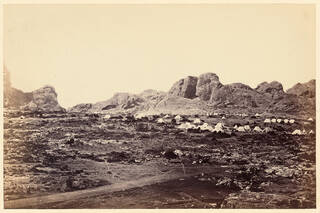
In April 1868, the expedition reached Tewodros’ fortress at Maqdala, in Ethiopia’s northern highlands. The British army’s overwhelming firepower resulted in heavy casualties on the Ethiopian side, while the British troops sustained almost none.
On 13 April, Napier’s forces launched the final attack on Maqdala that saw Tewodros’ armies entirely defeated. The Emperor took his own life. The British Army then ransacked the fortress and the surrounding area, laying claim to many Ethiopian manuscripts, sacred objects from the Ethiopian Orthodox Tewahedo church, and many other items of value. The loot from Maqdala was transported to the Talanta Plain around ten miles away, where a week later the army held its so-called ‘prize’ auction, an officially-sanctioned process through which treasures amassed from Maqdala were sold to raise funds, which were then distributed amongst the officers and troops.
Shortly after this episode, the V&A began to acquire Ethiopian material, and continued to do so throughout the late 19th and early 20th centuries. Some of these objects are known to have been amongst the loot from Maqdala, such as a selection of objects purchased at the Talanta plain auction by Major Trevenen James Holland, or items recorded as having been looted at Maqdala by Colonel Arthur William Macnaghten of the Bombay Cavalry.
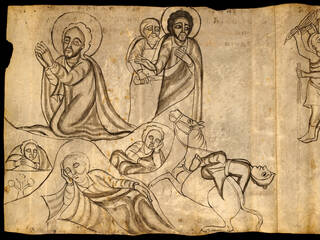
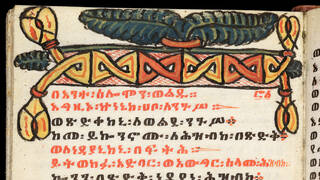
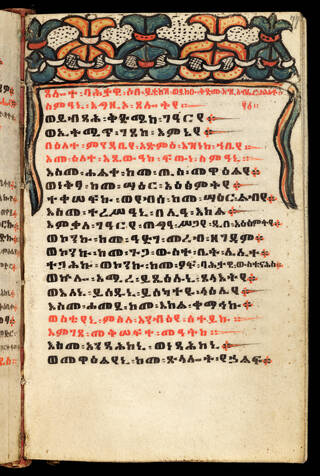
In the case of an Ethiopia Psalter or book of Psalms in the V&A’s National Art Library, although we do not know exactly how it was brought from Ethiopia to Britain, it was recorded in the museum’s inventory as having come from a ‘church at Maqdala’. This assertion is confirmed by a passage within the text itself, which also states the manuscript was written by the Ethiopian scribe Aleka Zeneb, secretary to Emperor Tewodros.
However, not all Ethiopian objects in the V&A collection have clear provenance: that is, information about the chains of ownership or appropriation that eventually brought them into the museum. Today, when assessing potential additions to our collections, our curators seek to find out as much as possible about their ownership histories before objects are ‘accessioned’ or formally acquired by the museum. However, for earlier generations of museum professionals, making such enquiries and keeping records of such details were not always part of established practice when acquiring objects. This leaves us with crucial questions about the provenance of some of our collections, some of which we hope to address through further research, and others to which we will likely never have a definitive answer.
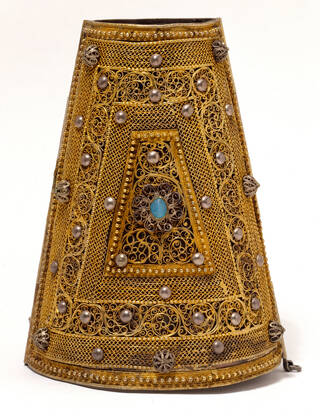
Despite these lingering uncertainties, there are some objects for which we can make an educated guess that they most likely came to the museum as a result of the 1867 – 68 expedition. For example, an Ethiopian censer was purchased by the museum in 1870, while two honorific armlets arrived at the India Museum (whose collections would later be transferred to the V&A) in 1873. These acquisition dates, occurring so soon after the events of 1868, strongly suggest a connection between these objects and the British army’s presence in Ethiopia a few years earlier: either directly as loot from Maqdala, or otherwise acquired during the course of the expedition to and from the Emperor’s fortress. That the majority of the V&A’s Ethiopian holdings appear to be linked with the events of 1868 is a reflection of the broader historic collecting practices through which African material culture was acquired by the museum in its earliest decades, with African objects tending to be opportunistically acquired as a result of British military activity rather than through dedicated curatorial efforts to develop the museum’s African collections.
The crown and chalice
Two of the most famous objects looted from Maqdala are today in the V&A collections: a solid gold chalice and a gold crown, both sacred items from the Ethiopian Orthodox church. Ethiopia is one of the world’s oldest Christian countries, and material associated with its church was especially sought-after by museums, libraries and private collectors who saw the 1867 – 68 expedition as an opportunity to enrich their collections.
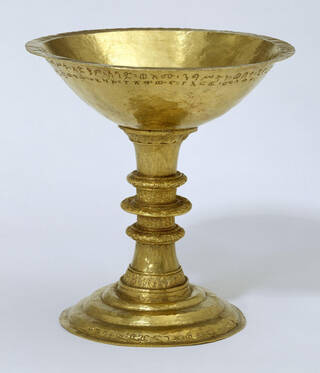
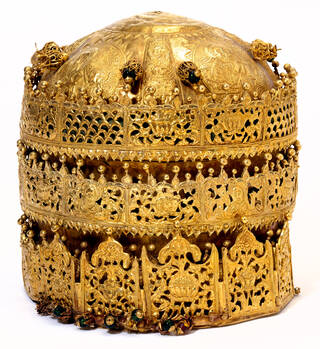
The provenance of the crown and chalice, both before and after the events at Maqdala, is particularly well known to us. This is in part due to inscriptions on the chalice itself, written in the ancient Ethiopian language Ge’ez. These inscriptions tell us that the chalice was made by a goldsmith named Walda Giyorgis, and given to the Church of Our Lady of Qwesqwam, near Gondar, as gifts from the Ethiopian Emperor Iyyasu II (who ruled from 1730 to 1755), and his mother Empress Mentewwab. It is thought that the gold crown now in the V&A collection formed part of the same gift.
In the early 1860s, Tewodros seized objects from other Ethiopian towns and churches during his military campaigns, particularly in Gondar, as part of his efforts to establish a treasury and church at Maqdala. The crown and chalice were amongst the objects taken by Tewodros and brought to Maqdala for this purpose.
In April 1868, the crown and chalice were looted from the treasury at Maqdala by a British soldier, before being spotted by Richard Rivington Holmes, an assistant curator at the British Museum who had been sent to accompany the expedition. Holmes hoped to acquire the crown and chalice for the British Museum’s collection. However, after their arrival in Britain, a prolonged disagreement ensued about whether the items would be purchased from the army by the UK government. This led to a parliamentary debate in 1871, where British Prime Minister William Gladstone famously argued that these sacred objects should never have been taken from Ethiopia.
The crown and chalice were eventually loaned to the South Kensington Museum (later renamed the Victoria and Albert Museum) by H.M. Treasury in 1872. They remained on loan to the museum from the government for over 100 years, until the passing of the 1983 National Heritage Act ultimately led to their compulsory transfer into the museum’s permanent collection in 2005. A large silver cross and an Ethiopian shield, originally on loan to the museum from the Lords of the Admiralty, became part of the V&A collection for the same reason.
In 2007, the museum received a formal request from the Ethiopian government for the restitution of the crown and chalice. The museum is currently prevented from permanently deaccessioning objects from its collection under the terms of the 1983 National Heritage Act, but we welcome opportunities for further discussion about how the V&A might facilitate access to these items in Ethiopia.
Queen Terunesh’s dresses and jewellery
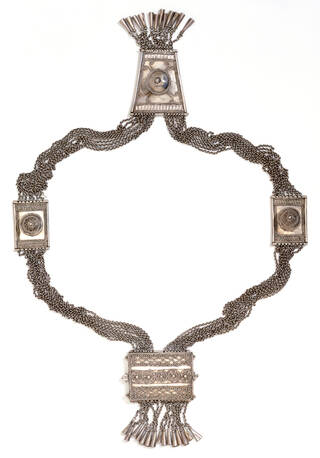
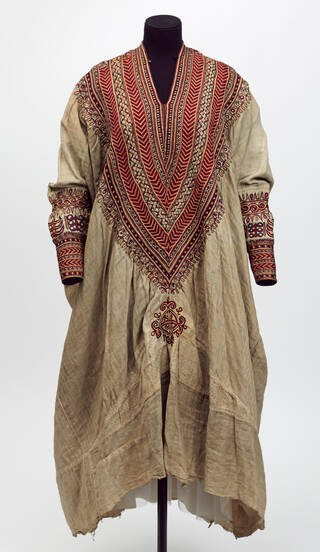
The V&A’s collections also include textiles and jewellery that belonged to Queen Terunesh, wife of Emperor Tewodros and mother of his son Prince Alemayehu. When Terunesh died just one month after her husband, a selection of her possessions was sent to the Secretary of State for India at the India Office in London and given to the South Kensington Museum the following year. The orphaned Prince Alemayehu, aged seven, was also brought to Britain, where he lived until his death in Leeds at the age of just 18.

Speedy, Rassam and Simpson
For other Ethiopian items in the V&A collection, their provenance has not been traced directly to the looting at Maqdala, but they are nevertheless linked to the 1867 – 68 expedition and to notable figures from this history. Three such figures are Captain Tristram Charles Sawyer Speedy, Hormuzd Rassam and William Simpson.
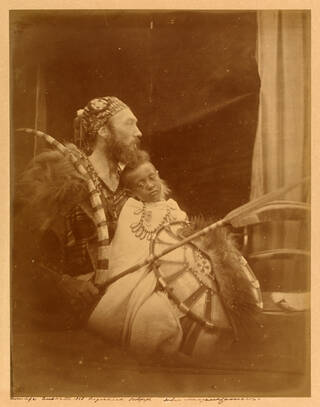
Speedy, a British army officer and explorer, visited Ethiopia from 1861 – 62 and spent time at Tewodros’ court before returning with the 1867 – 68 expedition, on which he served as an interpreter. After Queen Terunesh’s death, Speedy acted as guardian to Prince Alemayehu during his initial years in Britain, and was famously photographed with the young prince by the English photographer Julia Margaret Cameron. When Speedy died in 1910, some of his possessions passed to his goddaughter Ida Perrin, who in 1936 gave the V&A a selection of Ethiopian objects from Speedy’s collection. Exactly how, or when during his time in Ethiopia Speedy acquired these items is not known.
Hormuzd Rassam was sent to Ethiopia in 1866 to negotiate the release of Tewodros’ hostages. He received gifts during his time in Ethiopia from Abuna Salama III (head of the Ethiopian Orthodox church), Menelik (then-King of the Shoa province of Ethiopia, who would later become Emperor Menelik II), and Tewodros himself, all of which were later given to the V&A. A bitäwa armlet in the V&A collection is the only known surviving gift from Tewodros to Rassam, since other gifts from the Emperor were confiscated when Rassam and the rest of his party were arrested and placed in the prison at Maqdala, joining the other hostages.
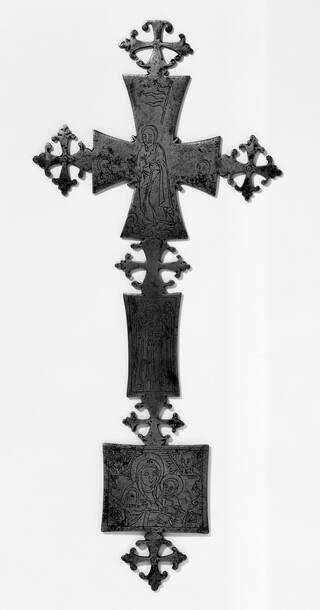
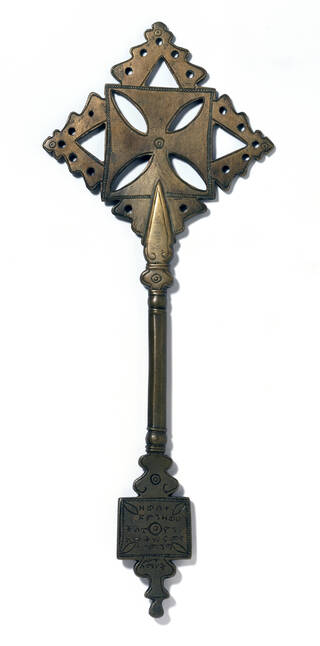
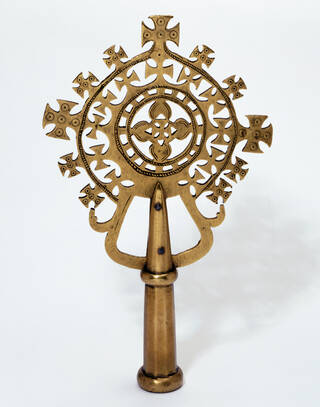
William Simpson was an artist and journalist sent to Ethiopia on behalf of the Illustrated London News to provide sketches for the newspaper's coverage of the 1867 – 68 expedition. Simpson did not travel on the outward expedition, instead joining the army around a week after the looting of Maqdala. He then accompanied the return march to Britain. During his journey with the army, he visited a church at Chelicut, where he purchased two hand crosses from an Ethiopian priest, demonstrating that the collecting of Ethiopian objects by British individuals took place not only at Maqdala itself, but also throughout the course of the expedition.
Displaying the Ethiopian collections
The first displays of Ethiopian material at the V&A, installed in the months following the looting at Maqdala in 1868, combined material from the museum’s collection with loaned objects from the Royal Collection which were presented as ‘trophies’ from the army’s defeat of Tewodros. By the mid-20th century, however, little Ethiopian material remained on display at the museum apart from the famous crown and chalice.
In recent decades, several temporary displays have allowed the V&A to bring more focus to the Ethiopian objects in our collections, exploring their provenance, and – for some items – the ongoing discussions and debates about their presence in the museum’s collection. The 2010 display Ethiopian Sacred Art showcased manuscripts and crosses from the Ethiopian Orthodox Church, while Terunesh’s possessions featured prominently in V&A Africa: Exploring Hidden Histories, a 2012 exhibition that highlighted the presence of previously-overlooked African material across the V&A’s collections.
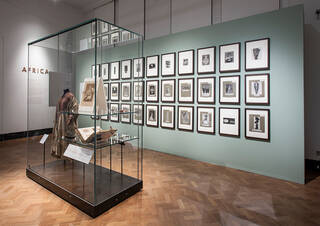
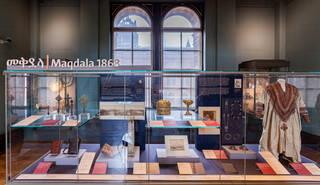
In April 2018, marking the 150th anniversary of the looting at Maqdala, the museum launched the temporary display Maqdala 1868. This display brought renewed focus to the provenance of the museum’s Maqdala collections, acknowledging the controversy that has surrounded their acquisition ever since their arrival in Britain, and the ongoing calls for their return to Ethiopia.
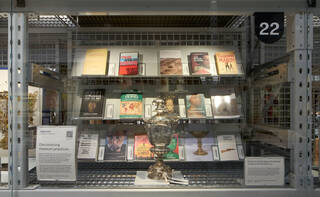
In 2020, the museum acquired the Maqdala Cup, an item of 19th-century presentation silver decorated with depictions of the burning and looting of Maqdala, reflecting how British military expeditions were championed through material culture in the 1870s. Its acquisition has provided opportunities to explore not only the reception of the events of 1868, but also wider questions about how the museum’s approach to colonial and imperial histories has changed over time. For the opening of V&A East Storehouse in May 2025, the museum’s staff-led Decolonisation Reading and Listening Group produced a display exploring responses to the cup and the histories it embodies, with over 100 group members participating in the co-curation process through a series of workshops.
Researching the provenance of our Ethiopian collections
Provenance research on all our collections is an ongoing process, and we are always seeking opportunities to deepen our understanding of objects and their histories. In 2025, the museum hosted a doctoral placement as part of efforts to confirm, clarify and accurately record (as far as possible) the provenance of Ethiopian objects in the V&A collections. This led to several new discoveries regarding previously unidentified or miscatalogued items that were found to have in fact come from Maqdala, and the records for these objects have now been updated in our Explore the Collections database. There are undoubtedly still further discoveries to be made and new insights to be gained. We welcome opportunities to collaborate and learn more about the collections in our care.