A spectacular sword from the Shōgun of Japan
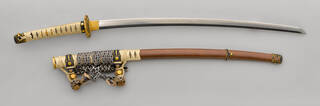
In the 19th century, the penultimate Shōgun of Japan (a hereditary commander-in-chief in feudal Japan) presented Queen Victoria with a diplomatic gift that included a magnificent Japanese sword, complete with a lacquered scabbard. The blade was made by Kazuhide and dates to 1860.
Traditional samurai sword blades are folded multiple times, hammering the hot steel into many layers – some up to thirty times! The result is an exquisite object of beauty and craftsmanship, of which no modern techniques can faithfully reproduce.
This particular sword has never been polished, so retains the intended finish – as was preferred at the time. Whilst this sword was most likely specially made to be presented as a gift, samurai swords are believed to contain the soul of their owners.
So, when ordinary diplomatic pleasantries simply won't do, a traditional samurai sword indeed makes an extravagant gift.
Beyoncé's butterfly ring
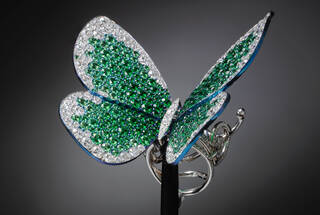
Designed by jeweller Glenn Spiro, this extraordinary butterfly ring features green tsavorites and diamonds, with spring-mounted wings that flutter as the wearer's hand moves. The ring is an exquisite example of naturalism in contemporary fine jewellery and certainly a conversation piece!
Spiro was once an apprentice for Cartier and held a keen passion for gemstones from a young age. His atelier is housed in the mirror-lined rooms that once belonged to royal couturier Norman Hartnell, in London's Mayfair, where he can continue to create incredible pieces.
The ring formed part of Beyoncé's personal jewellery collection and was donated to the V&A by the superstar musician and performer. It now sits among collections associated with iconic women, including Queen Victoria and Queen Elizabeth I. What a fantastic gift to receive!
The Beauharnais Emeralds
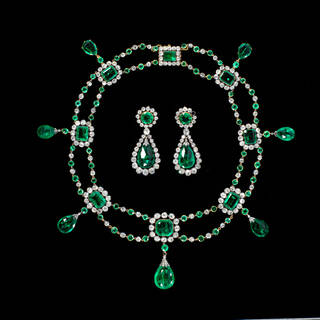
In 1806, Napoleon Bonaparte gave a spectacular collection of emerald jewellery to his adopted daughter, Stéphanie de Beauharnais, as a wedding gift on her arranged marriage to the heir of the Grand Duke of Baden.
The necklace was designed and executed by Napoleon’s court jewellers, Nitot & Fils. It is set with faceted table-cut emeralds in borders of brilliant-cut diamonds, suiting low cut dresses that were fashionable during Napoleon's era. In the 1820s, it was modified and extra drops were added to the back of the necklace. The drops could be detached and worn as earrings. It was captured in a portrait of Beauharnais, or "Princess Francais" as Napoleon nicknamed her.
The gems are a reminder that marrying into European royalty could involve considerably more than a set of towels or a tea set!
Snuffing out smallpox

In 1768, English doctor Thomas Dimsdale travelled to Russia to inoculate Catherine the Great, her son and members of the imperial court against an epidemic of smallpox. The inoculation was not just to help prevent the royal family contracting the disease, but to demonstrate to their skeptical subjects that it was safe and necessary to do so.
Despite anxieties predicting an angry mob attacking Dimsdale and his assistant, the inoculation proved to be a success. As a thank you, Catherine the Great made Dimsdale a Baron of the Empire, a Councillor of State, and Physician to Her Majesty and presented him with a princely sum of £10,000 plus an annuity and works of art. His son, Nathanial Dimsdale was also made a Baron of the Empire and gifted a vari-coloured gold snuffbox, encrusted with diamonds. The neo-classical decorated snuffbox forms part of the Gilbert Collection loans at the V&A.
Some people get a thank-you card – others get a title, a small fortune and a diamond-studded tobacco accessory.
The ultimate wedding gift
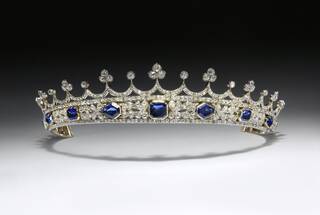
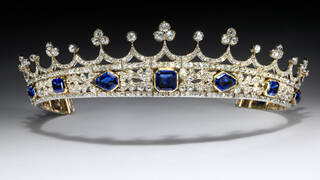
Prince Albert had the exquisite diamond and sapphire coronet made for Queen Victoria in 1840, their wedding year.
The couple famously shared a passion for extravagant jewels, and this lovingly designed crown sparked Victoria's keenness for matching sets. In the same year, she purchased a suite of diamond and sapphires, including earrings, a brooch and a bracelet – because why not have it all?
The design of the coronet was based on the Saxon Rautenkranz, recognised as Albert's coat of arms. The stones were thought to come from jewellery given to Victoria by King William IV and Queen Adelaide.
Forming part of the most iconic part of her jewels, Victoria favoured the coronet the most, a symbol of the enduring love for Albert, even after his death.