"Never mere accoutrements, his costumes and clothes were essential to his performances, creative vision, and wider self-expression, carefully designed to create a lasting visual and emotional impact that has reached across the generations and still reverberates today."
This trail is estimated to take around 35 minutes. Click on the map link for each stop to find the objects on our digital map.
Stop 1: The Flash ensemble + half mic, 1980
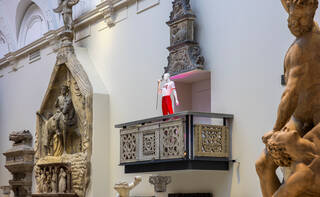
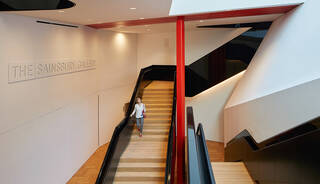
Look up at the balcony!
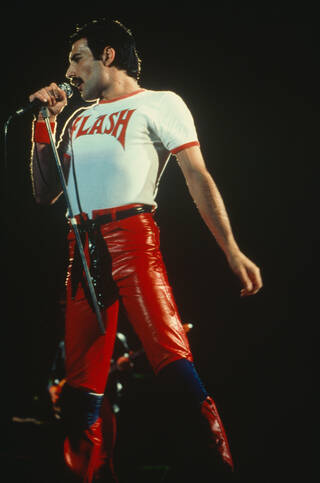
Flash Gordon, Queen's first and only soundtrack album, was created for the 1980 film of the same name. This look includes a red and white Flash T-shirt hand-drawn by Freddie. By this time his stage wear had shifted from '70s glam to simpler ensembles. This is also accompanied by a half-mic that had become synonymous with Mercury on stage.
Freddie captivated huge crowds with his mesmerising performances. Underneath the display of his playful superhero Flash ensemble are some powerful sculptural representations of Gods from antiquity, including Apollo, Zephyr and Narcissus. The costume is positioned within balcony panels for the Palazzo Pola in Florence, Italy, 1490. At the time, balconies like this were a show of status to the outside world.
Stop 2: The cloak and crown ensemble worn on the Magic Tour, 1986
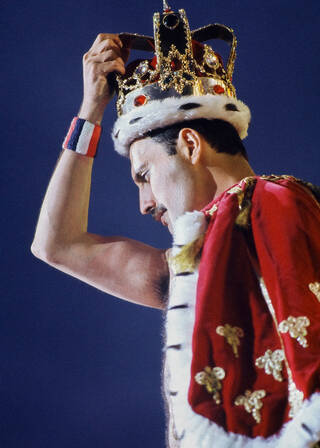
“I won't be a Rock Star. I will be a Legend”
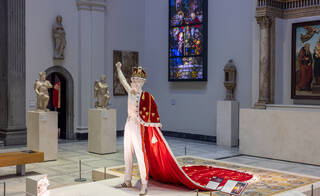
This cloak and crown ensemble was worn by Freddie for show climaxes on the Magic Tour. Freddie had commissioned the pieces from designer Diana Moseley, expressly looking for a costume that would finish off the shows in grandiose fashion. This look encapsulates the theatricality and humour of the loved performer.
Queen pioneered theatrical staging, building worlds through sound, light and spectacle. Freddie’s majestic crown and cloak are presented dramatically and playfully at the heart of the V&A’s epic Medieval and Renaissance galleries. Music flourished during the Renaissance, when new types of musical instruments developed and existing instruments were produced in ever greater numbers.
Stop 3: A jacket from the early 1970s and kimono, 1950 – 70, both from Freddie’s private wardrobe
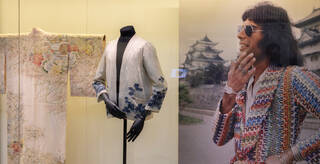
"If I’m dead and I want to be buried with all my treasures, like Tutankhamun, I’ll do it. If I want a pyramid in Kensington, and I can afford it, I’ll have it. Wouldn’t that be fab?"
The jacket was worn by Freddie for early Queen rehearsals and press shots. Made from kimono fabric, it demonstrates an appreciation of Japanese textile design. The kimono is one of a great many that Freddie acquired in Japan. Some were worn on stage but most, like this one, were part of his private wardrobe.
The V&A holds one of the world’s most comprehensive collections of Japanese art and design. Freddie’s fascination with Japanese culture began before he first visited the country in 1975. He went on to visit countless times, acquiring prints, furniture, ceramics and traditional textiles and kimono among other objets d’art. His home was a modern cabinet of curiosities, filled with the fruits of decades of collecting.
Stop 4: An ensemble worn at Imperial College gig, 1973
“The most important thing, darlings, is to live a fabulous life."
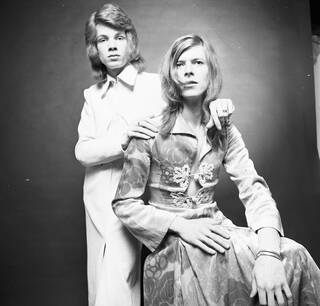
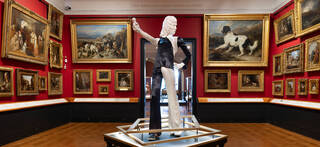
This is a monochrome two piece worn by Freddie at an early Queen show at Imperial College, London, neighbouring the V&A South Kensington. Queen would play and rehearse there in their early days. Characteristic of 1970s glam-rock fashion, this look reflects Freddie’s early experimentation with stage wear, identity and image making.
Echoing Freddie’s love of art, this costume is surrounded by a display of Victorian paintings and works by the Pre-Raphaelites – including an 1883 grand piano decorated in gold and silver from sketches by Burne Jones and Dante Gabriel Rossett’s painting, The Day Dream, 1880.
Stops 5 & 6: The 'Mercury Wing' catsuit and bolero ensemble, 1975; The ‘Spine Suit’ or the ‘Black Queen’ suit, 1975
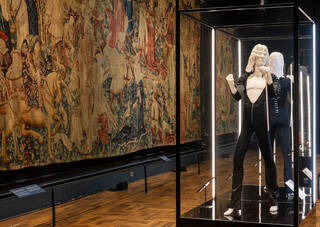
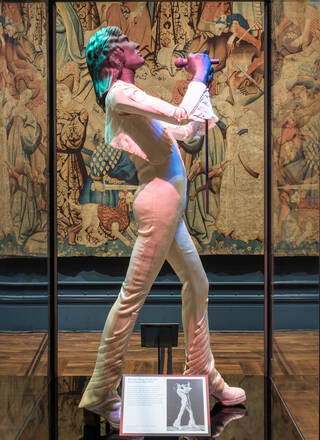
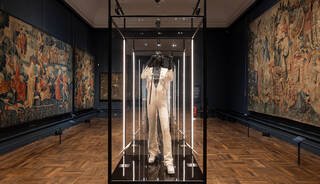
Inspired by the winged sandals of Gods Mercury and Hermes, designer Wendy de Smet incorporated wing motifs at the cuffs of the catsuit and bolero. Freddie worked closely with the designer on this commission, inspired by The Fairy Feller’s Master-Stroke, a painting by British artist Richard Dadd.
Another collaboration between Wendy de Smet and Freddie, the 'Spine Suit' has spikes down the sleeves signifying darkness, contrasting with the wings used in the 'Mercury Wing' suit.
Alongside the display of the white ‘Mercury Wing' ensemble and the ‘Spine suit’ is a unique, spatial audio reimagining of Queen’s Bohemian Rhapsody. This atmospheric sonic experience uses the original isolated recordings from 1975 and transports them into an ambient installation with the costumes and dynamic lighting.
Freddie had a passion for exquisite textiles and storytelling. The Tapestry Gallery displays some of the world’s most important medieval and Renaissance tapestries, depicting dramatic scenes of hunting and hawking, alongside the biblical story of Susanna and the Elders, which depicts the triumph of virtue over evil.
Stop 7: The ‘Made in Heaven’ music video costume, 1985
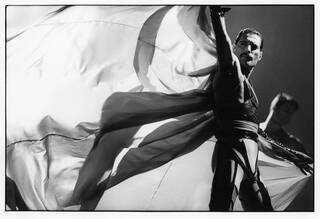
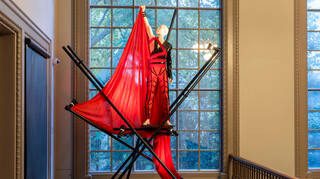
“You can do what you want with my music, but don't make me boring."
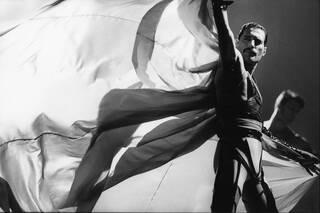
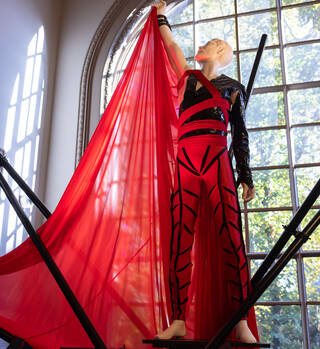
Created for the music video of the single Made in Heaven, this costume is inspired by Freddie’s love of dance, with references to The Rite of Spring and Dante’s Inferno. Freddie handpicked Diana Moseley to design his costume due to her experience designing for the stage. The ‘spider pants’, straps and cape all lend a superhero air to the costume.
Freddie was a master of image-making and reinvention, embracing new media like the music video. The V&A was the first museum to collect photography, and a display of vintage cameras can be seen next to his Made in Heaven costume. Adjoining galleries include cover-art photography for acts including Led Zeppelin (Freddie’s favourite band) and The Rolling Stones, as well as Annie Liebovitz’s images for the San Francisco AIDS foundation.