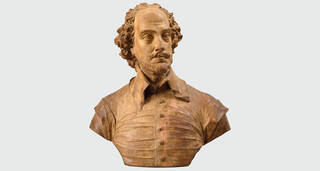
As well as animations, he directed his own films which won numerous international awards, including three BAFTAS (1994, 2009, 2011), a Palme d'Or (1979) and an Oscar nomination (1984). However, Emes’ work is most closely associated with the rock band Pink Floyd.
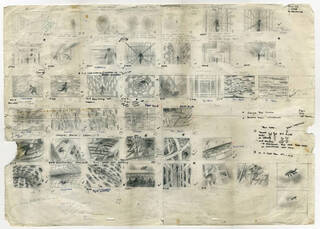
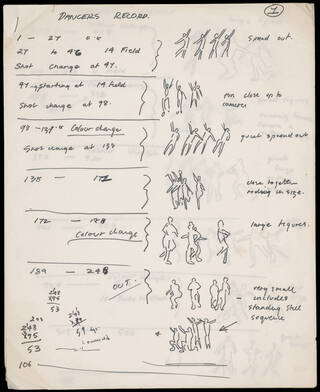
The experimental animation French Windows (designed 1971 – 72) is a visual interpretation of Pink Floyd's song One of These Days (released in 1971 on the album Meddle) – an instrumental track, containing a single dark-humoured lyric: "One of these days I'm going to cut you into little pieces" – a rare vocal from the band’s drummer, Nick Mason.
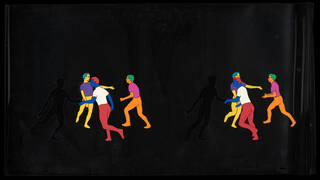
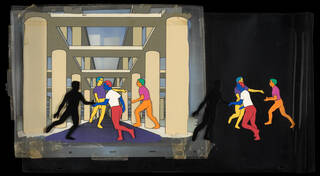
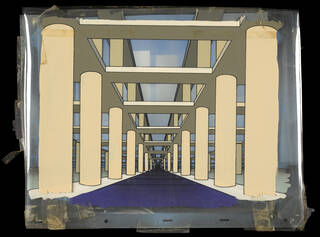
The video was produced by hand-painting gouache backgrounds and characters onto transparent cellulose sheets (cels) which were then overlaid to create scenes.
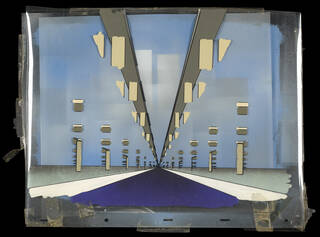
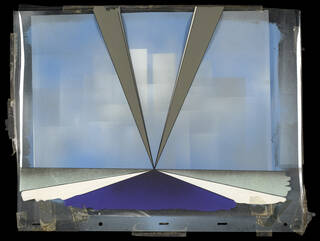
The film opens with a silhouetted figure in a bare, monochromatic room, seated next to a set of French windows, from which the piece takes its name. Emes then takes the viewer through these windows into a world that erupts with colour in which four figures dance against ever-changing backgrounds full of abstract architecture, geometric patterns and surreal spatial perspectives. Eventually, the opening silhouette falls through these psychedelic patterns into a cloudy night sky. The powerful opening and closing imagery appear to be a clear visual nod to the dream-like states of the lead characters in both The Wizard of Oz and Alice in Wonderland.
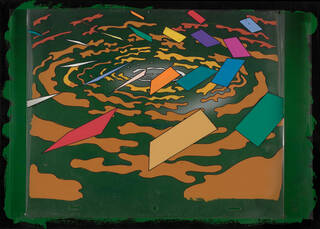
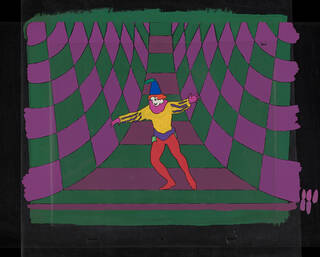
The striking visual imagery of French Windows encapsulates the psychedelic trends of the early 1970s in popular culture, and a wider legacy from historical artworks and movements. Emes studied Surrealism and Dadaism at the Birmingham School of Art, inspired by the works of Magritte, Dali, and De Chirico. Emes’ art, including French Windows, incorporates ideas from these artists, as well as the optical illusions and contradictory spaces of Escher. Emes’ experimental practice also looked to novel visual effects at the time, including Douglas Trumbull’s recent invention of the slit-scan in 2001: A Space Odyssey (Kubrick, 1968) to create futuristic, abstract landscapes of transcending time.
When aired on the BBC's hugely popular music show The Old Grey Whistle Test in 1972, French Windows caught the attention of Pink Floyd’s keyboard player Rick Wright. The band went on to commission Emes to produce animations for three tracks (Speak to Me, Time and On the Run) from the Dark Side of the Moon album that were projected on stage during their 1974 tour.
Discover more about the graphic identity of Pink Floyd.
Find out about the inspiration behind Pink Floyd album cover designs.