[TRAFFIC HUMS, CARS BEEP, SHOPPERS AND MARKET SELLERS CHATTER]
It started in east London on an ordinary day. It could have happened to anybody.
My name is Melissa Thompson. I was born in Hackney. I've lived in Hackney most of my adult life. I have a lot of fond memories of Hackney. It's a very diverse place to live. It's somewhere that made me who I am today, and it shaped me. I grew up here, went to school here. My primary school is the school that's right inside Ridley Road market and that's where I first met Kehinde. Ridley Road Market is essentially a food market. I come from a generation where my mum, she came from the Caribbean, so when she came here, a lot of the foods that were familiar to her she couldn't find in the supermarket. So you could find that in Ridley Road. You could find your piece of home away from home. You can go there and find things that will take you outside of east London. Every Saturday we used to go to Ridley Road Market. That was part of our Saturday routine with my mum, me and my sister.
So the day of us, well me, meeting Kehinde, I was actually with my mum, my sister, it was us three, and my mum wanted to go to the market. She's like, “oh, hold on a minute”, and she kind of disappeared into the market. And so every time I think about this, I always remember my mum and my sister, so it has that kind of family connection for me.
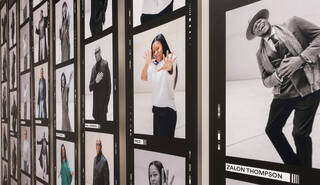
So it was me and my sister standing, talking at the top of the market, and then it was Kehinde and two others that came over to us and they said, “oh, like we would like to paint your portrait.” And me and my sister looked like, “what? What is this?” Then they went on to explain more and then he took out a book of his work, and that's when I saw the wallpaper, so it was the wallpaper background of different people posing. So it was like “oh have a look at the book” and we looked through it and then what it was, they said, “okay, if you want to do it”, and it was kind of like on the spot, “if you want to do it, go away and think about it, come back and if you want to, we'll paint your portrait”.
So what made me decide to do it and sit for the actual photoshoot was his work, it’s actually really beautiful when you look at it, it stands out and it's quite uplifting. It's bright, it's colourful. The colours, the colours pop. I'm still quite quiet. I wouldn't say I'm shy now, but I'm quite reserved, so I just wanted to, I dunno, just go for it. I think at that time, that year, 2019, I was like, let me just say yes more and kind of come out my shell a bit more. So, I guess the universe heard me and then it connected the dots. So, I said, “okay, I'm just gunna go for it”. I took a chance.
When I was growing up, I didn't really see many people in the museums. I didn't know it [the portrait] was gunna go to a museum. But a portrait of myself, so it was like, okay, it's like a representation of like people that looked like me, you know. I thought it would be nice to possibly be part of that, you know, because that's what lives on, isn't it? I thought about it like that, it would be nice for generations to come. Just having a young person looking at the portraits and be like, “oh, like, wow”, and being inspired and things like that. I thought it would be nice to just be part of that.
I didn't dress up for the portrait. It happened so quick or so fast. It's like that was what I was wearing on the day, so it was just an ordinary day. That was just my style. Very like comfort casual. I had a few silver necklaces on, and I still have those as well. So, there was no pressure, it was very relaxed. Hence, I was able to just wear my everyday clothes. I was literally plucked from the street, from Dalston, so I think they wanted to capture, in my opinion, like what east London looked like. Nothing was staged in the way I was dressed or anything. That's how I dressed. Let's say, let's fast-forward 100 years. It would be nice for people to see what people dress like then. Because the way we go into museums now and see how people dressed back then, it will kind of be the same.
The actual portrait, or the photo for the portrait, was taken in a church hall, which is in an area where I grew up in. Kehinde was the one that was directing us on how to pose and what direction to look in, how to sit, if we should use the prop or not, if we should stand up. And he would take the picture, and he would say, “hold it”. He wanted us to, or wanted me to, kinda like pose in like, kinda like a regal way. I think that's what I remember. It's kind of like a blur. There wasn't really no “you're posing because of this and that”, it was like, “just sit like you're almost like on a throne”. You pose, with your head up. Everything was kind of like sitting up straight upright. No slouching or anything like that and just look like you're commanding, and you know, you're overseeing. I remember at one point I kind of was smiling a little bit. I think they didn't really want the smile in it [laughs]. So I had to try not to smile too much. So that was a bit difficult because you're excited, isn't it?
When I was younger, like when I went to museums, I didn't see anybody that looked like me. So, I dunno, for someone on a school trip looking up and like “ahh”, and like recognising like the dress or the hair or what I was wearing, the dress code, the Nike Air Maxes, you know what I mean? And you know, or the jacket. It's like there's a bit of a connection, I guess. So, yeah, it's nice that I'm part of that.
[TRAFFIC HUMS, CARS BEEP, SHOPPERS AND MARKET SELLERS CHATTER]