The brick features an intriguing inscription:
Etruria potworks were
first erected by
Josiah Wedgwood Esquire
in year of Christ 1770
Rebuilt in
1790
Hamlet W[oo]d,
Oct 23 Aged 16y[ears]
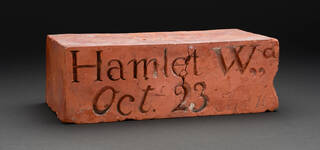
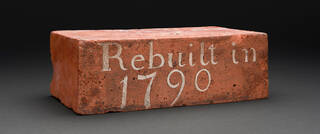
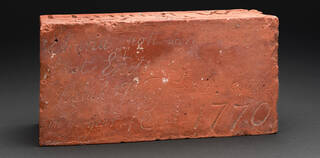
It is this inscription, and the reference to Hamlet Wood which makes this brick interesting. Who was Hamlet? Why was he selected to lay this brick? What was his story?
Hamlet Wood
Hamlet Wood was born 4 October 1774, the son of William and Mary Wood of Burslem. The Wood family was just as prominent in the manufacturing of ceramics in the Potteries as the Wedgwood family. His grandfather, Aaron Wood (1717 – 85), was a block cutter and modeller of salt-glazed pieces. His uncle, Enoch Wood Senior (1759 – 1840), was one of the leading producers of Staffordshire figures and blue-printed transferware, becoming a hugely successful businessman. His father, William (1746 – 1808), had been apprenticed to Josiah Wedgwood in 1767 as a modeller and spent the rest of his career there.
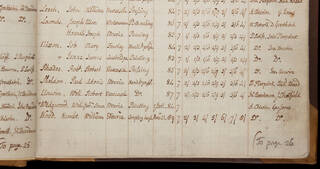
The earliest mention of Hamlet in the archives appears to be in Josiah Wedgwood’s Commonplace Book, which notes that Hamlet was apprenticed as a clerk in the Counting House for seven years from 11 November 1789. In his first year of his apprenticeship, he was to be paid two shillings a week, rising to three shillings a week in the second, and so on. Quite why Hamlet joined as a clerk for the business, instead of following in the family tradition of potting or modelling, is not clear. However, given that his wages, even in his first year, were already far in advance to what his fellow apprentices were earning across the rest of the factory, perhaps meant he was seen as being a particularly capable teenager with prospects.
Nothing concrete has survived in the archive to shed light on why Hamlet was chosen to lay the brick in 1790, but perhaps a combination of him being one of the younger employees in the company, with an important father also working there, and coming from a prominent family in North Staffordshire, were all factors.
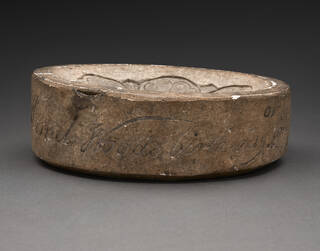
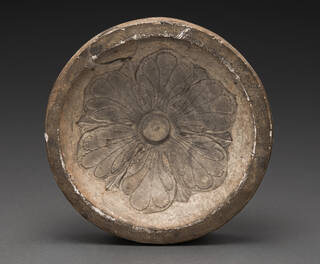
One early, touching insight into the relationship that Hamlet had with his father has survived in the collection. On the side of a plaster block mould is inscribed “Son Hamet [sic] Wood's Birthday or compleats [sic] 18 year october [sic] 4 1792”. It is not unheard of for employees of the company to inscribe moulds, tools etc, with important dates, and it is a moving acknowledgement by William of his only son’s passing into adulthood which has survived to this day.
Etruria village
One of Hamlet’s early responsibilities for the company seems to be in overseeing and assisting the Wedgwood family in property maintenance and collecting rent from the workers’ houses at Etruria. Writing to Josiah Wedgwood II (1769 – 1843) Hamlet enquired as to his earlier intentions on raising rents for these houses, but also acknowledged Josiah II’s not pressing the matter “was in consideration of their distress and from motives of compassion”.
He went on to inform Josiah II that:
Widow Jones died a few days ago, she has long occupied a house without paying rent, not being asked or troubled on account of her extreme poverty and your disposition to favour her, but I think you will not be inclined to shew [sic] the same indulgence to her daughter who is able to get her own living if she would be industrious – she has for a long time followed the practice of begging and is likely to pursue the same line of conduct… the House is much wanted for a workman who is at present obliged to travel.
This letter sheds light on the way in which the Wedgwood family managed their tenants in Etruria, many of which would have had family members working at the factory. We can consult rent accounts to see what happened to the property formerly let out to Widow Jones. In 1800, the rent books reveal that the property was then rented out to Widow Finney, but there seems to be no noted agreed annual rent listed, possibly indicating that instead of the house being relet to a workman, it was let to another widow with limited means.
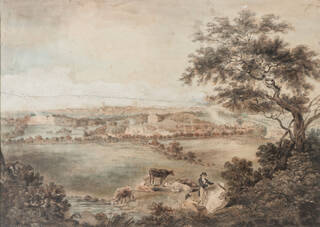
Possibly after Hamlet’s own marriage in 1804 to Martha Fenna, he would also rent a house in the Etruria village from the Wedgwood family. In a letter dated 1808, we have an age-old example of problems with troublesome neighbours. Hamlet wrote that:
“My wife has frequently complained of the disagreeable situation of the back door of my house, being in wet weather overshoes, or to use her own words up to the knees in mud for want of it being properly laid with bricks”.
In order to satisfy Martha, (who Hamlet feels that, as his wife, ought to “be indulged with little conveniences when not unreasonable”), and to spare the Wedgwood family any unnecessary expense, Hamlet applied to Bates, a fellow employee on the factory.
“for a few wastrel Quarries [tiles] which he looked out and sent me up. I paid the carrier and agreed with Jacob Simpson (in his own time) to lay them for me, before he had finished his job, Mr Jones [the neighbour] disturbs him, tells him I have no business with the Quarries and that he will acquaint Mr Wedgwood on his return home, with other such like expressions amounting to nothing less than I had stolen the Quarries.”
Hamlet ended the letter by reminding them of both his and his father’s long service with the business and asked whether he was “to be sent to Botany Bay Quarry stealing” as a result of a quarrel with his neighbour. Letters written shortly afterwards indicate that the Woods soon moved to a house in Wolstanton, but Martha, whose family came from Cheshire, was not entirely happy in her new home in the Potteries, as “she has hated this place for many reasons and has held out great inducement and persuasion to get me away.”
A change of heart?
By January 1809, Hamlet wrote to the company to inform them of his desire to leave when his contract for the year expired that coming November, if not sooner. Perhaps luckily for Hamlet, the business was unable to immediately release him, as two months later he wrote that,
“Since our last conversation on the subject of parting, I find some obstacles to my plan of emigration which I was not before aware of – my Mother to whom I thought proper to mention it to last Sunday look upon the change with alarm, as likely to bring on a separation from her forever”.
On account of his mother, he therefore asked if he could retain his position. However, he went on to explain what had prompted his initial wish to leave Wedgwood and emigrate: the desire for a better financial position for himself, and the opportunity for his wife to have a smallholding with some livestock.
Concessions must have been made for Hamlet as he remained with the business. In 1812, he wrote to Josiah Wedgwood II about the security of the Etruria factory. Whilst walking around the site, Hamlet discovered that one of the large back doors to the factory was ajar, and upon closer examination saw that the lock had been forced. Exploring further, he also found a number of crates, rails, and a chimney pot next to external walls around the site, which would allow them to be easily climbed.

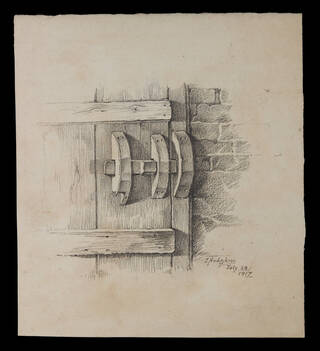
“No report has yet been made of anything being gone, but you are yourself aware how many things be stolen out of a manufacturing so extensive and where articles are so various without this being immediately or ever missed… I judged it proper to stick up a notice at the Lodge and offered 5 Guineas reward on conviction of the offender, but as nothing has transpired, I have little hope of finding the rogue. However it may alarm and deter others from such practises for a while and in the mean time perhaps you will consider of some more secure mode of preserving your property.”
Moving onto pastures new
By 1819, after serving the company for thirty years, Hamlet decided it was time to move on. Worries about Martha’s health and concerns that the air in the Potteries may have exacerbated her lung problems led Hamlet to take up a role with his family. Reflecting on his time with the Wedgwood Company, Hamlet recounted, "I have been at one and the same time, Cashier, Journalizer, Manufactory and Personal Ledger Keeper, Inland Correspondent, French Invoice writer, foreign order copier, and jobber of every description, and all this done with pleasure".
Within a month of this letter, Josiah Wedgwood II received a letter from Enoch Wood & Sons asking whether the Wedgwood Company would consider releasing Hamlet earlier than his contract originally allowed. Wedgwood declined, preferring to keep him on for the following six months – but this set of correspondence sheds light on what had persuaded Hamlet to leave: the opportunity to run (in partnership) the Belfast arm of Enoch Wood & Sons showroom. This partnership with his uncle and cousins lasted a few years until an announcement in the London Gazette in 1827 that it was to be dissolved, but that the business would be continued by Hamlet on his own.
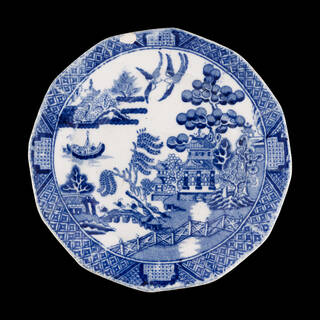
Any pleasure he may have taken from this did not last long. On the 8 December, 1829, Hamlet wrote to Josiah Wedgwood II explaining the incidents of the last few weeks. According to the letter, his uncle, Enoch Wood Senior, had a gloomy opinion of the economic situation of Ireland and they had decided to wind up that side of the business. As the manager of the showroom in Belfast, Hamlet thought differently. He had purchased the entirety of the stock, and hoped to carry on – believing that the situation would improve. Hamlet bought the business for £2,500, the amount to be repaid in three instalments, with 5% interest on the 1 January 1829, 1830 and 1831.
On 1 January 1829 Hamlet repaid £625, some £200 short (and excluding the 5% interest), believing that, given the economic conditions of Ireland, his money would be better spent supporting other businesses. Hamlet seems to have thought his family members would have given him some leniency in the situation, but discovered to his horror that in October 1829, his cousins, Edward Wood and Enoch Wood Junior, raised a Warrant of Attorney against him. Desperate attempts by Hamlet were made to save the business, but he was declared bankrupt. All of his stock was sold at auction to repay his creditors. His goods were sold for £1,300 to an earthenware dealer in Armagh, who then promptly sold the entire lot back to Enoch Wood & Sons. They then sold all of the remaining stock at vastly reduced prices. The letter ends with Hamlet saying that he did not blame his family for wanting their money, but the manner in which they did it, effectively ruining him and his business – a business which Hamlet believed was viable.
Later life
Nothing more is heard from Hamlet for the following three years. In his final surviving letter in the Wedgwood Archives, it seems that he did try and regain his financial footing in Ireland, before eventually returning to England. By the time of the 1841 census, he had relocated to Audlem, Cheshire. The decision to relocate to Cheshire, closer to his wife’s family than to his own in Staffordshire, perhaps indicates ongoing issues with the Wood family relationships. No children appear to have ever been born to Hamlet or Martha. Martha, passed away in 1842, after what is described as a “paralytic attack” by the newspapers. Hamlet died in 1846 at the age of 73 and was buried in Audlem.
And what of the business of Enoch Wood & Sons? Enoch Wood Senior died in 1840, a hugely wealthy businessman. He left significant legacies to his children and grandchildren, but stipulated that, for the good of the business, the money was not to be withdrawn until at least five years after his death. By 1845, the extended Wood family claimed their respective inheritances, draining the business of capital which resulted in the closure of the factory, with hundreds of people losing their jobs.