Arrive at the V&A South Kensington Cromwell Road entrance to start the trail. The trail takes around 25 minutes and takes place across three floors of the museum. It includes flights of stairs or lifts, and a step free route is available. Please ask a member of staff if you need directions.
Stop 1: Sender Unknown by Aziza Kadyri
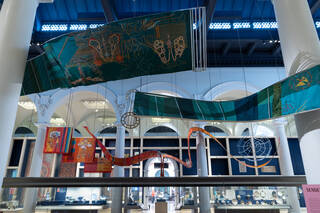
The art of suzani – intricately hand-embroidered textiles traditionally made for a bride’s dowry – is one of Uzbekistan’s most significant cultural traditions. Responding to the V&A’s suzani collection, artist Aziza Kadyri reimagines the textile tradition through a new commission exploring the intersection of AI, art and craft.
While suzani itself has long evolved through shared cultural exchange, AI models introduce a different kind of borrowing – one that can strip away layers of context grounded in lived experiences.
The artist asks whether technologies that risk erasing histories can instead be reimagined as tools for preservation and reinterpretation. This installation evokes this deconstructed sense of information transmission.
Part of the V&A’s Jameel Programme, celebrating 20 years of The Jameel Gallery with Community Jameel.
Further support from the Sarikhani Family.
Stop 2: Metamorphic Modulation by Albert Yonathan Setyawan
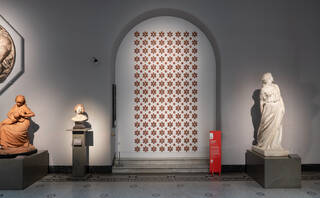
In this ceramic installation Setayawan explores form and the ambiguity of perception through repetition and pattern-making, underpinned by his conceptual investigations into meditative experiences.
The artwork centres on two enigmatic forms, one evoking a leaf and the other a flower. The installation comprises over 700 individual pieces, hand-modelled in clay, slip-cast in red terracotta, and left unglazed to celebrate the clay’s particular material qualities. This installation invites us to experience the work from different vantage points, as it shifts in appearance, playing with light and shadow.
Artwork commissioned in partnership with The Peninsula Hotels’ 'Art in Resonance' programme.
Stop 3: Time After Time by Andre Williams
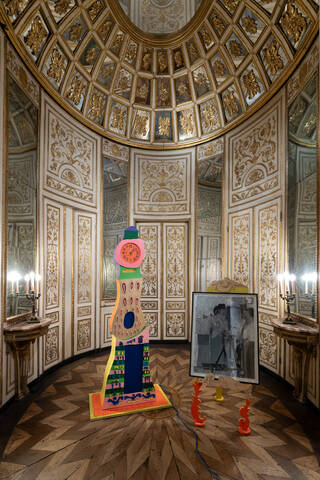
A new commission by IntoArt artist Andre Williams, paired with a painting by Dawn Wilson, and inspired by the musical heritage of the 18th-century mirrored room it sits within.
Williams’ longcase clock fuses traditions of clockmaking and soundsystem design. Set against the gilded oval interior and zigzag parquet floor, it marks time both visually and audibly, playing daily mixtapes curated by Williams. Decorated with Southern African Ndebele and Cameroonian Bamiléké motifs, the clock stands alongside an easel designed by Williams, holding Wilson’s drawing of Birmingham’s Youthman Promotion Sound System.
Stop 4: When the Void Gazes Back by Eunjo Lee
Inspired by the V&A’s historic Buddhist art collection, this new commission by Eunjo Lee creates a future world speculating how the growing agency of AI and its use of data can disrupt spiritual awakenings and non-human consciousness.
Through a digitally sculpted film, Lee delves into concepts of Zen, karma and impermanence rooted in Buddhism, reframing digital, shamanistic deities as ever-changing cosmic worlds within themselves. The deities also come alive as sculptures that are partially 3D printed from recycled clay. Embedded with sensors, visitors can follow instructions to interact with the sculptures.
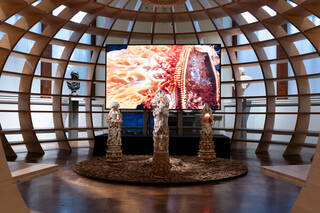
Artistic collaborators include Josef Stöger (Ceramic Sculptures), Kiryung Arrddon Nam (Interactive Experience Design), Gunho Hyun (Music), Harry Charlton (Sound Design), Steph Hartop (Voiceover).
Supported by the Ruddock Foundation for the Arts and Niru Ratnam, London.
Stop 5: Lovers Hold by Henry Svendsen
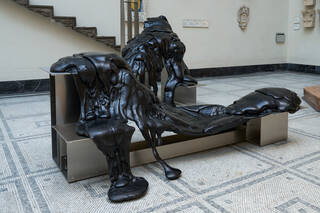
Lovers Hold extends Svendsen’s ongoing investigation into the plinth, via the spatial politics of cruising sites, reimagining sculptural supports as structure shaped by intimacy, proximity, and bodily negotiation.
Viscous, grotto-like forms suspended from stainless steel armatures support multiple bodies in repose, drawing on furniture designed for closeness, such as the loveseat. Evoking the improvised nature of outdoor cruising sites, these sculptures materialise fleeting contact as accumulated traces of desire. The work considers how bodies gather through structures not originally designed to hold them, exploring what it means to rest, lean, linger, and make contact in public space.
Stop 6: Craft x Tech Tokai Project
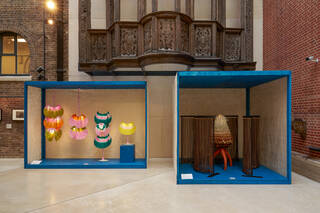
The project explores how Japanese craft specialisms in lacquer, metal, woodworking, ceramics, washi paper and textiles, can be reimagined through a thoughtful dialogue between traditional techniques and contemporary practices. Craft x Tech Tokai Project reinterprets the regions’ centuries-old traditions to create a collection of contemporary works that celebrate the enduring relevance of traditional craftsmanship.
Founded by designer and engineer Dr Hideki Yoshimoto of design studio Tangent, with curatorial direction by Italian independent curator Maria Cristina Didero, Craft x Tech was established to bridge traditional heritage and global design perspectives.
Stop 7: your golf course made my gpu by Sam Ghantous
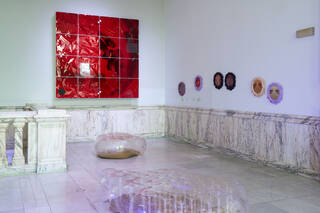
Digital life is mineral. In your golf course made my GPU, Sam Ghantous explores the entanglement between earth and technology through silica, the second most abundant earthly element.
The installation considers sand as a substrate onto which societies project their desires and aspirations for progress. From microchips and quartz crystals to artificial islands, his works trace the material state changes of sand across industry and landscape, implicating computing with earthly transformation.
By reconnecting digital technologies to their geological origins, Ghantous asks how visions of progress become embedded in matter, and how imagined futures remain bound to earth.
Supported by the Beaverbrook Canadian Foundation and the High Commission of Canada in the United Kingdom.
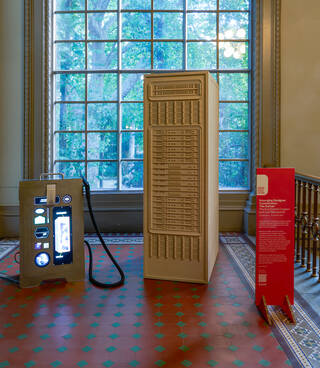
Stop 8: Emerging Designer Commission: The Server by Playfool
Drawing on the museum’s routine practice of object cleaning, the artist-design unit Playfool explores the role of human labour in the age of AI acceleration.
Behind our daily stream of online stimulation lies a burgeoning number of highly automated data centres. Playfool zeroes in on the one task in these places that resists automation: cleaning. Through alternative game design approaches, Playfool looks at the physical upkeep that sustains both the museum collections and the AI infrastructure, reflecting on what gets overlooked in the pursuit of progress
Please Touch! Take turns to clean the server. Your movements will be tracked and visualised on printed slips.
Stop 9: Image Syncers by Nina Davies
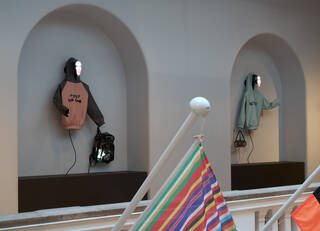
Explore how synthetic media alters human perception, behaviour, and identity in this multimedia installation and performance project.
Nina Davies examines a near future where images no longer depict the world. Grounded in viral TikTok trends where users mimic uncanny AI-generated dances, the work considers how people can adapt themselves to computational aesthetics.
Presented as an episode of a fictional podcast, the central video essay charts a mysterious collective attempting to physically transform themselves into AI-generated figures. Holographic forms appear as spectral stand-ins for the film’s characters, while surrounding vitrines display their personal belongings, smartphones, and analogue props used in their transformation process.
Supported by the Beaverbrook Canadian Foundation and the High Commission of Canada in the United Kingdom.
Stop 10: Once Upon A Garden by Linda Dounia Rebeiz
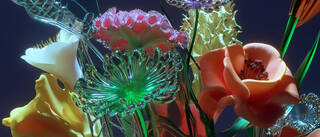
Once Upon A Garden is a speculative archive, exploring critically endangered and extinct flora left unrecorded in human history. Using AI as a time machine, Linda Dounia Rebeiz pieces together fragmented records to reconstruct visual data for lost plants. The installation presents 50 emergent species of speculative flora across five chapters, illustrating how AI models synthesize images from sparse context.
A Senegalese-Lebanese artist, designer, and writer, Rebeiz examines the philosophical and environmental implications of technocapitalism. Through her practice she mediates memories as alternative realities and evidence of excluded ways of being and doing.