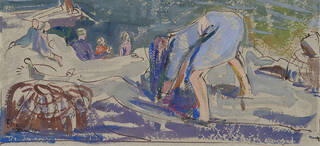
Born Edna Waugh in 1879, she grew up in a large nonconformist family in London and St Albans. Her minister, father Benjamin Waugh (1839 – 1908), was a founder of the National Society for the Prevention of Cruelty to Children (NSPCC) and her sister, Rosa Waugh Hobhouse (1882 – 1971), who also studied and taught art, would become an educator, activist and pacifist. Edna wrote poetry and made drawings from childhood, initially inspired by the Pre-Raphaelites.
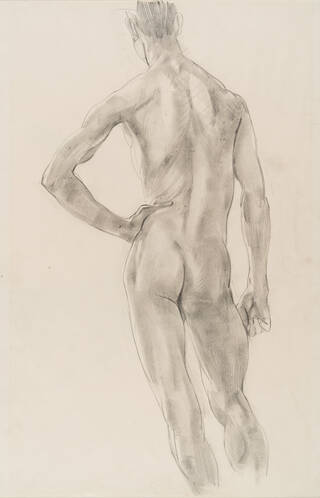
Edna studied at the Slade between 1893 and 1899 from age 14, where she won a prestigious scholarship in 1898. The young artist experienced the most equitable artistic training for women in Britain at the time and was allowed to draw from both the male and female nude models in life class. She was favoured by her teacher Professor Henry Tonks (1862– 1937), a stickler for anatomical accuracy, and became part of a vibrant circle of talented and ambitious students that included the Welsh artists and siblings Gwen John (1876 – 1939) and Augustus John (1878 – 1961).
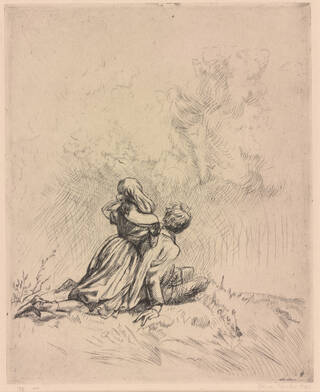

Following her marriage to barrister William Clarke Hall (1866 – 1932) in December 1898, she persisted with her art despite the lack of support shown by her husband, who was unloving and critical of her work. At home in rural Upminster, Essex, Clarke Hall began to make drawings from the world of Emily Brontë’s novel Wuthering Heights (1847). She ‘lived’ the characters of Heathcliff and Catherine Earnshaw, later writing ‘I simply was them’. Clarke Hall was fascinated by their intense bond, forged in childhood, which transcends marriage, compassion, revenge, and even mortality.
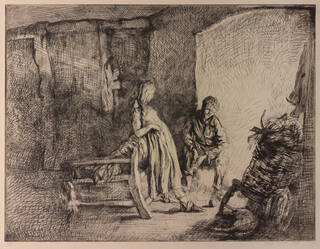
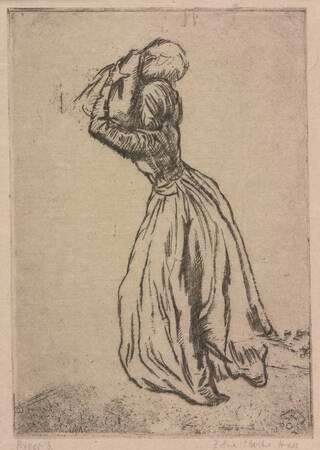
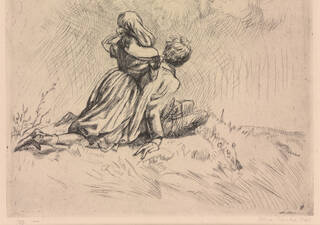
Over decades Clarke Hall would make drawings, watercolours and later etchings responding to Wuthering Heights. She would position the pair as children beside the fireplace inside the looming interior of Wuthering Heights, or as adults holding each other in anguished passion, their faces obscured. Her depictions of Catherine kneeling with her arms around Heathcliff, whose body is unfinished, concentrate grief and longing in the grasp of Catherine’s arms and the folds of her dress.
Despite the lack of support at home, Clarke Hall retained the reputation she had built at art school. Her art was included in a publication celebrating the Slade in 1907, alongside her peers Augustus John and William Orpen (1878 – 1931). Introducing her sister’s work, Rosa Waugh praised her ability to join draughtsmanship and sensitive observation of the world around her with imaginative power. ‘In all her work imagination and realism are more than brought together,’ she wrote, ‘they are so united that they lose their separate identities. Her subjects, whether actual or imagined, are treated realistically, but the realism itself is always imaginative.’ Clarke Hall chose to exhibit with the Friday Club set up by the Bloomsbury Group in the 1910s, a key venue for supporting innovative art in Britain. She was also the first woman to have a solo show at the Chenil Gallery in Chelsea in 1914.
The losses of the First World War, added to her fraught domestic situation, severely impacted Clarke Hall’s ability to make art, and her mental health broke down in 1919. She had consultations with neurologist Dr. Henry Head (1861 – 1940), who recommended that she establish a studio in London as an aid to recovery. Head was a colleague of Dr. William H. R. Rivers (1864 – 1922), whose treatment of ‘shellshocked’ soldiers at Craiglockhart Hospital near Edinburgh emphasised the importance of talking through repressed trauma and the therapeutic capacities of creativity. In 1922, Clarke Hall set up her new studio in Gray’s Inn, London.
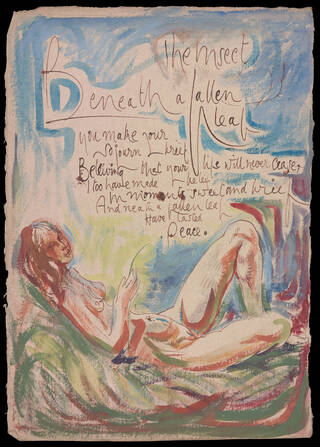
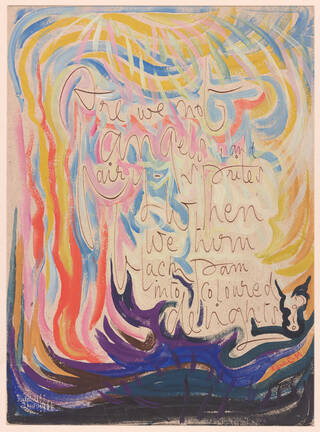
The 1920s were transformative for Clarke Hall’s career. Her London studio offered respite and enabled her to exhibit and sell her art more regularly. The ‘poem paintings’ were first exhibited at the Redfern Gallery in London in February 1926. Influenced by the Romantic artist William Blake (1757 – 1827), these works merge text and image. Painted in gouache and watercolour, they often depict a female nude amid radiations of bright colour with verses inscribed in black ink. At times, the poem paintings move into abstraction. In one picture the bands of colour are like tongues of flame enveloping the script, expressing the poem’s transmutation of suffering:
Are we not angels and fairy-sprites
When we turn black pain into coloured delights?
Clarke Hall’s status was further consolidated in 1931 when her representation of the market square of Lavenham, Suffolk, was featured in a poster commissioned by the Shell Mex petroleum company. This series of advertisements showcased the work of other significant artists like Vanessa Bell (1879 – 1961) and Graham Sutherland (1903 – 80).
After she was widowed in 1932, Clarke Hall acted to make the farm on her estate in Upminster commercially viable so that she could continue to live there. Without her knowledge, her husband had made stipulations in his will that the house and land should be sold. Friends rallied round and helped to establish a Trust that guaranteed to buy a certain number of artworks each year so that Clarke Hall could sustain her practice.
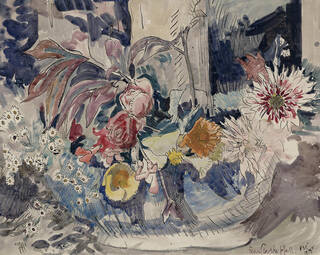
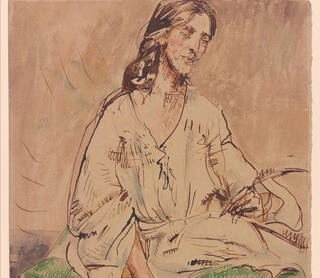
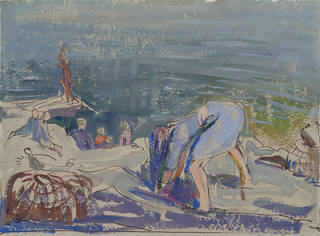
During the 1930s, Clarke Hall began to focus on still life. A watercolour of 1938 shows an abundance of flowers in a blue and white vase placed on a windowsill. As Rosa Waugh had written in 1907: ‘The smallest fragment amongst her drawings is intimate with nature, and they are all bent upon its expression’. Through Heathcliff and Catherine’s connection to their Yorkshire moors, visionary poem paintings, and fresh watercolours depicting her sons or other figures amid the landscape or by the sea, her art reveals her multifaceted affinity with the natural world.
Clarke Hall’s studio was destroyed during the Blitz in 1941. This event led to a drastic reduction in her artistic activity, compounded by her developing arthritis. She died in 1979, aged 100. Marked by the injustices of her marriage, her life is sometimes framed as a narrative of thwarted potential. Yet the considerable collections of Clarke Hall’s work at the V&A and other public institutions overturn this interpretation. There is an ever-growing recognition of her unique contribution to modern art in Britain and her realisation of what she described as her ‘true expression’.
FInd out more about Clarke Hall's obsession with Wuthering Heights.