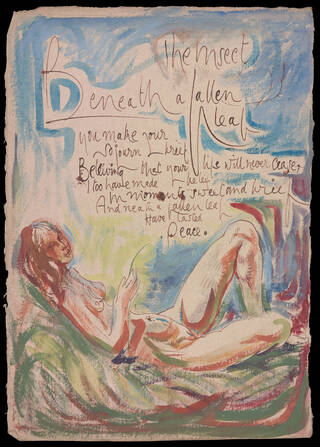
Clarke Hall would bring together bands of colour and female nude figures with poetry written in the first-person about love, grief, freedom, and transience. Sometimes the poem paintings depict the natural world or the artist’s surroundings, such as a farm cowshed on a moonlit night. Others deploy abstraction, their colourful brushstrokes forming auras around the text and merging the senses in an almost synaesthetic manner (causing sensory crossovers, such as tasting colours or feeling sounds).

The origin of the poem paintings can be traced to the early 1920s, and the treatment Clarke Hall underwent after a breakdown in her mental health in 1919. Neurologist Dr Henry Head (1861 – 1940), who published a collection of his own poetry in 1919, believed in the therapeutic power of creativity and encouraged Clarke Hall to uncover her suppressed emotions and past traumas alongside reengaging with her art practice. Crucially, he also recommended that Clarke Hall establish her own London studio separate from her Essex home, something she had not enjoyed since she had graduated as a prize-winning student from the Slade School of Fine Art in London in 1899. Clarke Hall experienced a strong sense of renewal with her recovery, and the poem paintings symbolise a rededication to her artistic vocation.


Through the poem paintings, Clarke Hall explored profound feelings of loneliness and longing. These were fuelled by her difficult marriage to barrister William Clarke Hall (1866 – 1932), which had drastically hindered her career, as well as the devastating impact of the First World War (1914 – 18). Their highly personal nature was another manifestation of the solace and emotional intensity that Clarke Hall had previously found in her art, when she drew the world and characters of Wuthering Heights (1847) by Emily Brontë (1818 – 48), an extended obsession that began in the early years of her marriage.
Like the initial Wuthering Heights pictures, Clarke Hall made her poem paintings in an almost unconscious state. The artist described the intuitive creation of one of the pictures in a letter: intending to fetch a pair of scissors, she ‘forgot everything and about half an hour afterwards I found I had been painting a page with a brand new poem on it’. The long and loose limbs of her female figures hint that she was not making meticulous studies from life but drawing from her imagination. Her distinctive handwritten script, often extending the tails of certain letters into the line below, conveys a striking sense of intimacy.
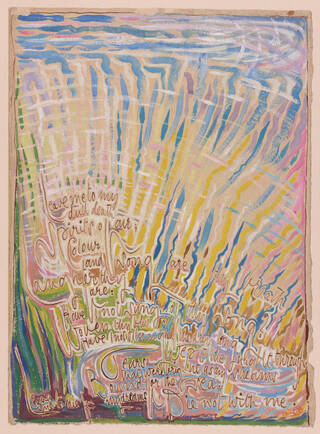
Emphasising the power of the imagination and uniting text and image, the poem paintings reveal the influence of William Blake (1757 – 1827). The singular Romantic artist, printmaker and poet, who experienced visions of angels and inspired the young Samuel Palmer (1805 – 81), had died in relative obscurity. Blake became an inspiration for the Pre-Raphaelites, one of Clarke Hall’s early influences. Dante Gabriel Rossetti (1828 – 82), another poet-painter, owned an important notebook belonging to Blake, sometimes known as the Rossetti Manuscript.
A major exhibition of Blake’s work at the Burlington Fine Arts Club in 1876 stimulated the reappraisal of his reputation, and a series of exhibitions in the early 20th century helped to make his work more widely known. His influence was cemented by the V&A exhibition Drawings, Etchings & Woodcuts by Samuel Palmer and other Disciples of William Blake in 1926. Blake was praised by some critics as an honorary modernist for his individuality and graphic experimentation that stood apart from his contemporaries.
Clarke Hall greatly admired Blake, owning copies of his poetry and referring to reading Alexander Gilchrist’s biography of the artist, published in 1863, in an undated letter.
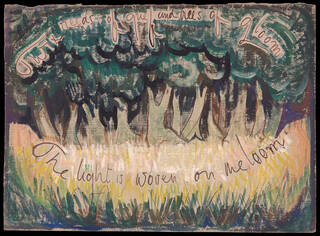
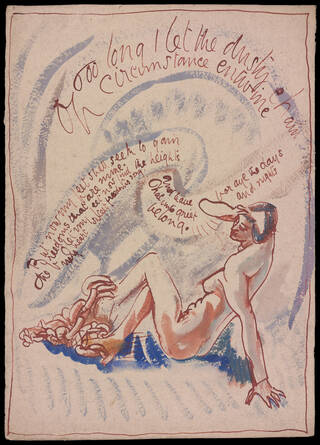
Another aspect of Clarke Hall’s affinities to the Romantic poet-painter can be seen in her lyrical poetry, sometimes characterised as ‘songs’, akin to his Songs of Innocence and Experience (1794) or psalms from the bible, using archaic words like ‘thy’ and ‘unto’. One poem painting, made between 1922 and 1926, depicts a female nude with her feet shackled and poetic verses interlinked like the loops of a chain. Lamenting the ‘dusty chain’ of circumstance, the poem resolves to pursue ‘the freedoms that are mine’ and sing ‘sweet freedom’s song’. Clarke Hall uses a motif of romantic literature, drawing on traditions of stoicism and Christianity, which interprets human souls as weighed down by metaphorical chains of convention or worldly concern. The imagery of the chain is evocative of Emily Brontë’s poetry and its celebration of a ‘chainless soul’ with ‘courage to endure’ in her poem The Old Stoic (about 1841).
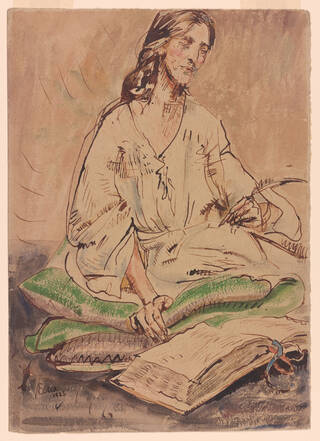
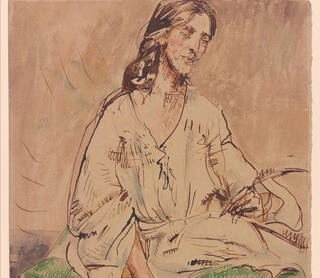
A self portrait of 1923. made during the poem paintings’ creation, expresses Clarke Hall’s renewed purpose and agency as both artist and poet. She sits on green cushions with a large album open before her, a quill pen poised in her hand. Throughout the 1920s, Clarke Hall claimed greater autonomy, exhibiting and selling her art with increased regularity, even donating some works to the V&A and travelling to Egypt with friends in December 1926. That year she also published her poetry collection, titled simply Poems. Her second published collection Facets (1930) would incorporate several of the poem paintings as lithographs.
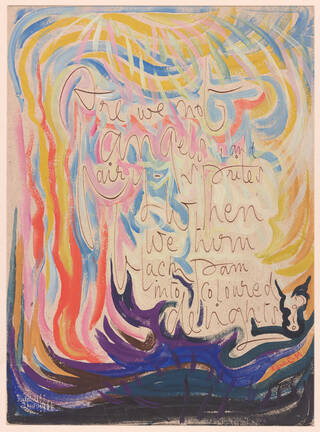
Clarke Hall’s poem paintings are testimony to the rejuvenation the artist felt in the 1920s and the catharsis of creative expression. They demonstrate the powerful creative exchange that exists between art and literature, remaining unique among reworkings of the romantic tradition in modern art.