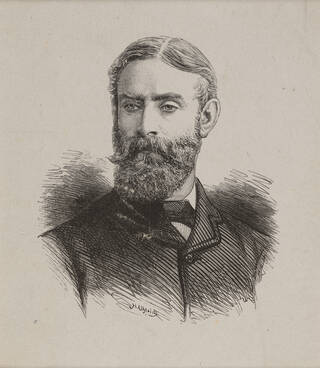
Caldecott was born in Chester, UK, to John Caldecott, a former tailor who was by then an accountant, and his first wife Mary Dinah, who died when Randolph was only six years old. He was the third of 13 children, six of whom were from John Caldecott’s second marriage. Randolph contracted rheumatic fever as a child, which affected his health into adulthood. His father encouraged him to continue attending school until he was 15, after which he started a job as a clerk for Whitchurch Ellesmere Bank in 1861. From an early age he enjoyed drawing and spent his free time in the countryside, drawing from nature. In the same year as he began to work at the bank, Caldecott had his first illustration published, when his drawing of a fire at the Queen Railway Hotel in Chester, UK, appeared alongside his account of the event in the Illustrated London News. His skill in quick, observational drawing made him a talented reporter.
Caldecott continued working as a bank clerk, moving in 1867 to work at Manchester & Salford Bank, but he also began to study at the Manchester School of Art. Caldecott was well liked by his colleagues, but admitted the work of the bank did not suit him. An album survives containing his doodles and sketches from this time.
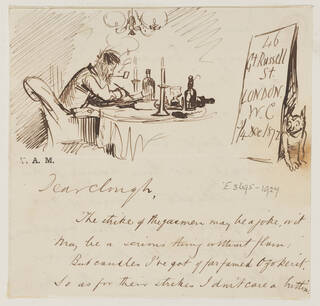
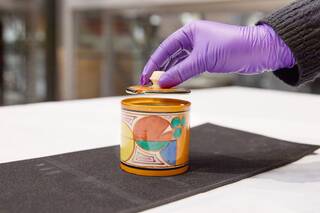
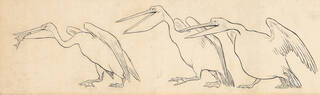
Caldecott began getting his illustrations published in local weekly papers, such as The Sphinx. The success of his illustrations in the periodical London Society prompted him to move to London in 1872 to pursue a career as an artist full time. In London he socialised with a circle of prominent artists, including John Everett Millais and Frederic Leighton. Though he was chiefly known as an illustrator, his artistic pursuits also spanned painting, design and sculpture. In the late 1870s, Caldecott modelled birds to top some of the pillars in Frederic
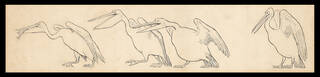
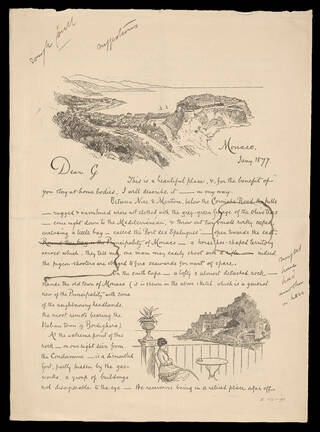
Leighton described Caldecott as having an "inexhaustible humour" and it was this trait which came through in his work and made him increasingly in demand as an illustrator. Henry Blackburn, who was editor of London Society, also commissioned Caldecott’s first book illustrations for a travel book about the Harz Mountains in northern Germany. Travel became a regular facet of Caldecott’s work. He wrote about and made drawings of the daily life and antics of his fellow tourists. Published in the Graphic in 1877, his Letters from Monaco painted such a candid picture of Monte Carlo that Blackburn, in his biography of Caldecott, expressed that no such pictures had been sent home before, making them the ideal correspondent’s letters.
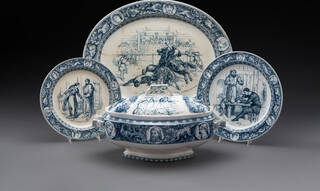
To translate his ink drawings into printed illustrations, Caldecott worked closely with several wood engravers. In 1874, James Davis Cooper approached Caldecott to create a series of illustrations to Washington Irving’s Old Christmas. The book was so successful that it had to be reprinted just two months after its initial publication in October 1875. The Pictorial World magazine commended Caldecott in its review, which read, 'Surely it has seldom happened in the history of illustration that an author should be so very closely followed – if not overtaken – by his illustrator'.
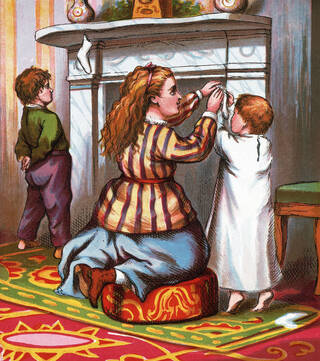
Caldecott also worked closely with the innovative wood engraver Edmund Evans. From 1878, the pair produced two children’s picture books every year, published by George Routledge & Sons. These are considered some of Caldecott’s finest illustrative work, and his best-selling. By 1884 he had sold 867,000 copies across 12 different books. Alongside Walter Crane and Kate Greenaway, Caldecott was highly influential on children’s illustration. For these books, Caldecott moved away from the dense hatching of his earlier style, which gave them a livelier feel. His masterful use of line and white space paved the way for a new style of children’s illustration with more movement and character.
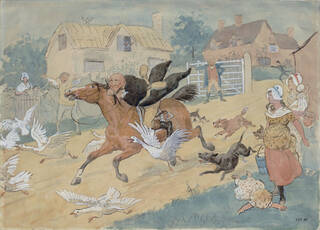
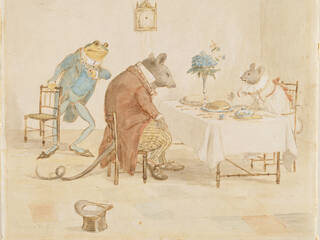
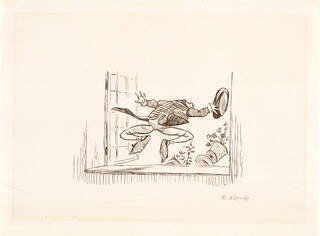
The illustration of John Gilpin riding across a double page spread was used as the image for the Caldecott Medal, a prize established in 1938 for illustrators of the ‘most distinguished American picture book for children’. Maurice Sendak, who won the Medal in 1964, heralded Caldecott’s work as ‘the invention of the picture book’, because of the way he combined text and image. Instead of simply representing the text, Caldecott’s images added extra, unexpected details. In A Frog He Would A-Wooing Go (which would go on to inspire Beatrix Potter’s Tale of Mr. Jeremy Fisher), the text reads ‘He took up his hat, and he wished them good night’, but, in Caldecott’s illustrations, the frog is shown jumping energetically out of the window, knocking over plant pots in the process. This juxtaposition of text and image allowed Caldecott to enrich well-known stories and nursery rhymes with his own wit.
Unfortunately, Caldecott did not live to see the impact of his work. In 1885, he sold his house in England and left for the US with his wife, Marian. They intended to travel up the east coast, with Randolph creating a new series of illustrations for the Graphic and taking advantage of the warmer climate to improve his physical condition, but the unexpectedly cold and wet Florida winter instead caused rapid decline in his fragile health.
Following Caldecott’s death on the 12th February 1886, there was an outpouring of praise for the late illustrator. Sentiments about Caldecott’s short but vibrant career are best summed up by his close friend, illustrator George du Maurier:
… a true illustrator if ever there was one. That is, an enhancer of the charm and humour of his text, whose art seems to be of the slightest – a very few strokes were enough for him to work wonders with. It is magic.