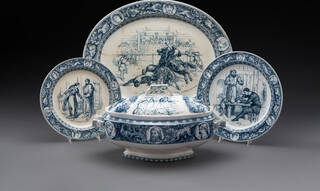
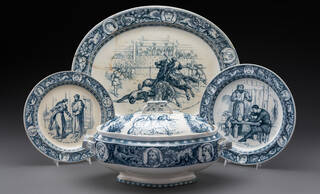
The famous historic novel Ivanhoe, from which the inspiration for the pattern was taken, was written by historian Sir Walter Scott (1771 – 1832) and was first published in three volumes in 1820. Set in medieval England, it tells the story of the famous protagonists Richard the Lionheart, Prince John, Robin Hood and the love story between the knight Wilfred of Ivanhoe and Lady Rowena. The novel is often credited for the increasing interest in Romance and Medievalism in Victorian England.
Thomas Allen
Thomas Allen was Wedgwood’s first professional art director. He studied at the Stoke School of Art from 1849 and at the Government School of Design at Somerset House, London. He continued his education there after the school moved to South Kensington, where it was renamed the National Art Training School, later the Royal College of Art. In 1852, he won a National Art Training Scholarship. On returning to Stoke-on-Trent, he was first employed by the ceramics manufacturer Minton and then by Wedgwood around 1875. He became Wedgwood’s Art Director in 1878 and retired in 1904.
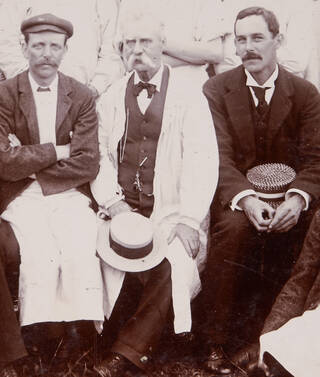
He was acclaimed as a figure painter and had immense knowledge of the tile industry. Under Allen’s influence, the range of studio and art wares grew greatly, and he was particularly renowned for the production of new tableware designs.
Allen’s first major display for Wedgwood was at the Paris Exhibition of 1878 where Wedgwood won a gold medal. These international exhibitions provided manufacturers with an important stage to showcase their artistic excellence and technical innovations. Winning the gold medal drew attention to Wedgwood's products, highlighting Allen's designs as new and fashionable to an international audience. Allen’s reputation would have allowed Wedgwood to charge higher prices for his designs, such as Banquet, Columbia and Ivanhoe. Ivanhoe was designed in around 1881 for a range of tableware and continued to appear on various shapes until the early 20th century. The pattern was also used for a series of 12 tiles.
'Ivanhoe' – the novel
Sir Walter Scott’s novel Ivanhoe remained popular for generations, continuing to inspire readers while also provoking debate until the present day. Today, aspects of the novel reveal prejudicial tropes and stereotypes that are widely ccondemned today but were far less likely to be challenged in the 19th century. No records survive explaining exactly why Wedgwood and Allen chose Ivanhoe as the inspiration for a new pattern, but the immense popularity of the novel at the time, together with a widespread enthusiasm for chivalric romance and an idealised vision of medieval England, were likely key factors in its selection.
The Wedgwood dinner set illustrations can be used to explore both the narrative and the social attitudes reflected in Scott’s novel and in Allen’s designs.
The main characters
Wilfred of Ivanhoe
The hero of the novel. A Saxon knight loyal to King Richard I. He is depicted as brave, honourable and devoted to justice and chivalry.
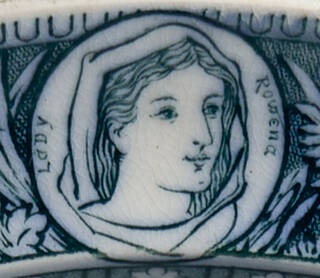
Lady Rowena
A Saxon noblewoman under Cedric’s guardianship. She is portrayed as beautiful and dignified and is Ivanhoe’s love interest.
Cedric the Saxon
Ivanhoe’s father. He is proud of his Saxon heritage and hostile to Norman rule. He initially disinherits Ivanhoe for following King Richard I on the Crusade.
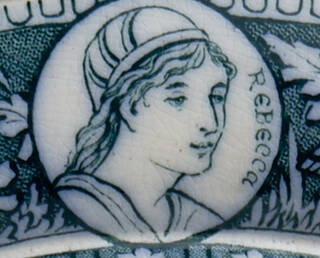
Rebecca
Daughter of Isaac of York. She is depicted as intelligent, courageous and compassionate. Allen’s portrayal of Rebecca’s appearance – the dress and headscarf with a floral pattern, as well as her jewellery – mark her out as ‘other’, compared to the depiction of the other women in the series, such as Rowena, who wears ‘typical’ medieval women’s clothing. Allen is depicting her as the trope of the ‘Exotic Jewess’.
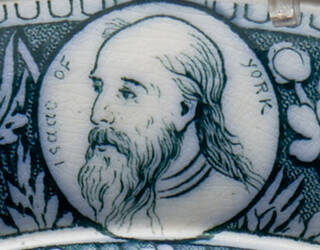
Isaac of York
A ‘wealthy Jewish moneylender’ who suffers persecution, but helps Ivanhoe financially. While Scott presents Isaac more sympathetically than many earlier writers, the character nevertheless draws on antisemitic tropes familiar from figures such as Shakespeare's Shylock in The Merchant of Venice, and contributes to the racialised representations of Jewish people found throughout 19th-century literature. Isaac is often described using negative stereotypes of the Jewish moneylender: fearful, greedy and physically caricatured. Modern readers and scholars have noted that this reinforcement of antisemitic tropes, contrasted with the apparent 'sympathy' for Isaac's suffering, serves to romanticise Jewish persecution. There appear to be clear parallels between Scott’s depiction of Isaac of York and the historic persona of ‘Abraham of Bristol’ – a wealthy Jewish merchant and moneylender living in early 13th-century England, during the reign of King John. He is one of the best-documented individuals from medieval English Jewish history because of the extreme brutality inflicted on him by the Crown.
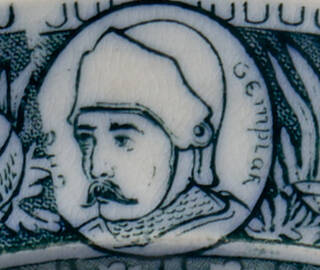
Brian de Bois-Guilbert
A powerful and conflicted Knight Templar and the main villain. He is obsessed with Rebecca and torn between passion and duty.
Reginald Front-de-Bœuf
A brutal Norman baron who imprisons Cedric and his companions.
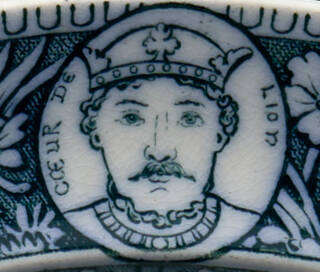
King Richard I
The Lionheart. He appears in disguise for much of the novel. He symbolises true kingship and justice.
Prince John
Richard’s brother and political rival. He is portrayed as scheming and weak and is backing the Norman usurpers.
Robin Hood (Locksley)
Leader of a group of Saxon outlaws. He is described as clever, fair-minded and loyal to Richard.
'Ivanhoe' – the dinner set
The story of Ivanhoe is set in 12th-century England. The Norman Conquest of 1066 has replaced the Saxon ruling class with Norman (French) nobles.
King Richard I (also known as Richard the Lionheart) is being held for ransom by Leopold V, Duke of Austria. In his absence, Richard's younger brother Prince John has allied with Philip II, King of France. Prince John is trying to keep Richard I out of England for as long as he can. He wants to build up his support in the kingdom so that he can eventually steal the throne from his brother.
1. Wamba and Gurth the Swineherd
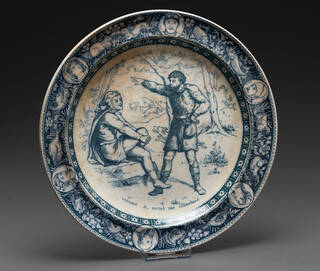
This earthenware plate with transfer printing shows Gurth, a Saxon swineherd and Wamba, a jester, lamenting the poor treatment of Saxons under Norman rule.
In the story, just after this scene, the jester and the swineherd guide two Norman nobles, Prior Aymer and Bois-Guilbert, along with a mysterious pilgrim from the Holy Land, to Cedric's hall at Rotherwood. There, Isaac of York, a wealthy Jewish moneylender, is met with hostility and prejudice. The mysterious pilgrim helps Isaac escape and is later rewarded with armour and a horse by him.
At a two-day tournament hosted by Prince John, a mysterious knight known as Desdichado ('The Disinherited') defeats all challengers. Revealed to be Wilfred of Ivanhoe, Cedric's disinherited son and the same pilgrim who aided Isaac, he names Rowena 'Queen of Beauty and Love' after his victory and repays Isaac for his generosity that enabled him to win the tournament.
The visible staining on this plate is a witness of its regular use and a common problem with 19th-century earthenware products – the glaze crazes and fat and other food residue seep underneath it, permanently staining the ceramic body.
2. Rebecca gives a purse of money to Gurth
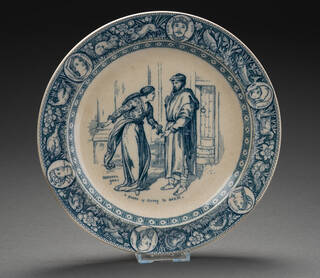
In the scene on this plate, we see Rebecca secretly returning the money that Ivanhoe had repaid Isaac, insisting on covering the cost herself. Gurth the swineherd then passes the coins on to Ivanhoe, who is moved by Rebecca’s generosity. Even in this monochromatic version of the pattern, Rebecca and her perceived otherness are readily identifiable through her attire.
This scene is followed by the second day of the tournament during which Ivanhoe is rescued in battle by a mysterious Black Knight, later revealed to be King Richard I, but is badly wounded. After being declared the victor by Rowena, Ivanhoe collapses and his identity is finally revealed. Isaac and Rebecca then take him into hiding where Rebecca nurses him back to health.
3. Prince John bandying words with Locksley
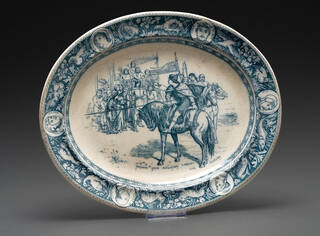
The tournament ends with an archery contest. This large earthenware platter, 37 cms wide, shows ‘Prince John bandying words (in discussion) with Locksley’. In the audience, we can see Rebecca and her frail father Isaac. Prince John deeply dislikes Locksley, who is later revealed as Robin Hood of Sherwood Forest, and challenges him to compete, promising a reward if he wins and a whipping if he loses. As expected, Locksley wins.
4. Friar Tuck entertains the Black Knight
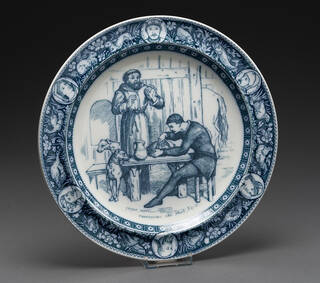
In this scene we rejoin the Black Knight as he attempts to head north but loses his way and seeks shelter in a chapel. There he meets Friar Tuck who pretends to be a hermit denying himself food and drink. However, the pretence soon collapses, and the pair spend the evening feasting and drinking heavily.
The scene is printed on a plate made from 'pearl ware', a slightly different white earthenware body, containing a greater proportion of white clay and flint. In addition, a small quantity of cobalt oxide was added to the glaze, making this product whiter than Wedgwood’s regular earthenware or Queen’s ware, in response to the preference of a segment of Wedgwood’s markets. Wedgwood first introduced a combination of a whiter body and a whiter glaze in 1779. The date stamp ‘CCK’ for the year 1882, impressed on the back, shows that the Ivanhoe pattern was produced on both earthenware bodies – the cream-coloured Queen’s ware and the whiter pearl ware – at the same time. In the case of this large service, both ceramic bodies are represented.
5. Front-de-Boeuf extorting silver from Isaac of York
The story continues with Cedric and Rowena travelling home and reluctantly allowing Isaac and Rebecca to join their party. Soon afterwards, the group – including the wounded Ivanhoe – is captured and taken to Torquilstone Castle. Gurth and Wamba escape and recruit Locksley, Friar Tuck and the Black Knight to help rescue them.
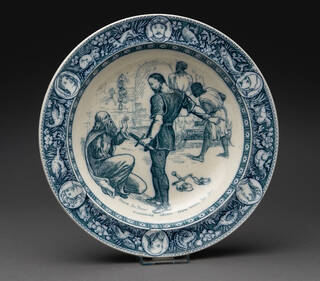
The scene depicted on this soup plate shows the castle dungeon where Front-de-Bœuf demands a large ransom from Isaac and threatens him with torture. Although Isaac initially agrees to pay, he refuses when he learns that Rebecca has been handed over to Bois-Guilbert. In the background we can see the fire being stoked, possibly for torture, by his Black, potentially enslaved, servants. The figures are visually marked out by the monochromatic treatment of the pattern which makes their dark skin and hair particularly conspicuous. Interestingly, in early 20th-century polychrome versions of the pattern, both skin and hair have been altered so that the figures could then be read as ‘white’ or Caucasian.
In his work, Scott's descriptions of Muslim captives and Black servants rely on racial and cultural stereotypes that are now widely recognised as prejudicial and objectionable. Characters are portrayed as silent, exotic figures associated with cruelty, menace, or moral otherness whose primary role is to reinforce the villainy of their masters. They are repeatedly defined by their religion and perceived ‘foreignness’ and serve to reinforce a sharp contrast between Christian Europe and the non-Christian world. Scott’s portrayal of Black characters, which Allen translated into this illustration, is limited and problematic. These characters only appear briefly as enslaved or subservient figures who are defined by strongly racialised physical descriptions rather than individual identities, denied personal names, speech or agency. Reflecting early 19th-century attitudes, these characters function largely as symbols, rather than fully realised individuals.
6. Rebecca repelling the Templar
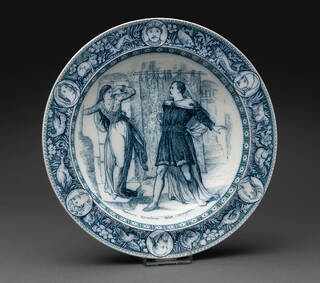
The scene on this pearl ware soup plate shows how elsewhere in the castle, Rebecca has been locked in a tower. Bois‑Guilbert appears in her cell, having come for her. Suddenly concerned about his reputation as a knight of a religious military order, he demands that she convert to Christianity so he can keep her as a Norman lady. Rebecca defiantly refuses to abandon her religious identity for him, even though it would guarantee her safety, and she is prepared to throw herself out of the window rather than submitting. Bois-Guilbert is forced to back down and moved by her beauty and courage, he apologises.
The conversion demand highlights the precarious position of Jews in medieval Christian society. Rebecca is admired for her intelligence, beauty and virtue, yet these qualities are never considered sufficient on their own. To be fully accepted, she must cease to be Jewish.
Meanwhile, Wamba, disguised as a friar sent to hear the prisoners’ final confessions, enters the castle and helps Cedric to escape by exchanging clothes with him. The outlaws then lay siege to Torquilstone Castle and, led by the Black Knight, storm the castle, free the prisoners and burn the castle down.
7. The Black Knight exchanges Buffets with Friar Tuck
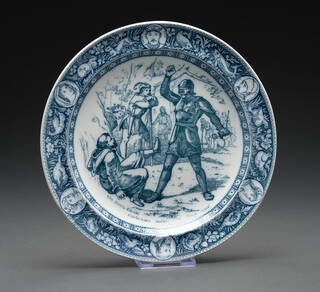
The story continues with the outlaws and the former captives gathering in the forest to thank the Black Knight for saving them. Friar Tuck arrives dragging Isaac behind him and jokingly claiming to have converted him to Christianity while they were hiding in the wine cellar. When Isaac denies this, the drunk Friar threatens him. The scene on this plate shows the Black Knight intervening and freeing Isaac after a brief scuffle with Friar Tuck.
The image of Isaac being dragged on a rope and pressured into conversion reflects a recurring pattern in Ivanhoe, where his Jewish identity makes him the target of ridicule, coercion and persecution. Conversion is presented as something Christians assume to be desirable, while Isaac's clear refusal reasserts his religious identity in the face of pressure, reflecting an unequal power relationship.
The story continues with the Black Knight, later revealed as King Richard, persuading Cedric to forgive his son Ivanhoe for supporting the Norman king and joining the Crusades. Father and son are finally reconciled.
8. Ivanhoe overthrows the Templar
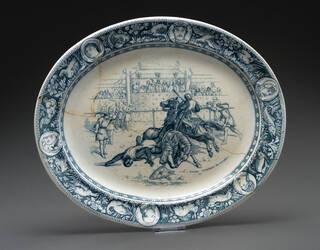
In the story, Rebecca is accused of witchcraft by the Knights Templar Bois-Guilbert who seems unable to overcome his attraction to her, and she is sentenced to be burned at the stake. She sends for Ivanhoe to defend her and in the scene on this very large (47 cms wide) platter, he fights for her in a trial by combat. Although still weak from his wounds, Ivanhoe overthrows the Templar Bois‑Guilbert, who dies during the combat. We can see him and his horse on the ground. The figure on the far left of the scene proclaims Ivanhoe the winner. Rebecca is declared innocent of all charges.
The Knights Templar were a powerful military-religious order who fought in the Crusades and answered directly to the Pope. Their wealth and influence later made them controversial, and Scott uses them in Ivanhoe to explore themes of power, corruption and fanaticism. The witchcraft charge shows the prejudices Rebecca faces as both a woman and a Jew. Her intelligence, medical knowledge and independence are treated as suspicious and unnatural. Scott shows how easily fear and prejudice can be transformed into formal accusations backed by religious and legal authority. The accusation is clearly false, yet many characters are willing to believe it because of her perceived ‘otherness’. Although Scott portrays her sympathetically, the plot nevertheless relies on longstanding cultural associations between religious minorities, ‘exotic’ knowledge and suspicion.
9. Ivanhoe and Rowena
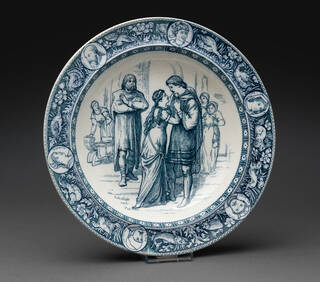
Just after Ivanhoe defeats Bois-Guilbert, King Richard arrives with a group of armed men. He orders the Knights Templar to leave England. Rebecca decides to slip away without speaking to Ivanhoe, departing quietly with her father, Isaac. Rather than openly accusing Prince John of rebellion, King Richard merely sends his brother away to live under their mother’s supervision. Cedric is delighted to see Ivanhoe honoured and celebrated after all that he has endured. He is also pleased by the prospect of uniting his family with Rowena, who is descended from King Alfred the Great. At last, Cedric gives his consent and Ivanhoe is allowed to marry Rowena.
The last scene of Allen’s Ivanhoe pattern, printed here on a pearl ware soup plate, shows Ivanhoe and Rowena embracing, his father Cedric looking on.
The continuation of the ‘Ivanhoe’ pattern at Wedgwood
The almost complete Wedgwood dinner set, decorated with the 1880s version of Thomas Allen’s Ivanhoe pattern, offers intriguing insights into English literary culture and the social attitudes found within its narratives. Wedgwood’s Ivanhoe pattern enjoyed popularity for several decades and was applied to a wide range of products in varied versions and colour combinations. The pattern demonstrates how 19th-century ceramics could serve as vehicles for storytelling, translating popular fiction into decorative form for the Victorian home. However, many of the tropes, prejudices, assumptions and stereotypes depicted in the novel, and continued in the pattern, need to be made more visible and reflected upon critically.
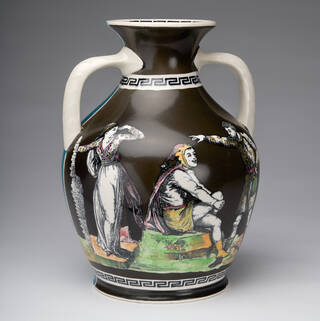
The later reuse of these scenes on objects such as this 1913 Queen's ware vase in the same shape as Wedgwood's celebrated Portland Vase demonstrates the enduring appeal of the pattern. However, once compared with the scenes on the dinner set, it becomes apparent that individual scenes have been cut and rearranged in a way that no longer preserves the original narrative order or the story of Ivanhoe as a whole. Rather, the figures have been reassembled to fit the shape of Wedgwood’s iconic vase and have become purely decorative, rather than narrative. The pattern, however, continued to be produced under its original name and the figures on this version of the Portland Vase likely retained at least some of the connotations attached to their roles in Ivanhoe.
More than a century after its creation, the Ivanhoe pattern remains valuable not only as an example of Wedgwood’s 19th-century production or Allen’s draughtsmanship, but also as a record of the cultural and societal attitudes that shaped it. Examining the objects alongside the novel reveals how such attitudes were circulated, reinforced and sometimes obscured through decorative art. Like Scott's novel, the pattern reflects Victorian engagement with questions of identity, belonging, difference and power. While many of the assumptions embedded within these depictions are now recognised as problematic, if not offensive, they offer important insights into the society that produced and consumed them. By examining these objects critically, we can better understand not only the values of the Victorian period but also the ways in which historical attitudes continue to shape our interpretation of the past.