The manuscript, along with its leather carrying case, was purchased by the South Kensington Museum (which later became the V&A) in November 1868. Seven months earlier, the British army had marched on the fortress of the Ethiopian Emperor Tewodros II at Maqdala, to secure the release of British hostages held by Tewodros and to (in the words of expedition leader General Sir Charles Robert Napier) ‘vindicate [Britain’s] national honour’ by overthrowing the Emperor. After the final attack on Maqdala on 13 April, during which Tewodros took his own life, the British Army looted vast quantities of Ethiopian material from the fortress and the surrounding area. The South Kensington Museum began collecting some of the looted objects, along with other items acquired during the course of the army’s expedition through Ethiopia, almost immediately following these events.
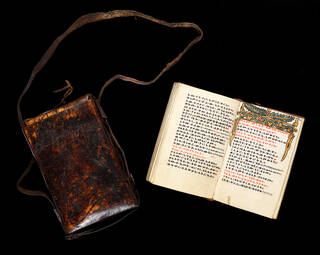
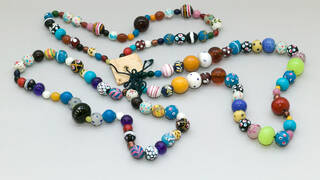
When the manuscript in question was first purchased by the museum, it was recorded in the museum’s central inventory as ‘Book: Parchment M.S. in Amharic’, and described as ‘with illuminated headings, bound in red leather, in case: from a church at Maqdala’. The museum bought this book from a Mr W.H. Saunders along with several other items including an Ethiopian scroll, a communion spoon, and a silver item resembling a necklace. The price paid was around £15 for the group.
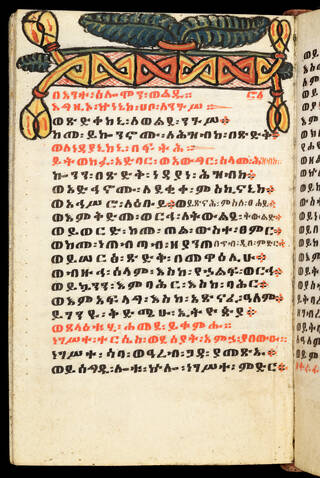
The description in the inventory makes it clear that, at the time of its acquisition by the museum, the manuscript was known to have been amongst the loot from Maqdala. However, the museum’s librarians and curators appear to have made little further effort at that time to assess the object or its contents.
Today, provenance research is an important part of museum practice for the V&A and other cultural institutions around the world, but previous generations of curators and librarians did not always make concerted attempts to establish the ownership histories of the objects they acquired. In the case of this manuscript, most attention seems to have been paid to its leather cover, which was seen as an interesting example of bookbinding. However, it is the text within this manuscript that contains the most striking revelations about its history.
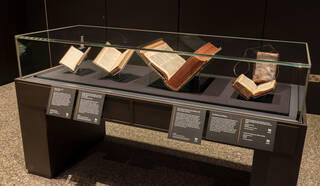
In 2024, the manuscript (at that time still catalogued as a service book) was selected for display in the opening section of The Music is Black, as part of the exhibition’s examination of the roots of Christianity and its influences on musical practices and cultures. The inclusion of this Ethiopian manuscript establishes the presence of Christianity in Africa for many centuries outside of a European colonial context, while items displayed alongside – such as a copy of the 19th-century ‘Slave’ bible produced for use in the British West India Islands – also illustrate the use of religion as a tool used by European colonisers and enslavers to impose their rule on African people. These objects set the scene for the exhibition’s exploration of the role of music within the Christian faith and its influence on musical styles.

The proposed inclusion of the manuscript in this major exhibition prompted the museum’s curators and librarians to look again at the volume and to reexamine its significance. The museum was greatly aided in these efforts by Fr. Dr Abate Gobena, Lecturer at University College Stockholm and a priest of the Ethiopian Orthodox Tewahedo Church, and Eyob Derillo, a curator and scholar specialising in the diverse manuscript cultures of Africa. Thanks to the insights of these two experts, the museum made several crucial discoveries about the manuscript in its possession.
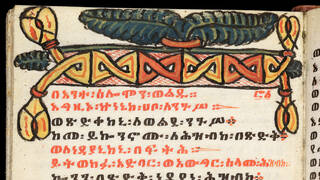
The first revelation was that the description of the object as a ‘service book’, suggesting that it was a liturgical text, is inaccurate. It is in fact a psalter, or book of the psalms of David, with added canticles (biblical songs or poems). The description of the language inside as ‘Amharic’ (the most widely spoken language in Ethiopia, and the country’s official working language) is also incorrect: it is actually written in the ancient language Ge’ez, which serves as the liturgical language of the Ethiopian Orthodox Tewahedo Church, and from which the script or fidäl used to write various Ethiopian and Eritrean languages – including Amharic – is derived.
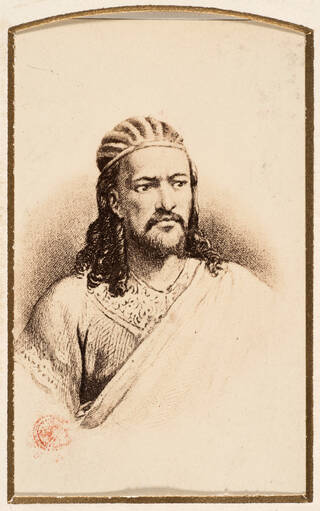
Upon taking a closer look at the Ge’ez text within the manuscript, Eyob Derillo discovered a line on its final page that revealed the psalter was written at Maqdala by Aleka Zeneb, a secretary and friend of Emperor Tewodros, as well as his royal chronicler. This discovery has dramatically reframed our understanding of this manuscript, connecting it not only to a named scribe but also to Maqdala itself, and to the famous Ethiopian Emperor who died there. Furthermore, with such high-status and carefully-bound manuscripts typically being created by scribes for figures of great respect, it is highly plausible that this manuscript was the personal devotional book of Emperor Tewodros himself. While we may never be able to confirm this for certain, the possibility that the manuscript in our collection may have been carried by the Emperor, and may even have been with him at his death, is a startling and poignant discovery that demonstrates the importance of re-examining and reevaluating our collections and the information that has been prioritised – or omitted – from the historical record.
In January 2025, as part of the public programme organised in tandem with the curation of The Music is Black, the museum hosted an event exploring Ethiopian Christianity and its links to representations of faith in reggae music. The Psalter served as a focal point for two days of presentations and discussion that included a talk from Fr. Dr Abate Gobena about the significance of this manuscript, and other sacred texts, in the Ethiopian Orthodox Church.
The extraordinary discoveries made through a re-examination of this manuscript serve as a reminder of the importance of proactively researching the provenance of our collections, and the transformative insights that such research can yield.