The young Gilberts: designers and dress makers
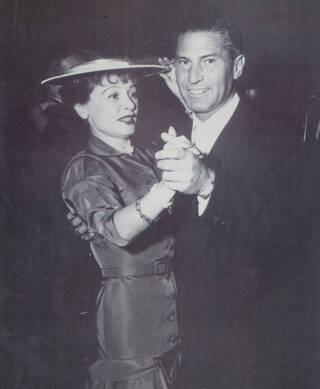
Rosalinde and Arthur were both born into the fashion industry. Rosalinde’s parents were tailors, while Arthur’s father ran a thriving fur business. Both Jewish families emigrated from Poland to Britain in the 1890s.
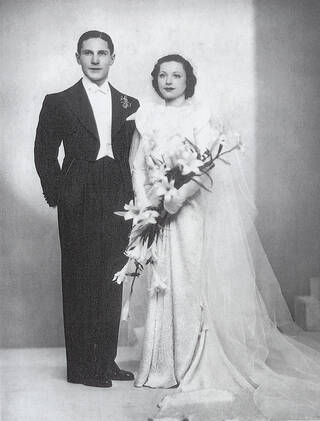
As a young woman, Rosalinde had worked alongside her parents in their tailoring business, and then as an apprentice dressmaker in a London atelier. She married Arthur in 1934, wearing a highly fashionable, silver lamé Schiaparelli wedding dress for the occasion. When asked why she didn’t wear one of her own creations, Rosalinde replied, “Well, my mother was rather superstitious and didn't want me to wear something that I had made in my own workrooms”.
Visual richness and intricate detail appealed to the Gilberts. After they married, the couple established Rosalinde Gilbert Ltd, a womenswear label producing ready-to-wear clothing, operating in London from 1935 – 49. Arthur ran the business side while Rosalinde designed the garments. Rosalinde often stated that working in fashion gave the couple an eye for detail, foreshadowing their later passion for craft and design.
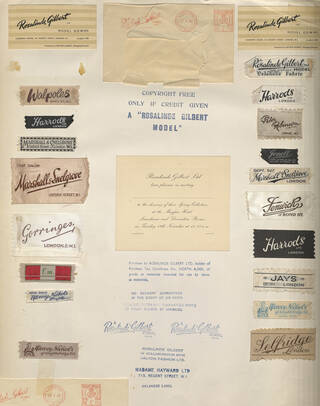
Their showroom and workshop were located at 315 Regent Street in London, just north of Oxford Street and close to the main shopping areas of London. As a wholesale couturier, they did not operate their own stores or sell to individual customers. Instead, garments were produced in runs of no more than a few hundred and sold via high-end retailers and department stores like Harrods, Harvey Nichols, Selfridges, and Fenwick. The clothing was frequently inspired by the latest Paris collections, such as Dior’s 'New Look'.


These formative years in London defined their taste in a way that remains recognisable in their collection – precious materials, virtuoso work and outstanding design are combined to create perfection. The pinnacle of their London success was arguably the selection of Rosalinde Gilbert Ltd garments for inclusion within the post-war exhibition Britain Can Make It!, held at the V&A in 1946.
Arthur and Rosalinde decided to relocate to Los Angeles, California in 1949 and sold their fashion business in the same year.
A museum collection
Once in Los Angeles, Arthur became a highly successful property developer. By 1963, the couple had begun decorating their newly designed villa in Beverley Hills. Arthur started to look for fashionable works of art for their home, and this exploration of art and interior design sparked a love for historic objects. With expert support, they began actively collecting in the late 1960s, very soon aiming to build a museum-worthy collection in each of their chosen areas. Beginning with mosaics, they soon began acquiring silver, and then added gold boxes and enamel portraits to their collection.
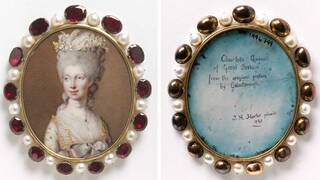
The Gilberts acquired masterpieces from prestigious collections, and enjoyed works associated with, or owned by important figures of history, such as Emperor Napoleon Bonaparte, Queen Charlotte, the first British Prime Minister Sir Robert Walpole and his collector son Horace Walpole, Empress Catherine II of Russia, the Churchill family, Queen Victoria, King Frederick II of Prussia (Frederick the Great), and the Rothschilds.


By the 1970s, Arthur and Rosalinde began collaborating with the Los Angeles County Museum of Art, working together to present exhibitions featuring objects from their collections between 1975 and 1991. For many years, the Gilbert Collection had its own rooms at the museum. Arthur visited the galleries frequently. Armed with a magnifier, he encouraged visitors to look at the intricate details of the masterpieces from his collection, particularly the micromosaics. The Gilberts were also champions of scholarly research, commissioning leading experts to author lavishly illustrated volumes on each collection area.
After Rosalinde’s death in 1995, Arthur decided to transfer the Gilbert Collection to their native London and set up a UK trust to look after it. From the year 2000, the treasures were displayed at Somerset House in London, before moving to the V&A in 2008.
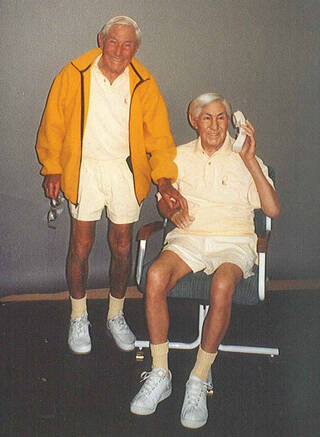

The Somerset House display included a recreation of Sir Arthur's Beverly Hills office. Sat in the office chair was a wax figure of the collector himself, clad in his favourite attire – the yellow Beverly Hills Tennis Club’s colours. The fragile wax figure of Arthur is still cared for and preserved at the V&A.

When he was knighted in 2001, Sir Arthur chose a prized piece from the collection as the symbol for his newly created armorial – an early 17th-century cup in the shape of a partridge, set with feathers carved from mother-of-pearl.
The Gilbert Collection at the V&A and beyond
The Gilberts’ vision to share their collection with the public is in complete alignment with the V&A’s mission to be a sourcebook for the imagination and to inspire creativity. In 2024, the Rosalinde and Arthur Gilbert Galleries closed for an ambitious refurbishment and expansion. The space dedicated to the Gilbert Collection nearly doubled in size, expanding from four galleries to seven, overlooking both the John Madejski Garden and the Exhibition Road Quarter. The Gilbert Galleries (rooms 70 to 73) reopen to the public on 14 March 2026.
As the only permanent galleries at the V&A dedicated to a private collection, the Gilbert Collection’s unique position within the museum provides visitors with an exclusive insight into how a world-class collection is built. It will be a space to consider the role played by the private collector in the art market and the formation of museums. The complex histories and motivations of collectors are also investigated in new depth.

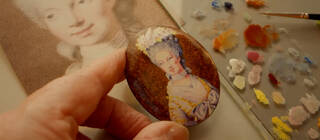
The galleries provide access to one of the largest collections of micromosaics in the world, and the most extensive and comprehensive collection of gold boxes ever formed in the UK. The quantity, quality and diversity of the Gilbert’s collection allows for unparalleled detailed study.
An active programme of short- and long-term loans to other institutions extends the reach of the Gilbert Collection outside of London. National Trust properties Belton House, Dunham Massey Hall, and Erdigg Hall incorporate Gilbert objects into their displays.
New research, provenance and restitution
The Gilbert Collection continues to grow in the spirit of Rosalinde and Arthur. New objects are occasionally acquired – most recently a stone mosaic panel of a fox from the French royal Gobelins manufactory. The V&A and the Gilbert Trust are committed to the conscientious care, proactive research and increased public access to the existing collection. Dedicated publications on stone mosaics, glass micromosaics and gold boxes explore the specific crafts that captivated the Gilberts in depth. A programme of tours, talks and the annual Gilbert lecture bring the objects and collecting histories to life.

In 2024, the micromosaics collection received innovative laser cleaning treatment developed by the V&A conservation department. Deep layers of dirt and yellow wax were removed for the first time, allowing visitors to appreciate the incredible skill involved in the making of these masterpieces.
Research into the collection continues to evolve. In 2018, the Gilbert Collection’s Provenance Curator launched a three-year research project to uncover the hidden histories of Gilbert objects resulting in the temporary display Concealed Histories: Uncovering the Story of Nazi Looting (December 2019 – January 2021). The research revealed eight stories of Jewish collectors and their families who lost everything under the Nazis. It was the first display of its kind in a UK museum, and new research on 20th century Nazi looting of Gilbert objects continues.
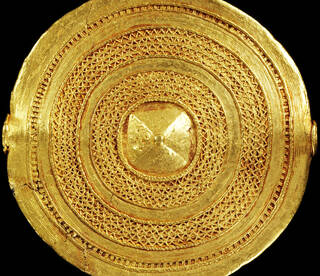
The Provenance Curator also discovered that, unbeknownst to Arthur Gilbert, a 4,250-year-old gold ewer in the collection had been illegally excavated and exported in the 1970s. As part of its restitution to the Museum of Anatolian Civilisations in Ankara in 2021, the Gilbert collection commissioned contemporary artist Adi Toch to create an object in response to the historic ewer.

This groundbreaking provenance research now has a permanent residence in the Gilbert Galleries in Room 71A, where visitors can discover telltale clues and fascinating science and behind the identification of fakes and forgeries. This gallery also presents current research into the Soviet looting of a pair of gates from a monastery in Kyiv, the findings of which have triggered wider research into its Ukrainian Heritage.
The Gilbert Collection reflects Arthur and Rosalinde’s lifelong passion for craftsmanship and beauty, and their belief that art should be shared widely with the public. At the V&A, the collection continues to be enjoyed and appreciated, as Arthur and Rosalinde intended, while ongoing research ensures it is studied, understood and shared responsibly.